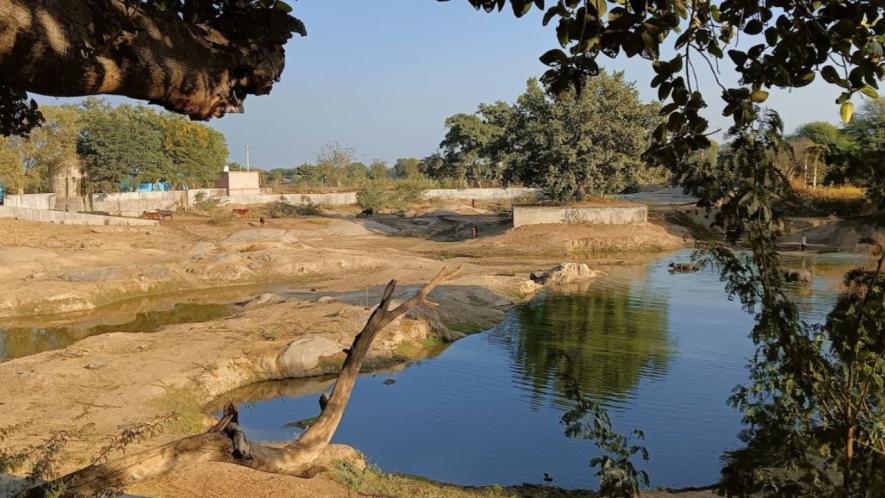
Balotra, Rajasthan: In the fading light of Balotra’s dunes of Rajasthan, Goma Ram (56) watches his camels lower their heads to graze. The animals move slowly, picking at sparse grass near a shallow water structure repaired or tanka only two years ago. “Earlier, we would have had to walk much farther,” he told 101Reporters. “Now, at least here, there is water.”
For generations, nomadic herders such as the Raikas, Kalbeliya and Banjaras have lived across the wide stretches of the Thar Desert by moving with the seasons. Their lives followed the cycle of the monsoon. When the rains arrived in late June, grasslands turned green and herders travelled with their camels, sheep and goats in search of fresh pasture. When the land dried, they returned to their home villages or moved towards areas with water.
That natural order of things is now breaking as rains arrive late or sometimes not at all, and summers stretch longer and burn hotter. Traditional grazing routes that once supported thousands of animals have turned into barren stretches of sand. Pastoralists across western Rajasthan said they have noticed these changes intensifying over the past 15 to 20 years.
According to the India Meteorological Department, western Rajasthan has warmed by about 1.2°C over the past three decades, while rainfall has declined by roughly 17%.
“Districts such as Barmer, Jaisalmer and Nagaur now receive barely 220-250 millimetres of rain in many years, well below the 450-700 millimetres generally considered necessary for reliable kharif crops. In 2024, Barmer received 468.3 mm of rainfall, western Rajasthan 511.1 mm and Jaisalmer 451.9 mm, which were higher than the long-term regional averages but marked by intense spells and long dry breaks, underlining how erratic and volatile rainfall has become in the region.”
“Earlier, every few kilometres there was a johad or a tanka,” recalled Hadmana Ram Raika (56) from Asada village near Balotra. “Now the sand stretches forever. We wait for the rains, but sometimes they never come.”
Scarcity of rainfall has made it harder to recharge traditional water systems, shrinking grazing lands and forcing herders to rethink survival in the desert. Many now say their future depends on how well communities can revive and adapt practices that once sustained life in the Thar.
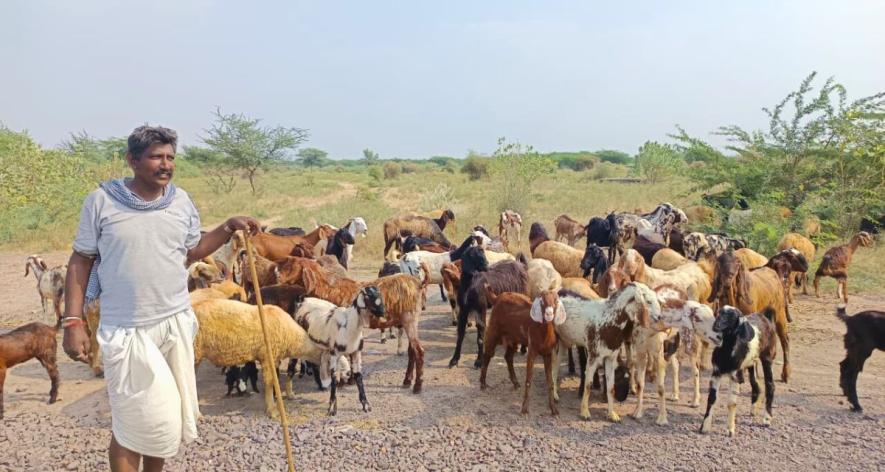
Hadmana Ram Raika, a 56-year-old herder from Asada village, Balotra (Photo - Sharvan Kumar, 101Reporters).
Traditional water systems and Orans a lifeline
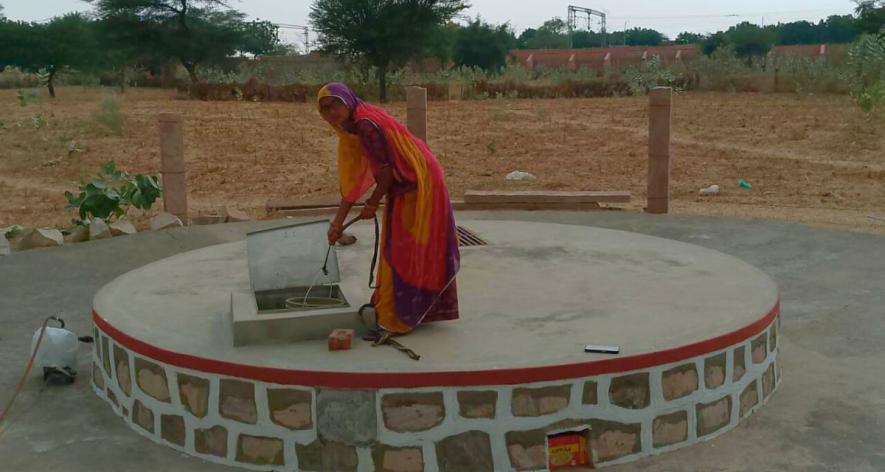
In the Baytu block of Barmer, adaptation has taken the form of restoration. Women-led self-help groups, with support from organisations working in the region, have begun repairing traditional water structures such as tankas and johads which are underground systems designed to capture and store rainwater.
Over the past two years, more than 250 tankas and johads have been repaired in the block. These structures often become the only reliable source of water for animals when wells dry up.
“We repaired four tankas near our hamlet,” said Tara Devi, who leads one such self-help group. “Now our animals drink nearby, and we don’t have to walk for hours.”
Community members say the impact of these repairs has become clearer with each passing year. According to a survey conducted in early 2024, more than 15,000 families are now benefiting from revived water systems. Women say their workload has reduced, and fewer animals are dying during prolonged dry spells.
These efforts are not seen as new solutions, but as a return to systems that once sustained desert life. “Earlier, every few kilometres there was a johad or a tanka,” said Hadmana Ram Raika, 56, from Asada village near Balotra. “Now we are trying to bring some of them back.”
But water alone does not sustain herding life in the desert. When fields dry up and grazing outside becomes impossible, herders turn to Orans, community-protected sacred groves that have long served as common grazing lands and water sources.
Rajasthan is home to an estimated 25,000 Orans, covering nearly six lakh hectares, primarily in districts such as Barmer, Jaisalmer and Jodhpur. Many of these groves are not recorded in official land records, making it difficult to assess how much land has been lost to encroachment and development. Community testimonies, however, point to steady shrinkage.
“We only take our animals to the Oran when fields dry,” said Devaram (53), a Raika from Tapra village. “The grass and leaves there are all my sheep and goats can eat. They would have perished without it.”
Sutraram (42) from Pokaran in Jaisalmer district, said that Orans as essential to daily survival. “They are not just land; they are our lifeline. We collect firewood, herbs, and sometimes fruits. If the Oran disappears, we lose everything.”
Environmental scientists say Orans function as ecological refuges. Trees help retain moisture, cool the air and support grass growth even during dry spells. “When the landscape dries up, Orans are often the only places where animals can find fodder, shade and water,” said Laxmi Kant Sharma, an environmental scientist at the Central University of Rajasthan.
Nearly 300 Orans in Barmer and Jaisalmer are actively protected today. Herders say their importance becomes most visible during drought years, when grazing outside these commons is no longer possible.
Tara Devi’s group draws water from a restored Tanka, a centuries-old desert solution revived for today’s crisis (Photo - Sharvan Kumar, 101Reporters)
Adaptation under pressure
Researchers working in the region argue that protecting isolated water bodies or Orans is not enough. What pastoralists need, they say, is recognition of pastoral corridors, traditional routes that connect grazing lands, water sources and sacred groves, allowing livestock to move safely across the desert.
“Herders are the first to face climate change,” said Dr. Laxmi Kant Sharma, an environmental scientist at the Central University of Rajasthan. “If we secure their routes and revive the Orans, we also protect the desert ecosystem.”
Such corridors reduce conflict by preventing animals from straying into farms and help maintain biodiversity by sustaining native vegetation. Animals grazing along these routes disperse seeds and support the desert’s fragile ecology, herders and researchers say. Without formal recognition, however, these corridors remain vulnerable to encroachment, infrastructure projects and the gradual loss of common land.
And as grazing lands shrink, tensions between farmers and herders have increased. Traditional routes, village-level gochars or grazing lands, Orans and communal pastures, have been fenced off or converted for agriculture and other uses.
“When I was a boy, we could walk our animals freely,” said Narnaram, 52, a Raika from Jagsa village. “Now almost every field is fenced. If animals enter, farmers get angry. Elders have to mediate.”
Ravatram, 59, from Barmer, recalled a similar incident. “Last year, my goats wandered into a wheat field. The farmer shouted. I went to the panchayat to explain. Both of us promised to avoid future clashes.”
Common grazing lands in western Rajasthan, which earlier covered a much larger share of the landscape in the 1960s, had declined to around 34-35% by 2011-12. Herders say this loss has altered migration patterns and, in some cases, forced families to seek alternative work in towns and cities.
Within this shrinking landscape, herders are also adapting at the household level by changing the animals they rear. With longer dry months and limited fodder, many families are gradually shifting to hardy sheep breeds that can better survive desert conditions.
Institutes in Bikaner have developed improved Marwari and Rajnagari sheep lines that can walk long distances, survive on limited water and maintain body condition during droughts. A 2023 study found that these breeds perform about 25% better in survival and produce roughly 18% more wool compared to traditional Chokla sheep, particularly during prolonged dry spells.
“Our sheep can go three days without water,” said Chutara Ram, a herder from near Pokaran. “When there’s no grass, they still manage to survive.”
Adoption has been uneven. Larger herding families are more likely to introduce improved rams into their flocks, while smaller families often continue with local breeds due to cost constraints. A breeding ram can cost 30–40% more than local varieties and typically needs replacement every two to three years. Veterinary access remains limited, and treatment costs can exceed a week’s earnings.
“These new rams grow fast, but they also fall sick fast when the weather changes,” said Kheta Ram from Jaisalmer. “Our old Marwari lines were slow but steady.”
Studies have also shown that even improved breeds may not guarantee profit in the harshest zones. In some arid areas, net returns from sheep farming remain extremely low due to lamb mortality, low yields and poor market prices.
However, across western Rajasthan, particularly in Barmer, Jaisalmer and Jalore, many herding families continue to rely on traditional desert knowledge to adapt. Repairing tankas and johads, protecting Orans, adjusting livestock practices and resolving conflicts locally remain central to survival.
These practices emphasise careful use of scarce resources, community cooperation and respect for the desert’s limits. Scientists working with pastoralists describe them not as coping mechanisms, but as climate adaptation strategies rooted in lived experience.
“The people of the desert already know how to adapt,” said Sharma. “We just have to listen.”
As the sun dips behind the dunes, Goma Ram gathered his animals and prepares to move on. The grazing routes may be shorter now, and the rains less certain, but the desert, he says, is still home.
“We’ve learned to live with the desert,” he said, watching his camels disappear into the sand. “Not against it.”
Sharvan Kumar is a freelance journalist and a member of 101Reporters, a pan-India network of grassroots reporters.