





Assam: Flood Erosion Aftermath -- Losing Community Ties, Surviving Nightmares
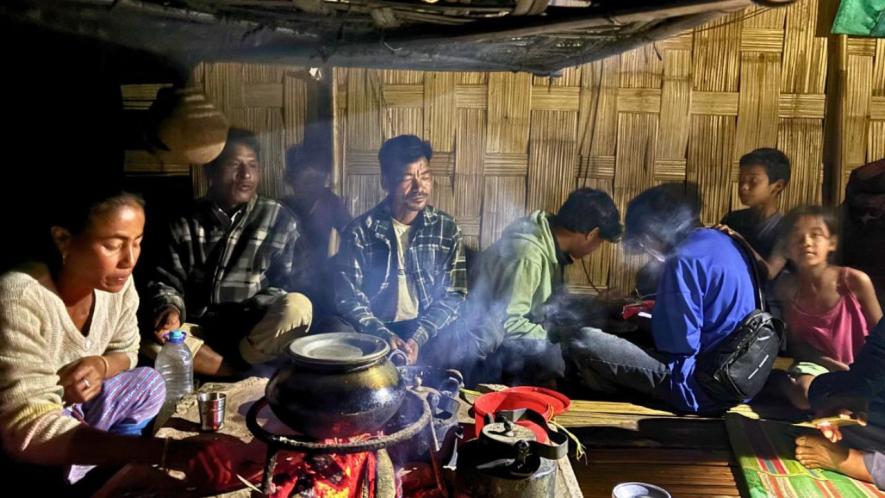
Residents feeling the warmth of the fire on a cold winter night (Photo - Sayantani Deb, 101Reporters)
Jonai, Assam: Sitting near a fireplace on a cold winter evening, cooking dinner to keep herself warm, Reshmi Rekha Pegu told 101Reporters about the night her village disappeared.
“E ratit sob hek hoi gol. Ekui bosabo nuarilu…everything got finished in a single night. We couldn’t save anything,” she said.
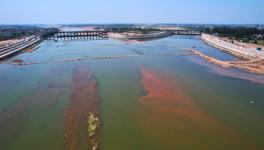
That night was June 29, 2024. After days of incessant rain, massive erosion triggered by the river Siang left more than 300 residents of Sivaguri village in Assam’s Jonai subdivision stranded in chest-deep water. Homes, livestock, farmland, utensils, everything was swept away within hours.
While floodwaters inundated the village, it was rapid riverbank erosion that intensified the destruction.
Women like Reshmi Rekha Charoh (32), Daina Taid (30) and Uno Pegu (33) clutched their young children in fear as floodwaters rose rapidly. Men, including Khagendra Charoh (45), Elaswar Taid (40), Mohan Tayeng (55) and Rajib Pegu (35), waded through the darkness searching for safe passage, focused on one thing alone: ensuring everyone survived.
For most families, this was not their first encounter with floods. Over 50 families living in Sivaguri had resettled there in the early 2000s, after the devastating flash flood of June 11, 2000, when a temporary natural dam on the Yarlung Tsangpo river, known as the Brahmaputra in India, burst, sending a 30-foot-high wall of water downstream and inundating large parts of Assam’s Dhemaji district.
“We have been living in Sivaguri for the last two decades,” said Tayeng. “Floods happen every year, but the water usually recedes in two or three days. We live in chang ghars, so a few metres of floodwater never affected our lives.”
Chang ghars are traditional, elevated stilt houses built in flood-prone areas of Assam.
But, what unfolded in 2024 was different.
A river behaving differently
From early 2024, villagers noticed a worrying change. The river was eating away land at an unusually fast pace. Khagendra Charoh, the gaon burah (village headman), said he began warning residents and repeatedly approached authorities as the monsoon set in.
“For me, the nightmare started a week before,” Khagendra said. “There was constant rain, and we heard that very heavy rainfall was happening in the hills of Arunachal Pradesh. Since our village is close to the foothills, the erosion became severe and everything felt uncertain.”
By 6 pm on June 28, water began entering the village. By midnight, the water had risen far beyond previous flood levels, submerging even elevated platforms—some nine and ten feet high—that villagers traditionally relied on for safety.
According to the Assam State Disaster Management Authority (ASDMA), Assam experienced three waves of floods and erosion in 2024. Between May and August alone, more than 186 hectares of land were lost to erosion, with Dhemaji district recording the highest loss. Jonai was among the worst-affected areas.
Environmental experts say this was different than a routine erosion event.
“The Brahmaputra system is always changing course, and erosion is common,” said Ravindra Nath, an environmentalist who has worked on climate change, disaster mitigation and rehabilitation for over three decades. “But erosion is usually gradual. What happened here was sudden and violent, driven by flash floods carrying enormous volumes of water from the upper reaches.”
Nath pointed to multiple climate-linked factors: unusually intense rainfall in Arunachal Pradesh, faster glacial lake outbursts due to rising temperatures, and heavy sediment loads exacerbated by mining activities upstream.
“Climate change is increasing the velocity of water,” he said. “When debris-laden floodwaters come rushing down, low-lying villages like Sivaguri have no time to cope.”
Between June 25 and 30, 2024, Arunachal Pradesh recorded nearly 93% excess rainfall, according to ASDMA data. These levels, experts say, were unthinkable a decade or two ago.
Rescued
On June 30, following Khagendra’s efforts, the District Disaster Management Authority (DDMA) began rescue operations, shifting villagers to a notified relief camp at Jonai Higher Secondary School.
“This was not a routine rescue,” said Ritu Dutta, field officer at the DDMA, Jonai revenue circle. “On June 30, a rescue boat capsized. Eight State Disaster Response Force personnel and one local administration official were trapped and later rescued by the Indian Air Force.”
Families stayed at the school for a month and were later moved to the newly constructed Jonai district library, where they lived for nearly six months.
On November 13, 2024, the Assam government distributed rehabilitation grants. Each family received Rs 1.20 lakh for house damage, Rs 5,000 for loss of clothes and utensils, and additional compensation for lost livestock. In total, over Rs 80 lakh was spent.
Residents said the compensation was insufficient to buy land or build permanent homes, forcing families to construct temporary shelters wherever space was available.
And the money was not sufficient to bring back Sivaguri. Today, the people of Sivaguri are scattered across Moidapur, Leku Jelem, Purona Jelem, Jelem, Jun Kareng, Kaitong, Holikuchi, Mazgaon, Jagun and even as far as Sadia in Tinsukia district.
“Sivaguri was not just a village…it was our identity,” said Johlar Taid (75), now living in Holikuchi. “With its loss, we lost everything.”
Taid, who was born in North Lakhimpur’s Boginodi area, spent over two decades working in Arunachal Pradesh before settling in Sivaguri. “All my children were born there,” he said. “Despite every hardship, we lived like a family.”
His wife, Santhali Taid, struggles to put her grief into words. “We built our dream house with the help of fellow villagers, spending Rs 4-5 lakh. We never imagined it would vanish overnight,” she said. “Now, in this winter, we live in a bamboo and mud house.”
What Santhali misses most are the kirtan sessions. “Every Monday, we gathered at the namghar and sang devotional songs, praying for peace and prosperity. That life is gone.”
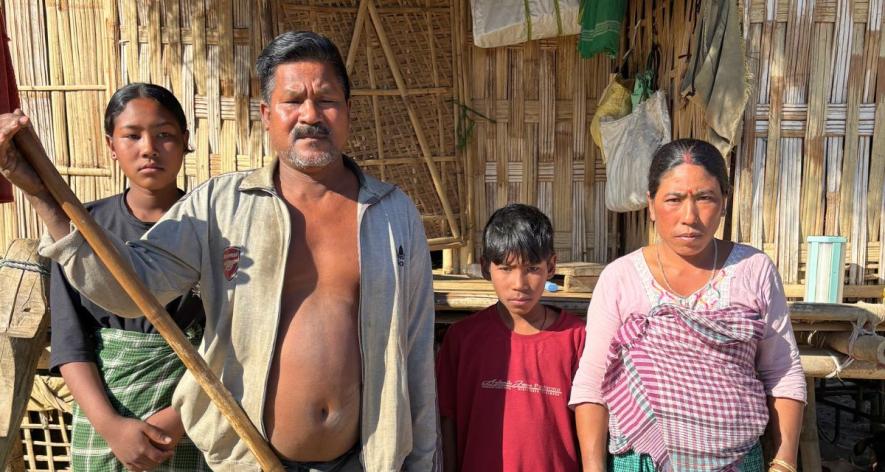
For the people of Sivaguri, climate change did not just wash away land but it scattered a village and fractured many lives (Photo - Sayantani Deb, 101Reporters)
Disappearing community
For Deepamoni Tayeng (26), Sivaguri was where she truly found belonging. “When I came here as a bride, the entire village welcomed me,” she said. “Some called me their daughter, some sister, some daughter-in-law. I never felt like an outsider.”
Women formed self-help groups, made pickles and sweets, and wove the mekhla sadors - the traditional dress worn by Assamese women - together. “I miss winter afternoons when we worked in the fields and shared pomelo and oranges,” she said.
For Phulonlata Mili Charoh, displacement has compounded vulnerability. Pregnant during her time in the shelter home, she felt supported by the community. Now in Jun Kareng, with two toddlers and ageing in-laws, the postpartum period has been isolating. “If this had happened in Sivaguri, everything would have been different,” she said.
Octogenarian Khagendra Pegu, now in Jelem village, spends his days doing bamboo work. “We had 12 bighas of land. I didn’t have to work,” he recalled. “I told stories to my grandchildren.”
He remembers Ali-Aye-Ligang, the Mishing community’s spring festival, when the village came together in celebration. “Now,” he said quietly, “I am just counting my days.”
His son Rajib, the sole breadwinner, travels 20 km daily for work in Arunachal Pradesh. “On good days, we earn Rs 400. On bad days, we are paid in rice,” he said. “We lost property worth nearly Rs 10 lakh.”
Education disrupted
For girls like Nayanmoni Pegu (18) and Dipika Pegu (16), displacement has meant interrupted education. Nayanmoni, who studied till Class VI, now stays home to care for her differently abled father and younger brother. “Earlier, my friends encouraged me to go to school,” she said. “Now we all live separately.”
Dipika dropped out after Class IX. “Our situation worsened so much that continuing school became impossible,” she said.
Rumi Pegu (25), however, continues her MA in Assamese. “Education is the only way to bring change,” she said.
Across settlements, girls spoke of fear after sunset. Sivaguri had solar lights in common areas. Their new hamlets are dark, isolated and often close to forest areas like the Poba Reserve, where elephant movement is common.
Water, sanitation and mental health
Women in Purona Jelem walk several kilometres twice a day to fetch water, often in groups to avoid elephant encounters. “The well is 20 feet deep,” said Nirmala Mili. “It is difficult and dangerous.”
Sanitation is another challenge. “Earlier, every household had a toilet,” a resident said. “Now 50-60 people share one toilet. For women, especially during menstruation, it is extremely difficult.”
The psychological toll is severe. “Climate-change-driven disasters cause direct trauma, prolonged grief and chronic anxiety,” said Dr R Padmavati of the Schizophrenia Research Foundation.
Many women said they still wake up at night reliving the flood.
“With every monsoon, fear returns,” Community psychiatrist Nilesh Mohit said. “Displacement also disrupts treatment for those already dealing with mental illness.”
Despite living miles apart, Sivaguri’s residents refuse to let their community dissolve.
“Every few weeks, we book autos and visit each other,” said the gaon burah [village elder]. “Earlier we were neighbours. Now we are guests. But the bond remains.”
For the people of Sivaguri, climate change did not just wash away land, it scattered a village, fractured lives, and left behind a longing for a home that no longer exists.
Sayantani Deb is a freelance journalist and a member of 101Reporters, a pan-India network of grassroots reporters.
Get the latest reports & analysis with people's perspective on Protests, movements & deep analytical videos, discussions of the current affairs in your Telegram app. Subscribe to NewsClick's Telegram channel & get Real-Time updates on stories, as they get published on our website.