





May Day 2026: Workers Left Behind in ‘Development Story’
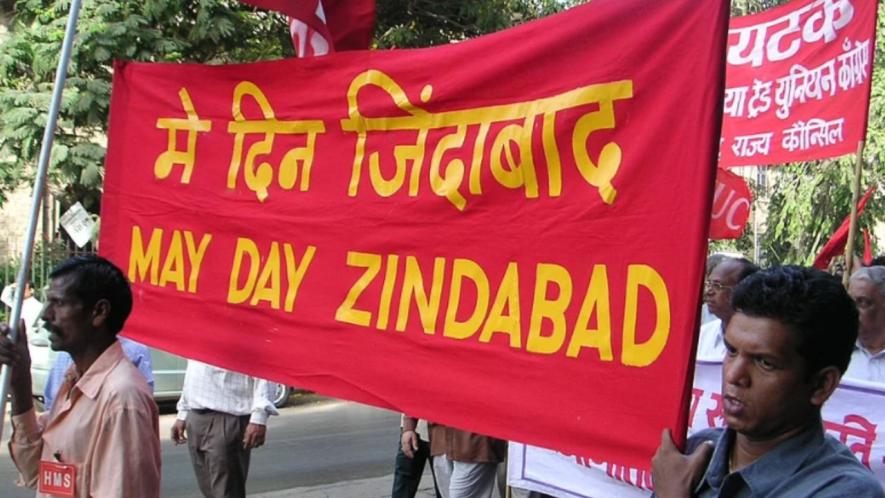
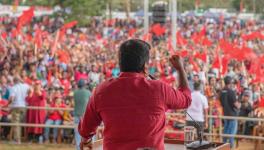
May Day rally in Mumbai
May Day, celebrated every year on May 1 in India, is often limited to formal events and symbolic speeches.
But this year, Labour Day comes at a time of heightened anxiety and questions because of events that have unfolded over the past few months in the country's industrial belts—such as Noida in Uttar Pradesh, Gurugram, Manesar, Panipat in Haryana, Surat in Gujarat, and Barauni in Bihar. This compels one to ask: Has India's development journey left behind its most important base: the working class?
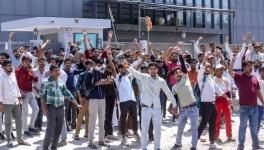
The labour movement that erupted in Noida in April 2026 provided the most poignant and uncomfortable answer to this question. To dismiss it as merely a “violent incident” or a “law and order crisis” amounts to not only turning a blind eye to reality but also shows a refusal to understand the deep discontent that has been brewing for a long time.
In fact, what happened in Noida wasn't sudden. It was the explosion of a crisis that had been brewing for years, not months. The workers' grievances were not new: low wages, unstable employment, long working hours, and rapidly rising inflation. But the way these grievances were consistently ignored finally forced them to take to the streets.
Thousands of labourers working in Noida's industrial areas earn between Rs 11,000 and 13,000 a month. This figure speaks volumes, and when compared with the city's actual expenses, the picture becomes clearer. Rent alone can range from Rs 4,000 to 6,000. After paying for food, transportation, and other essential expenses, workers are left with nothing. The persistent rise in gas cylinder prices and food prices has exacerbated this crisis. In this situation, “life” becomes a daily struggle, not a mathematical balance.
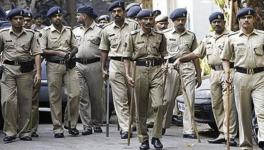
Against this backdrop, the protests that began on April 9, quickly spread. The workers' demands were basic: wage increases, fair overtime pay, and fixed working hours. But as the movement's spread, so did the tension. On April 13, incidents of violence reported, and this is where the second chapter of the story begins: the State's response was violent and involved police repression of the workers.
The UP government and the Noida administration immediately characterised the entire incident as a "law and order" crisis. Mass arrests were made, hundreds were detained, and numerous raids were conducted. This action was accompanied by the creation of another narrative—that of "outsiders" and a "conspiracy."
This is where the question arises: are we beginning to view every labour movement as a conspiracy, disconnected from its root causes? Isn't it easy to dismiss the workers' voice as "inspired" or "managed," thus denying its legitimacy?
Several independent reports and testimonies have revealed that those alleged to be the "masterminds" themselves appealed for peace during the protests. This raises suspicions that this entire narrative was created to divert attention from the real issues.
To understand the Noida incident, it's important to view it in a broader context. Labour unrest, which began in Barauni in January 2026, spread to many industrial areas across the country within a few months. In Panipat, Manesar, Surat—everywhere workers took to the streets with similar issues. This wasn't a centralised movement, but the underlying conditions were similar—stagnant wages, rising inflation, and insecure employment.
Workers in Gurugram and Manesar also protested for better wages and working conditions. Thousands of workers went on strike in the textile industry in Panipat. The situation there is even more complex, as approximately 95% of the workers are migrants. They have neither stable employment nor any social security. The sudden increase in cooking gas prices has made their lives even more difficult. When a basic necessity—cooking food—becomes expensive, it's natural for discontent to erupt.
Taking all these events together, a clear picture emerges—a deep structural crisis exists in India's labour market. While the country's economic data tells a story of growth and progress, the real income of workers has remained virtually stagnant. Inflation has steadily eroded their purchasing power, and even the basic necessities of life are now becoming beyond their reach.
Recent labour laws have also played a role in exacerbating this crisis. The government presented the new labour codes as "reforms," but workers' experiences are different. The potential for increased working hours, ambiguity regarding overtime, and a reduction in union rights have increased worker insecurity. These changes are being felt particularly strongly in sectors where contract labour is prevalent.
Another important aspect of this entire scenario is the role of the media and public discourse. Mainstream media have often viewed these events through the lens of "violence" and "anarchy," while workers' core issues—wages, inflation, and working conditions—have received relatively little coverage. When the story of a movement is written based on its consequences rather than its causes, it remains incomplete.
This is where the historical significance of May Day comes to the fore again. The struggle waged by Chicago workers in 1886 for the right to an eight-hour workday remains relevant today. Even then, workers were labeled "unruly" and "dangerous," but history has proven their demands were justified. Today, when 10-12-hour workdays are becoming commonplace in India, it's natural to question: are we regressing in history?
May Day reminds us that workers' rights are not the result of any government or institution—they are the result of struggle. But it is equally important to consider why these rights must be repeatedly fought for in a democratic society.
What's needed today is to view this entire crisis not simply as a "movement" or an "incident," but as a warning. If the workers' real problems aren't addressed, this discontent will only spread. It can be suppressed by police action or conspiracy narratives, but it cannot be eliminated.
Both the government and industry must understand that development isn't measured solely by investment, production, and export figures. It's also determined by whether the benefits of that development reach the lowest strata of society. If the working class itself is struggling to survive, it's natural to question the sustainability of any development model.
Workers are not just a "factor" of production; they are the backbone of the entire economic structure. If this backbone is weak, the entire structure will become unstable.
The recent protests in Noida and other parts of the country tell us that this is not just a regional problem, but a national challenge. Understanding and solving it requires courage, sensitivity, and political will.
May Day 2026 offers us an opportunity not only to remember the struggles of the past but also to embrace the challenges of the present. This day forces us to reflect on the kind of society and economy we want to build—one where growth figures shine but workers struggle, or one where development and justice go hand in hand.
Ultimately, the question is simple: are we ready to listen to workers, or will we wait until their voices become louder? History has shown that when workers speak, it's not just a voice, but the beginning of change.
(This is the English translation of the original article in Hindi published on our Hindi website)
Get the latest reports & analysis with people's perspective on Protests, movements & deep analytical videos, discussions of the current affairs in your Telegram app. Subscribe to NewsClick's Telegram channel & get Real-Time updates on stories, as they get published on our website.