





Noida: High Profits, Stagnant Wages, and a City on Edge
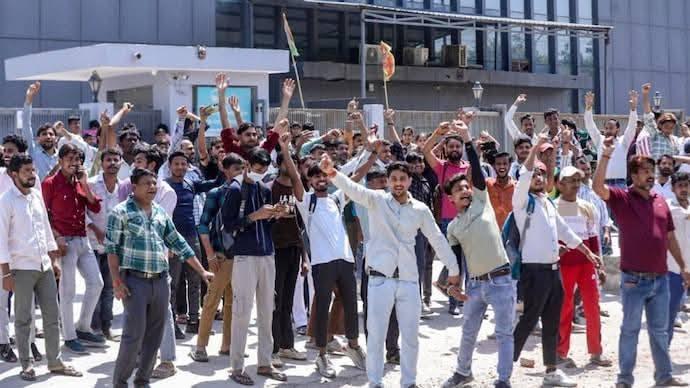
Image Courtesy: CITU Facebook
The twin engines of high growth and rising corporate profits in India’s industrial heartland have long been celebrated. But beneath the glossy facade of Uttar Pradesh’s manufacturing hubs in Noida, a starkly different story is unfolding—one of stagnant wages, exploited contract labour, and simmering anger that erupted into violence on April 13, 2026.
We have undertaken a new ground-level study by interviews of workers in NOIDA Sector 15, which paints a troubling picture of both macro and micro conditions for workers in the National Capital Region (NCR). The central finding is urgent and clear: real wages have barely budged for decades, while the cost of survival has skyrocketed. The study argues that for Noida—part of the national capital territory or NCT—the only just solution is to immediately adopt the minimum wage standards of neighbouring Delhi.
Macro Picture: Profits Soar, Workers Stagnate
At the aggregate level, the Indian organised industrial sector presents a paradox of prosperity for capital and penury for labour. Using data from the Annual Survey of Industries (2026), the authors of the study show that capital per factory skyrocketed from Rs. 494 lakh in 2006-07 to Rs. 1,778 lakh in 2023-24. Profits per factory followed suit, rising from Rs. 167 lakh to Rs. 413 lakh over the same period. Yet, wages per factory crept up at a snail’s pace—from Rs. 61 lakh to just Rs. 276 lakh.
Even more damning is the employment figure: the average number of workers per factory remained virtually frozen, moving from 71 to 75 over nearly two decades. This is not a story of job creation; it is a story of capital deepening without labour benefit.
The human consequence of this is casualisation of the workforce. The share of contractual workers in the organised sector has exploded from 13% in 2000 to 42% in 2023-24. Contractors, as the study later found on the ground, act as a buffer to suppress wages, evade responsibility, and deny benefits—leaving workers with no job security, no paid leave, and no bargaining power.
Furthermore, the wage growth for all workers has been grim. Using data from the State of Working (2026), the study notes that the lowest growth in salaries and wages for both young (20-29) and older (30-64) workers occurred during 2017-2023. Women, already paid less than men, have fared even worse.
Micro Reality: Voices From Factory Floor
To understand the human face of these numbers, we conducted field work in Noida’s Sector 15 industrial area during the April protests. The interviews reveal a systemic architecture of exploitation.
A 22-year-old worker, a 6th standard pass-out, earns Rs. 18,000 per month working 10-hour a day at a snack outlet in the Metro station of Noida Sector 15. He supports the demand for doubling overtime wages. Another factory worker, fearful of a security guard, whispered that he earns just Rs.10,000/month for eight hours of daily labour.
The most harrowing account comes from a young woman, a 12th pass from Pauri Garhwal, who recently resigned from Motherson, a major auto parts manufacturer. Despite working 10 hours daily for six months, she earned only Rs. 9,000 per month. Her monthly travel cost from Dwarka (30 km away) was Rs. 5,000, and a single LPG cylinder for cooking cost another Rs. 5,000. “My expenses exceeded my entire salary,” she told the researchers, explaining why she walked away.
A driver-porter for Motherson, working 24-hour shifts with his nephew, earns Rs. 20,000 per month after fuel costs. He was unequivocal in his diagnosis: “Workers are being exploited by contractors… paying very lower wages of Rs. 10-12,000. The factory forces long 10-12 hours of work and does not pay for overtime. Removal of contractors can lead to better wages.”
Tinderbox: Violence, Arrests, Demand for Delhi’s Wage
The protest on April 13, 2026, was not spontaneous. Outside Motherson, researchers documented broken CCTV cameras, shattered window glass, and stone-pelting. An ice cream vendor recounted how 500 workers had gathered, demanding Rs. 20,000 per month—a 35% hike recently announced by the Haryana government for its workers.
The state’s response was swift and heavy. Police invoked prohibitory orders under Section 144 of the CrPC (now Section 163 of the Bharatiya Nagarik Suraksha Sanhita - BNSS) for maintaining law and order in Noida and Greater Noida. The study’s authors met family members of arrested workers outside the Deputy Commissioner of Police’s office. One worker’s younger brother described how his sibling was arrested without evidence. Families from as far as Hathras, Uttar Pradesh, were paying advocates Rs. 8,000-10,000 per bail. In one case, a single lawyer had collected Rs. 3 lakh from 100 workers—each paying Rs. 3,000.
What do the workers want? The notice pasted on Motherson’s gate after the protests shows revised wages: Rs. 13,690 for unskilled, Rs. 15,059 for semi-skilled, and Rs. 16,868 for skilled workers. But this is far below the prevailing minimum wage of Delhi: Rs. 18,456, Rs. 20,371, and Rs. 22,411, respectively. Even Haryana’s new rates (Rs.15,221 for unskilled) are higher than Motherson’s offer.
The Way Forward: A Policy Imperative
We can conclude that the current trajectory is unsustainable. With global recessionary pressures, war-induced inflation, and a spiralling LPG cost (a 12kg cylinder was reportedly priced between Rs. 3,600 to Rs. 4,800 in the grey market), workers simply cannot survive on current wages.
The solution, the study argues, based on macro and micro labour markets, is neither radical nor new. The Central and Uttar Pradesh governments must immediately intervene to set a minimum wage for Noida-based on the Delhi benchmark. Delhi and Haryana minimum wages can be the benchmarks for revising the minimum wages in Noida and other areas of NCR in Uttar Pradesh, like Ghaziabad and Faridabad, for ensuring peace and harmony.
If policymakers ignore this warning, the violence of April 13 may be only a prelude. When profits triple but wages flatline and stagnant employment with increasing contractual workers, when a day’s work cannot buy a week’s meal, the factory floor will inevitably become a battlefield. The choice is simple: a just wage today, or a larger crisis tomorrow.
Narender Thakur is a Professor and Abhinav Singh, is a student of BA (Hons.) Economics 8th Semester, Department of Economics, Dr. Bhim Rao Ambedkar College, University of Delhi. The views are personal.
Get the latest reports & analysis with people's perspective on Protests, movements & deep analytical videos, discussions of the current affairs in your Telegram app. Subscribe to NewsClick's Telegram channel & get Real-Time updates on stories, as they get published on our website.