





Noida Fury: Labour Unrest in Increasingly Unequal Economy
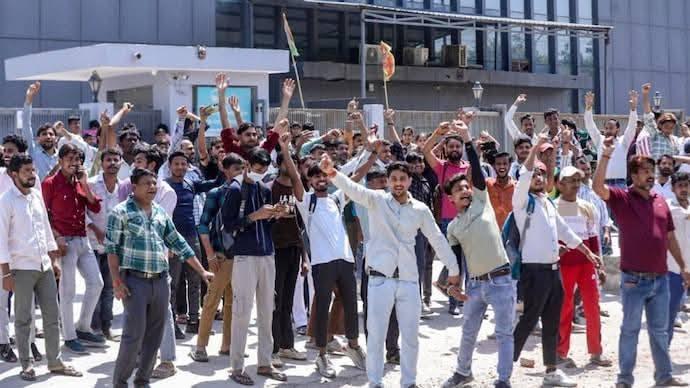
Image Courtesy: CITU Facebook
In Uttar Pradesh’s Noida, a protest over wages turned into a spectacle of fire and fury. Vehicles were torched, property vandalised, police deployed in force, the now-familiar script of law and order breakdown was repeated. In the aftermath, wages were reportedly revised upward by around 21%, a concession that came only after the situation had escalated. To reduce this fury to indiscipline or mob excess is to wilfully look away. What erupted in Noida was the consequence of a system that has steadily stripped workers of both voice and security. This should not be looked upon as an isolated outburst. It was a signal, and a deeply unsettling one.
Protests do not become violent in a vacuum. They turn volatile only when every institutional route to justice is blocked. India’s labour market stands hollowed out from within; collective bargaining has withered, grievance redressal mechanisms fail to inspire confidence, and the State appears increasingly distant as a mediator. In such a setting, negotiation is not only difficult, it is rendered meaningless. Workers find themselves complaining into a void, repeating demands that go unheard. It is then that the streets become the site of protest. Turning into a space where the presence of the working class can not be ignored.
Protest is not the beginning of the crisis; it is what remains when every other avenue has been exhausted. What happened in Noida was not a sudden breakdown of order; it was the slow unravelling of trust reaching its inevitable conclusion.
To understand how, one has to step back and look at the longer trajectory of India’s economic transformation. Growth did come, but with privileges of flexibility for capital and a steady erosion of security for labour. Informalisation has not remained confined to the margins; it has seeped into the very core of what we still call the formal sector.
Jobs that once promised stability now carry the anxieties of informality: short-term contracts, uncertain wages, little or no social protection, and the constant fear of replacement. Workers are indispensable to production, yet treated as if they are easily dispensable. They create value, but remain excluded from the basic assurances that give work its dignity. This is not an accidental outcome; it is built into the way the system now functions.
The recent protests reveal the quiet collapse of a social contract that once, however imperfectly, structured relations between labour, capital, and the State. That contract rested on a simple understanding that workers would offer discipline and productivity and employers would provide fair wages and a degree of stability, and the State would stand in between, ensuring that neither side could simply override the other. This understanding has now fractured.
What remains is not negotiation but confrontation, not trust but accumulated resentment. What we are witnessing is not merely economic distress; it is a loss of faith in the very possibility of being heard. The eventual 21% wage revision raises an uncomfortable question; if the demand could be conceded after the violence, why was it denied before it?
There is always a temptation to treat such incidents as aberrations, moments of excess that can be contained, explained somehow, and forgotten. This is a comforting illusion. The fury of the working class in Noida illuminates something far more structural, the fact that when wage demands find no institutional space, they do not disappear; they return, sharper and more urgent. When grievances are ignored far too long, they intensify. When survival begins to feel uncertain, restraint becomes a fragile expectation. People do not choose disruption lightly or in a hurry. They arrive at it when every other language has failed them.
This is also a story about the changing texture of everyday life for the working class. Across the country, wages have struggled to keep pace with the rising cost of living, food, fuel, rent, transport, everything essential has become more expensive. At the same time, inequality has widened in ways that are both visible and deeply felt. The distance between those who accumulate and those who struggle to get by is no longer abstract; it is lived, daily, in the contrast between aspiration and reality. For many workers, even a small setback, a delayed payment, a denied increment, can unsettle an already fragile balance.
The global context has only sharpened these pressures. Conflicts across regions have disrupted supply chains, pushed up energy prices, and added to inflationary burdens. These are often discussed in macroeconomic terms, but their effects are felt at the micro level. They show up in household budgets that no longer stretch as they once did, in anxieties about the next month’s expenses, in the quiet fear that things may get worse. That fear matters. It changes how people respond to uncertainty, how long they are willing to wait, how much they are willing to endure.
What burned in Noida was the belief that the system still listens. Workers today are not just underpaid; they are unheard. Not just insecure; they are made to feel invisible within an economy they sustain with their labour. The anger we see is not only about wages; it is about dignity, about recognition, about the need to be acknowledged as participants rather than expendable inputs. The fact that concessions often follow conflict, rather than negotiation, reveals a system that responds not to voice, but to rupture.
The case of protests in Noida, is not an anomaly. It is a warning. A labour regime that erodes voice cannot expect silence indefinitely. An economy that deepens inequality cannot remain socially stable. A State that steps back from welfare mediation will eventually confront the consequences of that withdrawal.
The images of burning vehicles are dramatic, but they are not the story. They are symptoms. The real story lies in the slow erosion of the conditions that make dialogue possible. To prevent Noida from becoming a recurring pattern, there is an urgent need to rebuild and strengthen institutional mechanisms of labour negotiation, ensure credible grievance redressal, and restore the State’s role as an active and trusted mediator in labour–capital relations.
Shirin Akhter is Associate Professor at Zakir Husain Delhi College, University of Delhi. The views are personal.
Get the latest reports & analysis with people's perspective on Protests, movements & deep analytical videos, discussions of the current affairs in your Telegram app. Subscribe to NewsClick's Telegram channel & get Real-Time updates on stories, as they get published on our website.