





Delhi-NCR Gears up for February 12 Nationwide General Strike
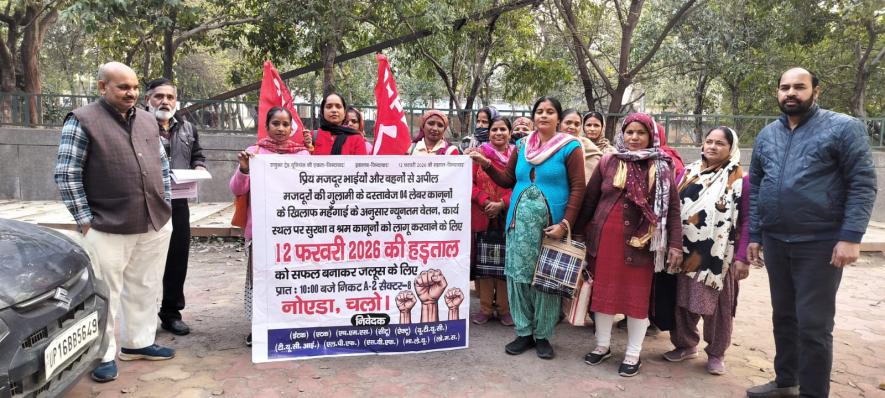
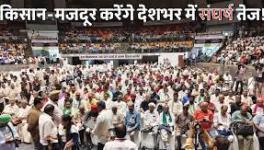
New Delhi: With just days to go before the nationwide general strike on February 12, 2026, preparations across Delhi and the adjoining industrial regions have reached a fever pitch.
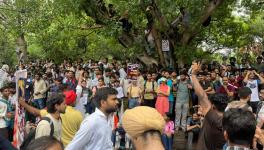
Central trade unions, sectoral federations, and workers’ organisations have launched an extensive mobilisation campaign that includes pamphlet distribution, gate meetings, street-corner gatherings, bike and tempo rallies, and street theatre performances, aiming to build momentum for what they describe as a decisive resistance against “anti-worker” labour codes and broader pro-corporate policies.
The strike has been jointly called by central trade unions along with the Samyukta Kisan Morcha and other federations, and has received support from Left parties and a range of mass organisations.
At the heart of the protest are demands to repeal the four new labour codes, ensure minimum wages, protect social security, and reverse policies seen as promoting privatisation and weakening labour protections, among others.
Intensive Campaign by CITU
The Centre of Indian Trade Unions (CITU) has been among the most active in the capital. According to P. V. Anniyan, general cecretary of CITU Delhi, preparations began as early as December.
“The preparations for the general strike are in full swing in Delhi. We started general body meetings among our members by the second week of December, and these continued till the last week of January,” he said.
CITU said it had prepared a four-page pamphlet explaining the “ill effects” of the labour codes for its leadership and cadre, even as an earlier booklet released in May continued to circulate.
Demonstrations were organised at district headquarters in three districts, where memoranda demanding repeal of the labour codes were submitted to authorities, including a memorandum addressed to the President of India.
In the last week of December, the Joint Trade Unions of Delhi met to chalk out a district-wise campaign plan. The mobilisation for the January 9 Joint Trade Unions convention, which formally announced the February 12 strike, saw what leaders described as an “overwhelming” response.
CITU-affiliated unions across sectors — including airport workers, Delhi Jal Board employees, Municipal Corporation workers, rehri-patri (street vendors), anganwadi workers, construction workers, and app-based platform workers have released their own campaign materials tailored to their sectors, the trade union said.
“This time, beyond our own members, we have consciously reached out to jhuggi-jhopdi colonies adjoining industrial areas,” Anniyan said.
Mass organisation meetings, discussions, and online webinars on the labour codes are being held. Cultural interventions have also played a role: Jan Natya Manch’s street play ‘Labour Code Ka Fanda’ has drawn large crowds in multiple locations, he added.
The CITU leader said on February 12, major mobilisations are planned at four key locations — the Delhi Secretariat, Jantar Mantar, and the District Magistrate offices in Noida and Ghaziabad. In addition, around 20 industrial areas will see smaller mobilisations.
The programme planned at Jantar Mantar is expected to bring together all central trade unions, representatives of the Samyukt Kisan Morcha, and organisations from the financial sector, he added.
“The working class of Delhi is gearing up to give a historic resistance and rebuff to the notified labour codes,” Anniyan said, adding that the codes “undermine decades of labour jurisprudence and are designed to make the labour market more flexible for capital in a neoliberal economy.”
AICCTU Raises Gender and Safety Concerns
The All-India Central Council of Trade Unions (AICCTU) has foregrounded the gendered impact of labour reforms in its campaign.
Shweta Raj, Secretary of AICCTU, Delhi, said the new wage definitions in the labour codes could weaken the principle of “equal pay for equal work,” a right secured through long, historic struggles by working women.
She alleged that by altering the definition of wages, the government could dilute women workers’ earnings and further entrench “cheap labour” conditions.
The AICCTU leader also criticised policies promoting night shifts for women without adequate safeguards, saying these could make women more vulnerable to exploitation if not backed by strong protections and accountability mechanisms.
AICCTU has also linked labour issues to urban crises, such as pollution. The union said while pollution in Delhi was partly driven by unregulated factories and rising private vehicle use, governments have been slow to act, and labour law relaxations could weaken compliance with factory norms.
Construction workers, among the worst hit during pollution-related work stoppages under GRAP restrictions, remained a major focus. AICCTU leaders said many registered workers had not received the promised compensation, while unregistered workers were largely excluded from relief.
In working-class neighbourhoods, such as Sant Nagar, Jharoda, Wazirabad, Nathu Pura, Mukundpur, and Majnu ka Tila, AICCTU activists have been conducting leaflet distribution, e-rickshaw campaigns, and donation drives for the strike fund, and are reportedly receiving “strong responses” from workers and local residents.
AITUC’s Industrial Belt Outreac
The All-India Trade Union Congress (AITUC) said it was concentrating on direct outreach in industrial clusters. In West Delhi’s Mangolpuri industrial area, pamphlet distribution and street-corner meetings were held.
Professor Dinesh Varshney, secretary of the Communist Party of India Delhi State Council and a national executive member of the party, addressed workers, explaining how the 44 labour laws had been consolidated into four labour codes. He said these changes favoured big capital at the cost of workers’ rights.
Mukesh Kashyap, AITUC Delhi State Vice General Secretary, emphasised the need to ensure statutory minimum wages in Delhi.
The AITUC has held similar campaigns in Kirti Nagar, Okhla, and Wazirpur, with leaders addressing small gatherings of workers on the implications of labour reforms.
Gautam Budh Nagar and Noida: Door-to-Door Mobilisation
In neighbouring Gautam Budh Nagar, CITU and other unions have launched widepsread contact campaigns, street meetings, gate meetings, and street plays reach workers
At a meeting, Trade Union Centre of India leader Uday Chandra Jha and CITU district vice president Ramsagar called upon workers to completely halt work and join street protests on February 12. CITU district secretary Gangeshwar Dutt Sharma accused the government of weakening legal protections for workers and siding with employers.
In Noida, women activists from the Janwadi Mahila Samiti, including Asha Yadav and Rekha Chauhan, along with CITU leader Arun Kumar Patel, used rickshaw-mounted loudspeakers and pamphlet drives to spread awareness.
Campaigns have also been carried out in Bhangel Phase II, Greater Noida, Sector 57–58, Khoda Chowk, and other labour-dense areas.
A bike rally led by CITU district president Mukesh Kumar Raghav and co-secretary Paras Rajak was held recently, passing through industrial zones and market areas before culminating in a public meeting. Raghav reiterated demands for a ₹26,000 monthly minimum wage amid rising inflation and repeal of the labour codes. Rajak called the struggle “do or die” for workers’ rights.
Cultural Campaigns and Street Theatre
Street theatre has emerged as a powerful tool in the strike campaign. The Jan Natya Manch has performed plays highlighting the impact of labour codes and privatisation in markets and industrial areas.
Union leaders said such cultural forms help simplify complex legal and policy issues, making them accessible to a broader working-class audience.
Broader Political Context
Trade unions have also linked the February 12 general strike to broader economic concerns, including inflation, unemployment, privatisation under the National Monetisation Pipeline (NMP), and perceived underfunding of public welfare sectors, such as education and health, repeal of MGNREGA, Indo-US trade deal among others.
Unions have criticized the recent budget for offering tax concessions and incentives to corporations while “failing to address workers’ distress.” They also oppose moves related to electricity sector reforms, agriculture, and rural employment guarantees.
February 12 Strike
Union leaders describe the coming strike as not merely symbolic but a test of workers’ collective strength. Whether the strike will significantly disrupt production and services in the capital remains to be seen, but the scale of preparation suggests a high level of organisational effort.
For many workers and union organisers, the strike represents a critical moment to push back against policies they believe threaten hard-won rights. For the government and industry, it will be a measure of how deeply labour discontent runs in the country’s largest urban economy.
Either way, the general strike is set to be one of the most closely watched labour actions of the year.
Note: This report, originally written in Hindi, has been translated with AI assistance.
Get the latest reports & analysis with people's perspective on Protests, movements & deep analytical videos, discussions of the current affairs in your Telegram app. Subscribe to NewsClick's Telegram channel & get Real-Time updates on stories, as they get published on our website.