





Feb 12 Strike Will be Largest Ever Show of Resistance in Recent Times: Sudip Dutta
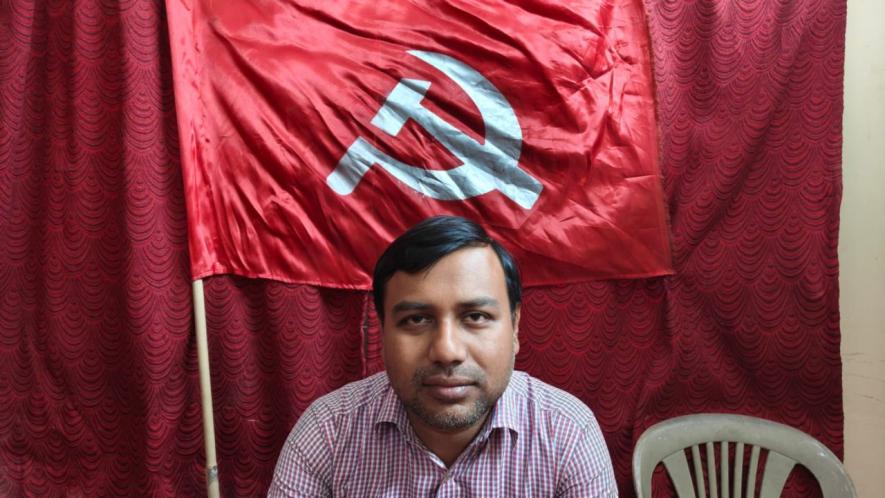
Sudip Dutta ,Citu national President during the interview. Photo by Rangan Banerjee
Sudip Dutta is the youngest president of Centre of Indian Trade Unions (CITU) since its inception. In an interview with NewsClick in Kolkata, Dutta talks about the hectic preparations for the general strike call by the Joint Forum of Trade Unions against the new labour codes among other demands, and the challenges facing the trade union movement in the country. Edited excerpts:
Sandip Chakraborty: What is the condition of the working class at this given moment?
Sudip Dutta: The working class is under the deadliest form of attack of our era and, at the same time, is in its peak mood of struggle.
It is true that the attack through the introduction of the labour codes has come into prominence, which are designed to take away the rights of the working class won over 100 years of struggle.
But the issue is not only this. Seeing these labour codes as a disjointed and isolated form of attack, detached from the entire policy framework that the bourgeois Indian State has imposed upon the working class, would be wrong.
The working class is facing a holistic policy attack—starting from the reduction in the share of wages; the right of unionisation, the right to strike, and the right to collective bargain; the shift from permanent employment to contractual employment; the growth of the informal economy; the huge boom of self-employed workers, gig workers, and new-generation workers—who are not covered under any form of social security or protection. In addition, there is de-criminalisation of plunder and criminalisation of resistance. We are facing the creation of an anti-union socio-cultural ecosystem and a neo-fascist State that is desperate to establish the rule of capital in the most blatant way. In a comprehensive sense, Indian workers have now become the easiest targets of exploitation by the ruling class.
At the same time, resistance has also increased. The February 12 general strike call will see the largest ever action by the working class against the State and the Indian bourgeoisie. The attack on the working people has increased to its highest level, and so has the resistance.
The working class is facing tremendous suppression, oppression, and exploitation, and is filled with immense anger. They are ready to agitate, to come to the streets, and to change the system. The call of the 18th Conference of CITU was to convert this crisis into a consensus for social transformation—a social change for the 21st-century working class. The working class is moving on those lines.
SC: Can you give examples of pockets of resistance that have grown across the country?
SD: There have been numerous struggles of the working class during this period. If you see the struggles of electricity workers against privatisation in Chandigarh, Uttar Pradesh, Puducherry and Maharashtra. In many places, the state governments had to roll back their privatisation bids, or in some cases the employees have been able to stall the privatisation process for two to three years.
Turning the wheel of time in the opposite direction, around 5,000 contractual municipal workers of Delhi have achieved regularisation through more than one month’s strike.
The Samsung workers in Tamil Nadu resorted to a strike against one of the most notorious union-busting MNC managements in the world. They struggled for more than a month to achieve the right to unionisation.
Then, there were heroic struggles of Anganwadi and ASHA workers across the country. Just recently, we saw in a place like Gujarat, thousands of Anganwadi workers burning copies of Narendra Modi’s budget.
In Tamil Nadu last year, in more than 15 multinational companies, there were strikes lasting more than seven days. Here in West Bengal, in the plantation areas, workers, even of deserted tea gardens, are again coming onto the roads and resorting to agitations for their demands.
If you consider CITU alone—it has more than 4,800 unions. It represents workers from road transport to water transport, from beedi workers to manufacturing, from coal to electricity, to scheme workers and unorganised sector workers, to construction sector workers, and many more. Workers from different sectors are engaged in wide-ranging struggles, all of which will culminate on February12.
From the banking sector to the insurance sector, from transport to coal workers, electricity, and steel sectors—all saw glorious strike struggles last year. Almost 90% of coal production was stalled in the last general strike. Petroleum workers also joined in.
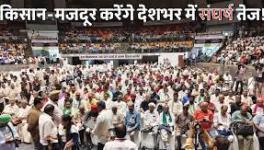
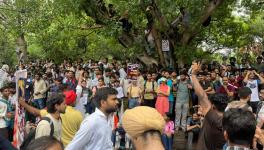
As per the line of resistance and defiance, this year’s strike will be the most visible one in recent times. The CITU has given the call to mobilise more than 1,000 workers in more than 1,000 places. We have asked our state committees to provide details of preparation. Millions of Indian workers under CITU’s banner will pour into the streets on February 12. Alongside them, the kisans, agricultural workers, other central trade unions, and the Samyukta Kisan Morcha (SKM) will take part in the largest ever show of resistance in India on February 12.
SC: But what will be the outcome of another one-day strike?
SD: We want to affirm this time that this is not like any other one-day strike. We have clearly stated that this is a ‘warning’ strike. This one-day strike will send an alert to the Central government, that if it does not roll back the labour codes and the labour rules they are now publishing, then we will go for multiple-day strikes, and we may also go for mobilisation of millions of workers at several state capitals.
It may be a long mobilisation in Indian cities and different points of the country—Bengaluru, Chennai, Kolkata, Delhi, and Mumbai. The form of resistance will gear up through this strike. This is the start of a new era of our resistance movement, and with that we are advancing.
The real geopolitical situation today is different from the earlier days. The crisis has hit the centre of capitalism—the US. The US is desperate to shift the crisis to other countries, and India is their biggest target. You can see how the US trade deal has nakedly compromised the sovereignty of India’s economy, and the Union Budget is also a part of that.
To adjust US tariffs, the government is exempting duties and taxes for the capitalist class. They have made a revenue budget which is no higher than the earlier budget. How are they going to make up for the loss? Certainly, by putting the burden on the people and the public sector. In the budget, they have curtailed subsidies to reduce expenditure on people.
On the other hand, to fill the gap, they have directed PSUs (public sector undertakings) to give more dividends to the national exchequer, thereby further weakening the public sector. At the same time, they are saying that public sector assets will be monetised.
They want foreign companies to sell energy to India. For that, they have changed the nuclear law as well. Through the so-called compensation-free mechanism, the US and French companies are being enabled to sell nuclear reactors to India.
This is a very coherent attack, and the labour codes are a part of it. In the Economic Survey, the government says that the world is going through turmoil due to geopolitical disturbances, that there is value-chain disruption, and that the government’s remedy is the imposition of labour codes.
Again, I will say that the crisis has hit the US, and they want to shift the crisis to India through tariffs. Indian monopolies, in turn, want to shift the crisis on Indian workers through labour codes, so that tariffs and derogatory trade deals can be adjusted by lowering wages.
The Indian working class and Indian peasantry are under tremendous burden. This is a new moment in history where they are going to respond in a much stronger manner. This one-day strike is only a warm-up. This will usher in a new era in the Indian working-class movement.
SC: Which other state-level trade unions aligning in this strike, such as LPF in Tamil Nadu?
SD: Tamil Nadu’s largest trade union, the Labour Progressive Front (LPF), along with the 10 central trade unions, are signatories to the strike. LPF itself is a central trade union.
In Jharkhand, the Jharkhand Mukti Morcha’s trade union will be a part of the strike, and so will Shiv Sena’s trade union in Maharashtra, which will 100% support the strike.
In several states, regional trade unions will also be part of the strike, especially where regional unions have greater influence than the central trade unions.
This time, the SKM has given us unconditional support. They told us that whenever we announce a strike, they will support it—the date is not a precondition. After the India-US trade deal, they have demanded the resignation of Piyush Goyal, the concerned minister.
On that day, they will also burn effigies of Narendra Modi and Donald Trump.
The joint platform of agricultural workers and the MGNREGA Sangharsh Samity has also supported the strike. We hope the world will see the might of India’s producing classes on that day.
SC: What makes you so hopeful about social transformation in our lifetime?
SD: When we were inducted into CITU, we were convinced about the social transformation that CITU wanted to bring about. That is the constitutional objective of CITU and of its cadres, and also the purpose of our lives. We cannot survive in this inhumanly exploitative, barbarous world order led by vulgar billionaires and their political agents. We cannot allow our lives to end in a defeatist mode.
Earlier, the news used to be about farmer suicides; now what is making news is the suicides of daily-wage workers. Around 50,000 daily-wage workers reportedly die by suicide every year in this country due to distress.
The working class is undergoing monumental pain, which reflects the condition in which the average daily-wage earner is living. Workers are dying in factories, on streets, and at home. In Kolkata, a few weeks ago, more than 25 workers were locked inside a warehouse and got burnt alive. Nobody cares.
On the US-India trade deal, even the pioneers of free trade are saying that no deal is truly free. In the US, workers are doing two to three jobs a day; no single job can sustain them. The US has turned toward protectionism— “America First”. Through military means—from Gaza to Venezuela—imperialist forces are seeking to control oil and resources. Europe is also facing de-growth and is trying to evade it by expanding into India. Hence, Indian workers are in a situation where they must resist or perish.
The crisis has set in at the very core of the capitalist world. If we can resist it here, the rebound of the crisis from below to above will shake the entire capitalist system. With this understanding—of both subjective and objective conditions—we are planning to make the Indian working class militantly visible on the streets.
Not only on February 12, but over the next one or two years, working men and women will come onto the roads with a militant attitude. Every day, you will get news of the Indian working class on the streets. We will make the ruling class afraid of the Indian working class.
SC: Your take on migrant workers and the problems they are facing?
SD: There is uneven economic development in our country. One alternative is a self-sustained economy across the country. At the same time, migration has always been a common pattern of historical development. People migrate for better livelihoods, for specific skilled jobs, or toward newer forms of industrial employment.
Earlier, there was a Migrant Workers Act, which has now been repealed. Even when the law existed, there was no effective mechanism. We saw how migrant workers died on streets and railway tracks during the COVID period despite the existence of the Act; now even that law is gone.
The CITU has adopted a two-pronged strategy to organise migrant workers. On one hand, we are trying to build social organisations of migrant workers in the host states. These organisations will address language-related and social issues. We are trying to create networks so that local leaders from migrants’ home states remain informed. On the other hand, we are trying to engage them in common unions with native workers. Working-class organisations should be built on the basis of workers’ position in production relations; this will also give protection against divisive forces.
Every month, we recover the bodies of migrant workers. It can’t continue like this. In Haryana, Odisha, and many other states, workers are harassed over religious and linguistic identities by communally divisive forces created by the Far-Right ruling elements. Through our coordination, we are trying to address the specific socio-cultural issues of migrant workers and build greater working-class unity among workers of all castes and creeds. At the same time, we demand that the Central and state governments ensure that migrant workers are not tortured.
SC: In Bengal, how do you see the role of the ruling Trinamool Congress union?
SD: The rule of a political force or party can be understood through its intervention during strikes. A strike is an ordeal—it reveals the class nature of an organisation. Many who call themselves Left-liberal oppose strikes.
For the past 15 years, one political force has consistently tried to break strikes. One thing can be confidently said about the Left Front government, it never attempted to break strikes or victimise striking workers.
But the union you mentioned (TMC) has always acted as a strike-breaker. Before 2014, even BMS (RSS-backed Bharatiya Mazdoor Sangh) was part of the central trade unions, and it participated in strikes; but this force in Bengal has always attempted to sabotage strikes.
They have done this by imposing tremendous intimidation and threats on working people. If you work in an auto stand or rickshaw stand, you must be a member of that political force; otherwise, you cannot even operate a hand-pulled rickshaw. I can guarantee that this does not happen anywhere else in the country. This force (TMC) never participates in any strike call. Even now, the strike called by the 10 trade unions, the joint agricultural forum, and SKM will again face attempts to break it.
However, we are convinced that this time there will be massive strikes across industries in West Bengal, barring the exemption given for board examinations. And any force that tries to break the strike, will be dealt with accordingly.
Get the latest reports & analysis with people's perspective on Protests, movements & deep analytical videos, discussions of the current affairs in your Telegram app. Subscribe to NewsClick's Telegram channel & get Real-Time updates on stories, as they get published on our website.