





Maharashtra: Pardhi Community Forced to Migrate as Climate Change Erodes Traditional Livelihoods
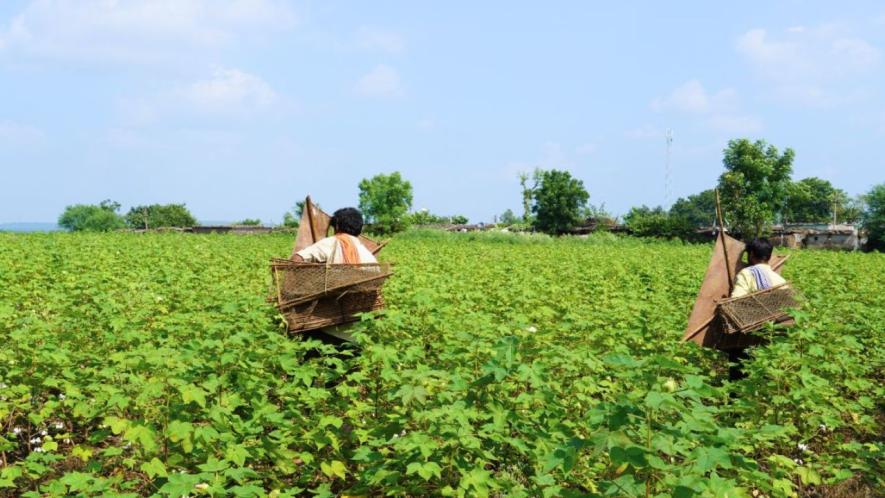
Namdev Pawar hunting birds in farmland, with his nets folded at back (Photo- Azib Ahmed, 101Reporters).
Yavatmal and Jalna, Maharashtra: For generations, the Pardhi community’s life revolved around Paradh and Padhar – hunting, small farming and seasonal migration that followed the rhythms of land, birds and rain. The word Paradh in Marathi means to hunt, a nod to their historical occupation. Padhar, in the Pardhi language, refers to seasonal migration undertaken for work and survival.
Today, however, each of these livelihoods, which were once embedded in farms, fields and local ecologies, is collapsing under the combined pressure of climate change, chemical-intensive farming and legal restrictions.
For the Pardhi community of Maharashtra, Padhar is no longer a tradition passed down through generations. It has become a necessity. As changing weather patterns destroy crops, wipe out medicinal herbs and drive away the small birds they once hunted, the Pardhis are caught between a deepening climate crisis and centuries-old stigma.
“Earlier, the land was alive,” recalled Namdev Pawar (40). “You could hear birds everywhere. Now the fields are silent.”
That loss is visible in villages like Malwagad, where climate stress has aggravated long-standing social and economic marginalisation. In this village of Mahagaon tehsil in Yavatmal district, about 40 Pardhi families live on the margins of society, literally and socially. The settlement, nearly a century old, still lacks toilets, clean drinking water and paved roads. Children attend nearby schools but face routine discrimination.
The Pardhis, primarily living in Maharashtra and parts of Madhya Pradesh, are among India’s 150 denotified tribes, once labelled a “criminal tribe” under the British-era Criminal Tribes Act of 1871. Though the law was repealed in 1952, the stigma has persisted.
“Wherever we go, people see us as criminals,” said Pravesh Chavan, a resident of Malwagad. “We are denied jobs and even a place to stay.”
Why traditional livelihoods collapsed
Traditionally, Pardhi men hunted small birds such as teetar (francolin birds), bater (quails) and rabbits not in forests, but in and around agricultural fields. Community members say this was once an integral part of the rural ecosystem.
“Earlier there was enough grass along field bunds,” said Manish Jadhav, a farmer from Pusad tehsil in Yavatmal. “Birds and rabbits could survive there. Now, even farmers struggle to grow crops. How will small animals survive?”
Maharashtra has grown steadily hotter over the past century. According to the India Meteorological Department, the state’s average annual temperature has risen by more than 0.6°C since 1901. Rising daytime heat, erratic monsoons and prolonged dry spells have reduced grass cover and disrupted insect populations, making farmlands increasingly hostile to small birds.
Pune-based ornithologist Satish Pandey said quails and partridges, which belong to the Phasianidae family, are ground-dwelling birds that spend their entire lives in grasslands and croplands. “They do not migrate. Any change in their immediate surroundings affects them directly,” he said.
The growing use of herbicides and pesticides has compounded the problem. “These birds feed on crop seeds,” Pandey explained. “When chemicals settle on grains, birds ingest them and many die.
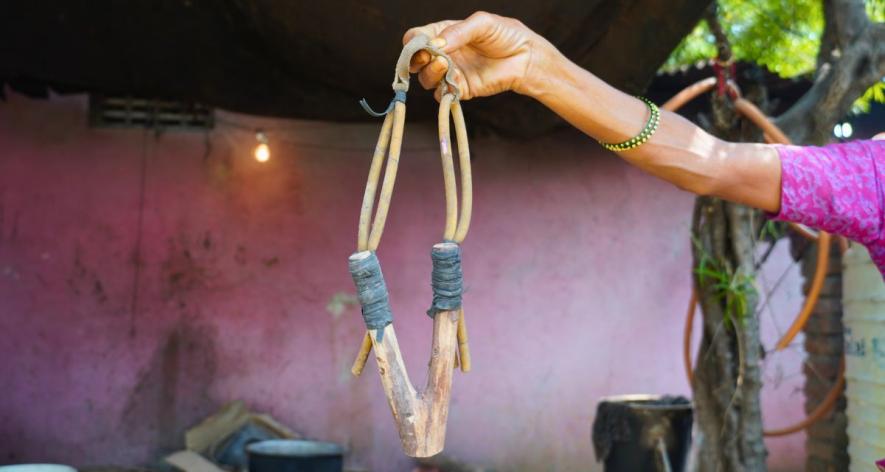
Masabai Kale, a Pardhi woman, holding a sling shot she made to sell in the local fare markets (Photo- Azib Ahmed, 101Reporters)
Climate change has further disrupted breeding cycles. “Their nesting usually coincides with the monsoon,” Pandey said. “Erratic rainfall leaves eggs exposed to extreme heat or predators.”
The State of India’s Birds 2023 report found that many farmland bird populations are declining due to a combination of climate change, habitat loss and chemical exposure. Higher temperatures force birds to spend more time seeking shade and less time foraging, affecting survival and reproduction.
The Pardhis once trapped birds using nets, selling a teetar for Rs 200-250 and a pair of bater for around Rs 150 in local markets. But now, sightings have dropped sharply. As rainfall has become increasingly unpredictable, pest attacks across Vidarbha have intensified. To protect cotton and soybean crops, farmers now depend heavily on chemicals.
“One litre of herbicide costing Rs 600 can clear weeds on an acre,” said farmer Manish Jadhav. “Hiring labour would cost nearly Rs 4,500. For the past 20 years, spraying has surged. “Earlier, neem extracts were enough. Now pests attack anytime. Chemicals are used throughout the crop cycle,” he added.
Malwagad sarpanch Kanu Chavan said birds feeding in sprayed fields often die within days. “We find dead birds regularly,” he said. His father, Tirupan Chavan (65), once trapped 60-70 quails a day in the 1990s. “Now we hardly see five,” Kanu said.
While men hunted or farmed, Pardhi women traditionally collected medicinal herbs (jadi booti) from riverbanks. These included patchouli, hatha jodi, rantulsi and murdafali, used to treat wounds, skin ailments and childhood illnesses.
Women dried the herbs in the sun and sold them in nearby villages, earning Rs 3,000- Rs 4,000 over three to four months.
But heavy rains and flash floods have destroyed these fragile ecosystems.
“When I went to collect herbs this year, everything was washed away,” said Mendibai Chavan (60). “We returned empty-handed.” For many women, herb collection was both livelihood and identity. Knowledge passed, not through books, but from mother to daughter.
“Our daughters ask us where the herbs have gone,” said Vachala Pawar, another collector. “What answer can we give? Everything is leaving us, the plants, the birds.”
Pawar's distress is confirmed by agronomist Vijay Kolekar who said that riverside biodiversity is particularly vulnerable to climate extremes. “Heavy rainfall causes sudden floods that wash away soil and vegetation. Drought dries the soil, making it prone to erosion. Rising temperatures worsen both,” he explained.
Climate extremes and migration
Rain-fed farming has become increasingly precarious across Vidarbha and Marathwada. Consecutive drought years have depleted groundwater and reduced crop productivity. Then, in recent years, intense rainfall events have caused devastating floods.
This year alone, Marathwada experienced extreme rainfall that destroyed crops across nearly 32 lakh hectares. Between drought and flood, farming cycles have broken down. Pardhi families owning one or two acres say their crops have failed repeatedly.
“We couldn’t harvest anything this year,” said Vijay Pawar (28) from Jalna district’s Partur tehsil. “Floods destroyed the soybean crop. We didn’t even recover the cost of the seeds.”
“Our farming depends only on God,” he said, quietly. “If it rains too much or too little, we lose everything.”
Kolekar noted that pest attacks have intensified with rising temperatures. “BT cotton resisted pests for nearly two decades,” he said. “But in the last six to seven years, the pink bollworm has broken that resistance.”
Farmers have responded with more chemicals, further damaging insects, birds and soil health. “Climate extremes are breaking traditional farming cycles,” Kolekar said. “Rain-fed farmers without irrigation are being hit the hardest.”
With hunting declining and farming unreliable, migration has become the only option.
Every October, Pardhi families leave their villages for farms and cities across Telangana, Gujarat and western Maharashtra, returning only in June before the monsoon.
They live in makeshift huts along roadsides, enduring temperatures above 45°C in summer.
“We live under the open sky, in heat and cold,” said Maya Pawar (52). “Even when we migrate, people call us thieves. It is difficult to get work.”
Men take up farm or construction labour; women sell herbal medicines and handmade toys at weekly markets and fairs (jatras).
But migration does not erase stigma.
“When a theft happens anywhere, Pardhis are the first to be questioned,” said Sunita Bhonsle, a Pune-based Pardhi activist who has worked with the community for over two decades. “People hesitate to even let us enter their homes.”
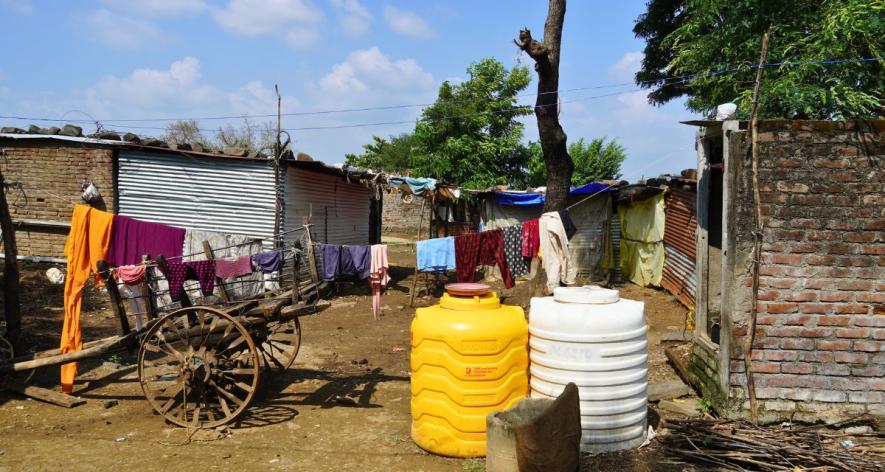
The Pardhi settlement in Mahagaon tehsil, nearly a century old, still lacks toilets, clean drinking water and paved roads (Photo - Azib Ahmed, 101Reporters).
What the state is not doing
Bhonsle said most Pardhis lack basic identity documents such as Aadhaar cards, ration cards and voter IDs, excluding them from welfare schemes.
“We don’t receive compensation for crop losses,” she said. “Even during floods, relief doesn’t reach us because we lack documents.”
The Pardhi Vikas Yojana, meant for the community’s upliftment, has largely failed to reach the poorest families, Bhonsle said.
“No one from our community has ever been elected as an MLA or MP,” she added. “So who raises our issues?”
Women continue to give birth at home, making birth certificates, the first step toward documentation, difficult to obtain. “Even ASHA workers do not enter our settlements,” Bhonsle said.
It is important to note, despite harassment and legal consequences, some Pardhis continue to hunt. An article by World Wildlife Fund(WWF), an international organisation that works to protect endangered species and their habitats, noted that the Pardhis had to endure more, after Wildlife (Protection) Act, 1972 was bought into affect. The act is to provide protection of wild animals, birds and plants, to ensure the ecological and environmental security of the country. The birds, Teetar and Bater, fall under Schedule IV of this protection act.
“With hundreds of years of practice and perfection in making a living out of hunting, they were suddenly left without a profession they could legally practise. With no formal and organised training and assistance provided to them to earn their bread in any other way, they covertly continued with their hunting practices,” the article noted.
“They stop us even when we hunt on farms, not forests,” said Namdev Pawar. “We don’t kill protected animals. This is our livelihood.”
“They caught me twice and beat me,” he alleged. “But what else can we do?”
“For us, hunting is identity,” Namdev said. “Meri wahi rozi roti hai.”
“We are ready for handcuffs,” he added. “But we will hunt.”
Possible solutions
Arvind Kumar Jha, a researcher who has studied the impact of wildlife laws on Pardhi livelihoods, said climate change has turned forest-dependent communities into “ecological refugees”.
Instead of criminalising traditional skills, he argued, the state should channel them into conservation. “In Kerala, former poachers are employed as forest watchers,” Jha said. “They were turned from threats into assets.”
Pardhis, he added, possess deep ecological knowledge of bird behaviour and terrain. “They could work as conservation guides or monitors, using the same skills that sustained them for generations.”
Without viable alternatives, Jha warned, arrests and stigma will continue to reinforce each other. “Rehabilitation, not punishment, is the only way forward.”
Azib Ahmed is a freelance journalist and a member of 101Reporters, a pan-India network of grassroots reporters.
Get the latest reports & analysis with people's perspective on Protests, movements & deep analytical videos, discussions of the current affairs in your Telegram app. Subscribe to NewsClick's Telegram channel & get Real-Time updates on stories, as they get published on our website.