





New Labour Codes: TUs Pledge to Make Feb 12 General Strike ‘Unprecedented’
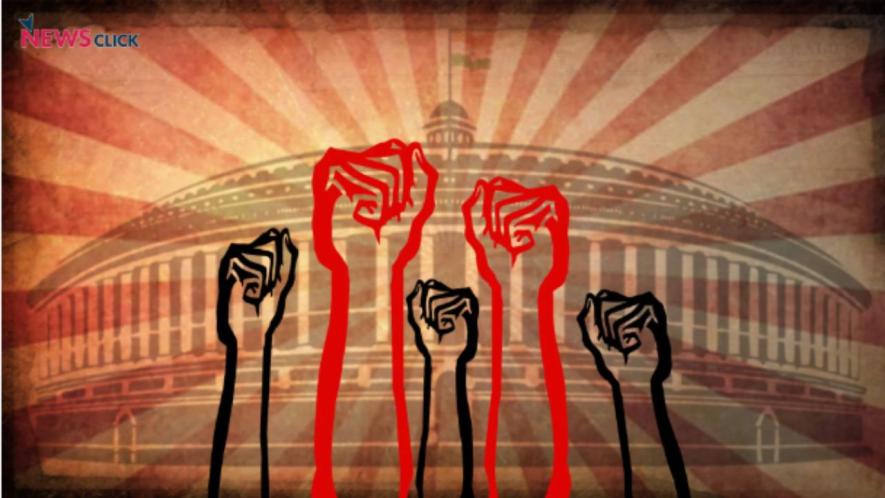
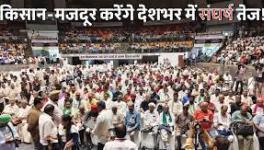
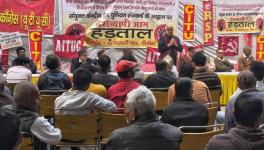
New Delhi: Amid rousing slogans for workers unity, 10 central trade unions (CTUs) in a National Convention held at Harkishen Singh Surjeet Bhawan last week-end pledged to ensure that the General Strike call on February 12 “will see unprecedented participation” of workers across sectors, including the informal sector.
Addressing the convention, trade union leaders said that the Centre notifying the new Labour Codes meant the “imminent loss of the right to form unions and collective bargaining” opening up new avenues for workers’ exploitation.
While the Narendra Modi government argues that the new Labour Codes will ensure that workers are recruited and compensated fairly along with “easing the rules for doing business”, the CTUs drew attention to provisions, such as relaxing the working hours, new definition of wages and no relief in case of occupational hazards.
In solidarity, the Samyukta Kisan Morcha, a collective of farmers unions, has also announced that it would mobilise farmers and agricultural workers in the February 12 strike in solidarity, and as their protest against the Draft Seeds Bill and Draft Electricity Amendment Bill.
Addressing the convention, Amarjit Kaur, general secretary, All India Trade Union Congress or AITUC, said workers cannot view this attack on their right in isolation. “We are part of the trade union movement, which on May 1 (Labour Day) raises the slogan of ‘Workers of the world, unite!'. We are comrades of trade unions who fought across the entire world to ensure fixed working hours. We are humans, not animals. We will work for eight hours, rest for eight hours, and give eight hours to our families. This struggle began in Chicago in 1886, spread throughout the world, and gained momentum after the October Revolution in Russia in 1917. The struggle intensified, and more labour organisations took to the streets across the globe,” she said.
Reminding workers of the immense struggles and sacrifices, Kaur said: “This is our history of fighting and struggling the 19th Century onward. In that struggle, we have stood together with each other all over the world. We have never been in favour of wars; we have always spoken of peace and tranquility in every corner of the world. But what are we seeing now? Mr. (Donald) Trump, who threatens India with with tariffs of 25%, and if we buy oil from Russia, another 25%, making it 50%, and recently, 100%, 600%. He just says anything. Is this just talk? No.
The AITUC leader flayed the way Venezuela was attacked, its elected President and his spouse and comrade were abducted, “and now US says it will attack Cuba, destroy Mexico, and destroy Brazil. This global policing and thievery are not happening in isolation; they are not separate.” She added that this was happening “because for several decades, capitalism across the world has been facing a crisis. It is unable to emerge from its capitalist crisis, and for that purpose, we know how Iraq was destroyed under a false slogan, how Libya was devastated, and how the Taliban were prepared in Afghanistan, only to be fought against for 20 years, destroying Afghanistan, and then leaving those same Taliban in power."
Kaur pointed out how “repeatedly Iran is being threatened. We see how more than 65,000 people, half of whom were women and children, were killed in the Gaza Strip. We know well that they have no regard even for UN agencies; those who arrived to help from all over the world were also killed; those who brought grain and medicine were also killed. How Palestinians were attacked, attempts were made to destroy them, and genocide was attempted. What is this fight? This is a fight to capture the world's natural resources, to capture oil and gas, to capture markets and trade across the world to increase their own business, and to capture routes—whether by air, road, train, or sea and rivers."
The AITUC leader said that "therefore, in that entire international context, we must take the attack on our country more seriously.”
She appealed to all participants in the national convention, “all of you trade union colleagues sitting here, think collectively. You are residents of India, a country that has always shown the way to the world. The direction this country takes affects many other countries. So, if today the government in India is engaged in crushing and suppressing everyone, and trade unions protest, they want to silence them through Labour Codes. They want to snatch away our union rights.”
Kaur pointed out how 198 years ago, the workers of this country went on strike in Kolkata, Bengal, “and today they are snatching our right to strike. Today they are dumping all our social security laws; they are changing the way unions are formed in our country; they are making the de-registration and de-recognition of unions easy,” adding that “in every way, these Labour Codes are meant to throw us toward slavery.”
E Kareem, general secretary, Centre of Indian Trade Unions or CITU noted that the process of the curtailment of rights of workers had, in fact, begun several years ago. “Even before the introduction of the Labour Codes, labour rights were already being diluted through four simultaneous processes: procedural changes in labour administration directed at curtailing inspection to check on labour laws compliance along with the granting of exemptions and self-certification by the employers; legislative and executive changes directed at increasing flexible employment relations, allowing employers to hire temporary contract or casual workers rather than permanent employees; restructuring of the premises and principle of social security for workers by reducing employer's contribution, greater emphasis on limited private insurance, linking benefits to market behavior rather than assured public provisioning; and imposition of additional conditions and restraints on registration of trade unions and collective bargaining."
Kareem pointed out that before notifying the labour code, in Tamil Nadu, in a company owned by Samsung, workers formed a trade union. “It was not registered. The union applied for registration to the Labour Department, who denied the registration. After a two-month-long agitation, strike, and action, the government intervened. This is the situation.”
The CITU leader noted that a brief look at the provisions of the Labour Codes illustrated how these processes were set to be further entrenched in an intensive manner. “The Code on Wages, which repeals four existing laws, restricts the definition of employees or worker to those employed in establishment or industry. Thus, preceding private households omitted therefrom are the vast majority of especially women workers: domestic workers, gig and platform workers, auxiliary nurses, apprentices, home-based workers, scheme-based workers—that is including Asha, Anganwadi, MNREGA workers—and the rather absolutely named new names to the poor workers, 'Sisters and Friends”
Kareem said "a section of workers are named by government: Pashu Sakhi, Bank Sakhi, Vaidya Sakhi, Drone Didis. These are the new names of the workers. All these are left out of the definition of a worker or establishments where five or fewer workers are employed, which implies the exclusion of 98.6% of agricultural establishments and informal sector workers from any benefits.”
Other labour rights and protection achieved as a result of many long struggles have thus become non-applicable, he said, adding that “for instance, this code reverses the achievement of the historic movement of the bidi workers of Nipani through which they obtained houses, subsidies, housing, and the cancellation of wrongful deduction by contractors under the guise of their workers being rejected."
Harbhajan Singh Sidhu, general secretary, Hind Mazdoor Sabha or HMS said trade unions had already conducted five strikes. “This will be the sixth strike on February 12. The previous strike was on July 9, 2024. Every sector in the country contributed to it. However, some sectors among us did not join. They thought, 'Our jobs are permanent, our salaries are very good, and we have secured good facilities through our struggles.' But if a pigeon closes its eyes on seeing a cat, thinking the cat won't do anything, there can be no greater foolishness. The cat will get a great opportunity to strike you down without a second thought. And that is happening now,” he added.
The HMS leader pointed out that in the last Budget session of Parliament, what Bill did the government bring? “They introduced 49% FDI (Foreign Direct Investment) in all our nationalised banks. If, within five or seven months, someone like Gautam Adani buys NDTV through the back door by purchasing its shares, you’ll wake up one morning to find all the banks have gone to Gautam Adani. And your entire insurance sector has opened 100% FDI to foreign investors. This means insurance is finished. Now, what choice is left for insurance employees? They will have to come and fight with us; they will join the movement because their jobs are at risk.”
Sindhu said “our banking comrades are fighters—they have fought before—and insurance workers have too. But right now, there is a fierce attack. All private banks in our country hold Rs 85 lakh crore of public domestic savings, and now foreign banks have entered all of them. Our domestic savings will also be taken over by foreign banks.”
Get the latest reports & analysis with people's perspective on Protests, movements & deep analytical videos, discussions of the current affairs in your Telegram app. Subscribe to NewsClick's Telegram channel & get Real-Time updates on stories, as they get published on our website.