





Feb 12 Strike: Class War in Contemporary India
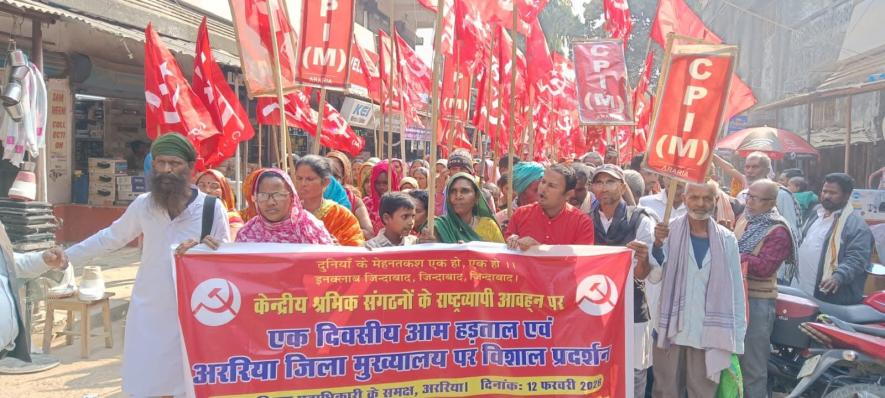
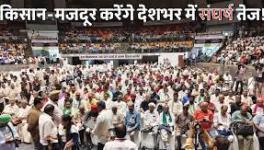
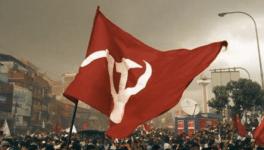
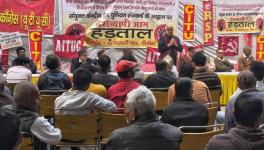
India has witnessed a historic 24-hour nationwide general strike on February 12, 2026, as the organised and unorganised industrial working class, along with peasants, youth, students, women, and broad democratic sections of society, rose in united resistance against the deepening crony-capitalist order and the anti-worker and anti-people economic policies of the ruling feudal landlords and capitalist (bourgeoisie) classes.
This Bharat Bandh is not merely an isolated protest, but a major expression of intensifying class contradictions under contemporary Indian capitalism, where the State increasingly functions as an instrument of monopoly capital, facilitating the accumulation of wealth for a small corporate elite while imposing austerity and insecurity upon the masses.
The strike call, pushed forward by a joint platform of ten central trade unions and various independent federations, reportedly mobilised over 30 crore workers, making it one of the largest collective actions of labour power in human history. It represents a powerful reminder that the working class remains the decisive force capable of halting the machinery of capitalist production.
Worker–Peasant Unity and Broad Democratic Front
The protest action received massive backing not only from trade unions but also from farmers’ organisations, student movements, youth groups, women’s collectives, and informal-sector workers, cutting across artificial divisions of caste and religion that the ruling classes routinely exploit to weaken popular unity.
This strike reflects the growing potential for a worker–peasant alliance, the backbone of any serious democratic struggle against comprador crony capitalism and imperialist domination.
Labour Codes as a Bourgeois Offensive
At the heart of the February 12 protest lies the opposition to the Centre’s labour and economic agenda, particularly the implementation of the four new labour codes, which trade unions correctly identify as a systematic attempt to:
- weaken job security
- dilute collective bargaining rights
- undermine existing safeguards
- expand contractualisation and precarious labour
These labour codes are not “reforms” but instruments of the bourgeois state, designed to intensify exploitation by increasing the power of capital over labour. These represent a new stage in the offensive of monopoly capital against the organised working class.
Union leaders have demanded stronger worker protections and expanded social security, warning that continued neglect of these demands will inevitably provoke further waves of struggle.
Disruptions as a Demonstration of Labour’s Centrality
The strike visibly disrupted key sectors of capitalist and State functioning on Wednesday:
- Public sector banks remained closed
- Government offices and PSUs saw low attendance
- Public transport, including buses and taxis, operated at reduced levels or halted in many regions
- Factories and industrial units suspended work
- Schools and colleges remained closed in areas of strong participation
- Markets and local shops shut down in major cities
Such disruptions are not “inconveniences,” but a living demonstration of the Marxist truth: labour is the foundation of all social production, and when workers withdraw their labour, the capitalist system trembles.
Nationwide Resistance
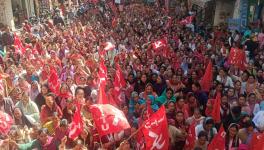
Major disruptions have been reported across multiple states including Kerala, West Bengal, Odisha, Karnataka, Maharashtra, Punjab, Haryana, Uttar Pradesh, Bihar, Tamil Nadu, Andhra Pradesh, Telangana, Rajasthan, and Delhi.
Commuters experienced significant disruption, especially where workers and protestors organised road blockades and mass demonstrations.
Authorities had to issue advisories and contingency plans, revealing the anxiety of the ruling establishment when confronted with organised mass power.
Rising Tide of Class Struggle
The February 12 general strike must be understood as more than a one-day stoppage. It is a political warning shot from the working masses against a system that concentrates wealth in corporate hands while pushing the majority into insecurity, unemployment, inflation, and exploitation.
This strike is a clear manifestation of the growing resistance to the capitalist path of development, and it signals the sharpening of class struggle in India.
The working class is beginning once again to assert its historic role — not only as an exploited class, but as a revolutionary force capable of challenging the entire structure of bourgeois rule.
The writer, an economics professor and author, is currently engaged in research on Sustainable Economic Development, Political Economy of the Global South, and India’s Socioeconomic Crisis. The views are personal. acpuum@gmail.com.
Get the latest reports & analysis with people's perspective on Protests, movements & deep analytical videos, discussions of the current affairs in your Telegram app. Subscribe to NewsClick's Telegram channel & get Real-Time updates on stories, as they get published on our website.