





Bengal: Water in Dam, Hunger in Fields; Kangsabati Boro Farmers in Limbo
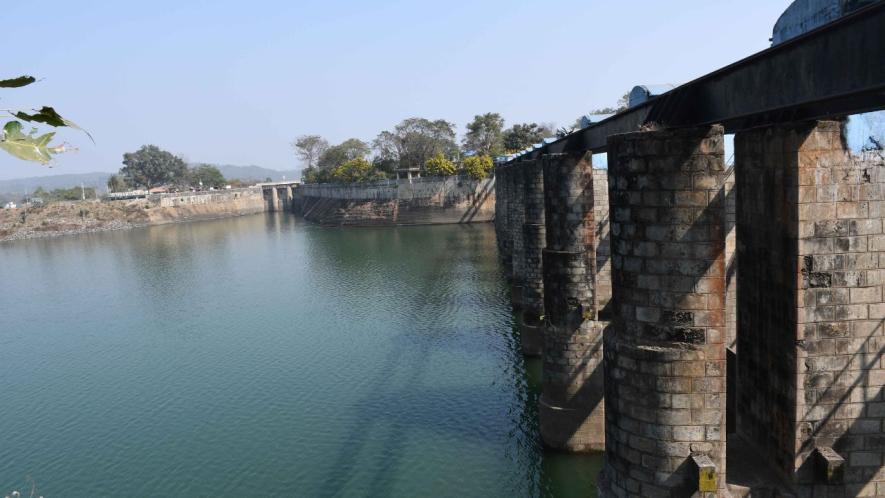
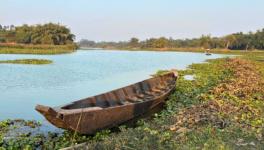
The Kangsabati Reservoir in Mukutmanipu brimming with water.
Despite adequate water in the Kangsabati Reservoir this year, farmers in the districts of Bankura, Jhargram, Paschim Medinipur and Hooghly have not received irrigation water for Boro Paddy cultivation. The Kangsabati irrigation department of Bengal has issued an official notice clearly stating that water will not be supplied for Boro farming this season. The department has stated that irrigation water cannot be supplied for Boro cultivation due to shortage of water in the reservoir. However, the ground reality appears to be different.
According to local observers, the Kangsabati Reservoir currently holds sufficient water that could support irrigation for Boro farming. But, thousands of bighas of agricultural land remain uncultivated during the current Boro season. Farmers and agricultural labourers are left without work and are facing serious economic hardship.
Boro cultivation, which could have resulted in significant paddy production and contributed to the economic growth of the region, has been halted for several years during the tenure of the Trinamool Congress (TMC) rule in West Bengal.
From a distance, the Kangsabati Reservoir appears to be a picture of planning and perseverance. Spread across Mukutmanipur — around 230 kilometres west of Kolkata city — it stands between the Ranibandh and Khatra blocks of Bankura district, encircled by ancient hills and dense forests.
Asia’s largest earthen dam, the reservoir’s deep blue waters and pristine surroundings have turned the region into one of Bengal’s most popular tourist destinations.
But beneath this picture postcard beauty lies a history of displacement and sacrifice. Nearly seven decades ago, the residents of Bankura and Purulia surrendered their homes and farmlands to make way for the irrigation project, trusting the government’s promise that water from the dam would transform their dry lands and secure their future.
Construction of the reservoir began in 1957 at the confluence of the Kansai and Kumari rivers flowing from Purulia. The Planning Commission approved ₹25.26 crore for the project, and 372 mouzas across Bankura and Purulia districts were brought under what came to be known as the Mukutmanipur project, later renamed the Kangsabati irrigation scheme.
“Thousands of villages lost their land. Most villages in the areas under the reservoir have been lost to history,” recalled Sahadeb Mahato, 75, of Mallikdangavillage in Ranibandh block.
He pointed out that while the Puddi gram panchayat exists today, there is no Puddi village anymore. Villages such as Basantopur, Dhatkidihi, Gholkuri, Bonpukuria, Serenggarh, Gonsaidihi, Bhalukchera, and Brikromdihi met a similar fate.
“When the dam construction began, people supported it because they wanted irrigation for dry lands,” said Gour Tantubai (87), a resident of Lodda village of Ranibandh. He added: “People in Bankura and Purulia stood behind the project. At the same time, we launched a movement demanding rehabilitation and financial compensation for displaced families.”
Decades later, the promise that sustained the farmers’ sacrifice appears broken.
Despite the Kangsabati Reservoir being filled to its capacity, farmers across Bengal’s Jangalmahal have been denied irrigation water for Boro cultivation for the past 13 years. Since 2012, no water has been released for winter paddy, even though the same reservoir continues to draw tourists and admiration. Farmers allege that this prolonged denial has nothing to do with scarcity, but with the state irrigation department’s sustained indifference.
Devastating Consequences
Seventy-year-old Gurupada Mahato now spends his days grazing cattle across the fields that once bloomed with crops. After harvesting Aman paddy, his land now lies unused. Just a few years ago, the same soil supported Boro paddy, sustained by irrigation from the Kangsabati Reservoir. Today, acre after acre of fertile land has turned barren, turning cultivators and agricultural labourers into a jobless workforce.
Others share the same fate. Elderly farmers, such as Gurupada Mahato, Srikanto Bauri, and Pratima Mahato, have been pushed out of cultivation entirely and now survive by tending cattle. Younger members of the farming families are forced to work in local brick kilns or migrate to other states as labourers to escape starvation.
Across Jangalmahal and Hooghly districts, agricultural fields lie abandoned — the silent markers of a dying agrarian heritage, waiting for water that has not arrived since 2012.
To understand the scale of the crisis within the Kangsabati command area, this reporter visited several affected regions across Bankura, Jhargram, Paschim Medinipur, and Hooghly districts. Farmers and land labourers were found living in a state of deep despair, uncertain of their future and increasingly disconnected from farming.
Whatever hope remained was recently crushed when the Kangsabati Irrigation Department issued an official circular clearly stating that water would not be supplied for Boro cultivation this season as well. The announcement left farmers helpless. With the government itself closing off their primary source of livelihood, a single question echoes across these villages: what are they supposed to do—and how long can they survive?
Across villages within the Kangsabati command area, farmers repeatedly voiced a common grievance: irrigation water for Boro cultivation stopped reaching them after the TMC came to power in West Bengal in 2011. Yet, despite receiving no water for winter paddy for over a decade, they continue to pay irrigation water tax every year.
Following the pattern of the past 13 years, a leaflet was recently circulated across the Kangsabati irrigation area, bearing the signatures of two superintendent engineers of the Kangsabati Irrigation Division—Shibjyoti Raja of the Bankura division and Amit Dutta of the Paschim Medinipur division. The leaflet stated that irrigation water would not be supplied for Boro cultivation due to allegedly low water levels in the reservoir.
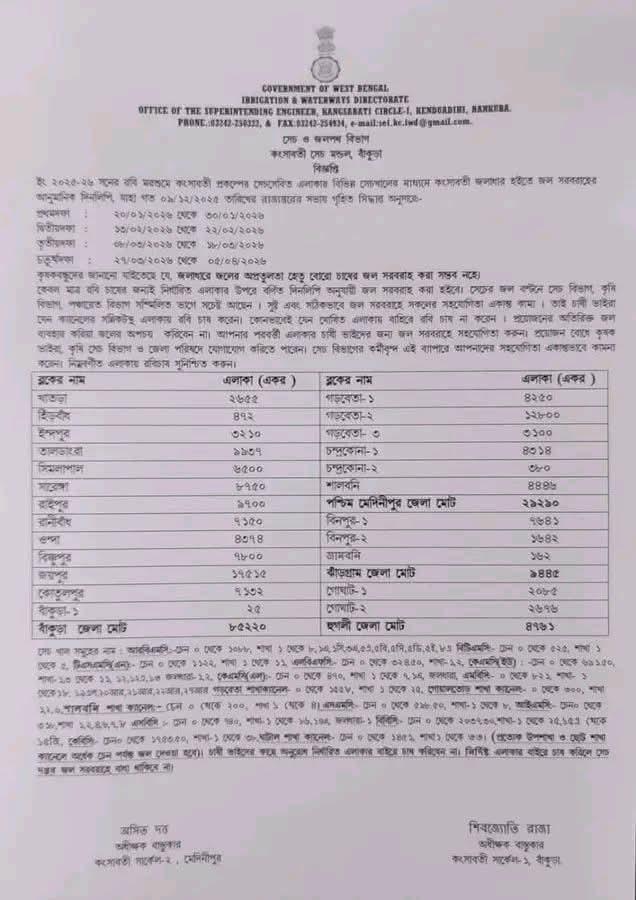
Kangsabati irrigation department notice on not providing irrigation water during the Boro season due to "shortage of water" in the reservoir.
Farmers Contest Govt Claim
“Despite experiencing one of the heaviest monsoon rainfalls in recent years, farmers in the Kangsabati command area are now facing an acute shortage of irrigation water,” said Madhu Sudan Mahato, a farmer from Sindurpur village in Ranibandh block of Bankura district. He pointed out that continuous rainfall for nearly three months during the last monsoon season had filled the Kangsabati dam to capacity.
“A significant portion of this water was reportedly released into the river without proper planning,” he alleged, adding that this practice has been repeated annually by the irrigation authorities for the past 13 years. As a result, even when the reservoir holds a substantial volume of water, farmers are denied water for Boro paddy cultivation.
Farmers across the region said that, like previous years, Boro paddy has not been cultivated this year either. They cited the prior announcement that irrigation water would not be released from the Kangsabati Reservoir. “On what assurance will farmers cultivate crops?” they asked, pointing out that without guaranteed water supply, investing in seeds, fertilisers, and labour is impossible.
Standing in his Bonsol field, an elderly farmer, Gurupada Mahato, said that the monsoon paddy had already been harvested and there was currently no crop on the land. “We are grazing our cattle in the fields. We have no other option,” he said, adding that the authorities have clearly stated that irrigation water from Kangsabati will not be provided.
A similar scene played out in nearby Barkola village, close to the Kangsabati Reservoir. Farmer Pabitra Bauri was seen grazing cattle on his agricultural land. Expressing his helplessness, he asked, “How can we cultivate if water is not supplied?”
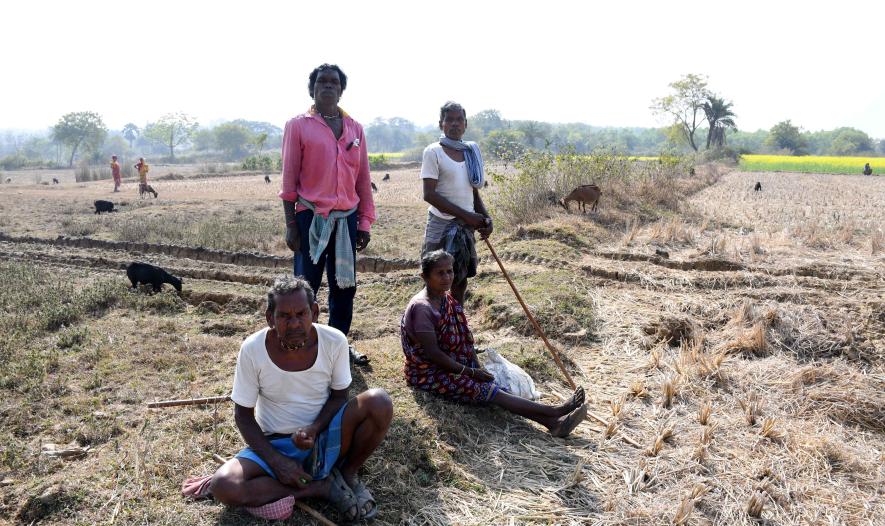
Farmers of Barkura village -- Pabitro Bauri, Srikanto Bauri, Susanto Bauri and Behula Bauri -- grazing cattle in their agricultural fields, unable to do Boro cultivation.
Another farmer, Behula Bauri, said agriculture in the region had now become entirely dependent on monsoon rainfall. “This year, due to sufficient rainfall, we were able to cultivate Aman paddy,” she said, underscoring how winter cultivation has effectively vanished from the cropping cycle.
How the Irrigation System Was Meant to Work
The Kangsabati irrigation scheme was constructed by diverting water from the Kansai and Kumari rivers flowing from Purulia. Designed as an earthen gravity dam with a concrete saddle spillway, the structure’s embankments are formed by layers of compacted mud arranged in a pyramid-like shape and reinforced with boulders for protection. This unique design has earned it the distinction of being Asia’s largest earthen dam.
The project created an irrigation potential of 3,48,477 hectares across Bankura, Paschim Medinipur, Jhargram, and Hooghly districts. While the original objective was to supply irrigation water during the kharif season, the scope of the project expanded significantly during the Left Front regime (1977–2011).
“The Left Front government’s land reform programme provided land patta, or title deeds, to landless people. Around the same time, high-yielding seed varieties entered the market, leading to large-scale cultivation across these districts,” said Sheikh Israyel, a retired officer of the Kangsabati Irrigation Department. “As a result, Kangsabati irrigation became essential for farmers,” he added.
Israyel noted that before 1977, there was little demand for irrigation water beyond the kharif season. After 1977, canals were renovated and extended, allowing irrigation for Rabi and Boro crops in addition to monsoon cultivation.
Tarubala Biswas and Pulin Bihari Baske, former chief of the Bankura and Paschim Medinipur Zilla Parishad, told this writer that earlier, irrigation planning involved collective decision-making. “To provide water for Boro cultivation, the superintending engineers of four districts, elected representatives of the Zilla Parishad, and government officials would sit together to assess how long the water would last,” he said. Leaflets were then distributed across the Kangsabati command area to inform farmers. “That process no longer exists,” they added.
State Govt Refusing to Answer Questions
A little distance from the abandoned paddy fields, farmers Srikanta Bauri and Sushanta Bauri pointed to their mustard crop drying under sun. “Despite having such a large reservoir nearby, we are not getting water,” they alleged, standing on land that should have been irrigated. Their experience reflects a broader pattern unfolding across the Kangsabati command area.
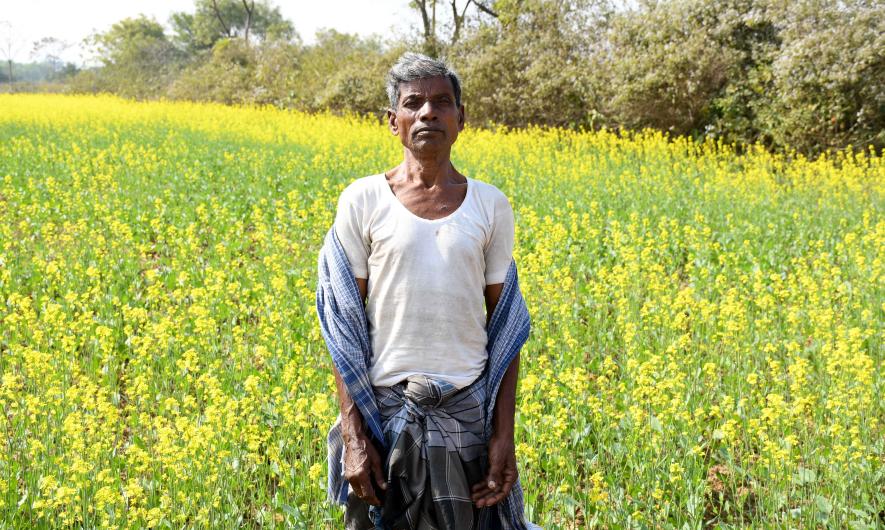
Susanta Bauri’s mustard field.
According to data available with the Irrigation Department, the Kangsabati Reservoir was designed to irrigate 12,53,756 acres of agricultural land spread across 24 blocks in Bankura, Jhargram, Paschim Medinipur, and Hooghly districts. In practice, however, irrigation over this vast area has failed to materialise for Boro cultivation.
Local residents argue that had irrigation-supported Boro paddy been cultivated across even a portion of this command area, rice production would have increased substantially. Agricultural labourers would have found employment, while farmers and rural households would have achieved greater economic stability.
“A strong cycle of local economic activity would have developed around agriculture,” said Madhu Sudan Mahato, adding that “In that situation, youths would not have been forced to migrate outside the state in search of work as migrant labourers.”
Yet the central question remains unresolved: is there truly a shortage of water in the Kangsabati Reservoir to justify the continued suspension of Boro irrigation?
Ground-Level Observations Tell a Different Story
During a visit to the Kangsabati Reservoir, it was found to be holding a substantial volume of water. An assistant engineer of the Kangsabati Irrigation Department, who spoke on condition of anonymity, explained that the reservoir had a maximum storage capacity of 40 feet. “If the water level remains up to 25 feet, irrigation water can be released for both Boro and Rabi crops,” he said, adding that the current water level has not fallen below that threshold. He also confirmed that water had already been released for Rabi cultivation, although Rabi farming—primarily winter vegetables—was practiced only on a limited scale in the region.
Sources within the department further revealed long-standing structural issues within the irrigation system. The Kangsabati canals, they said, had not undergone proper renovation for several years. While silt is removed annually in the name of maintenance, it is allegedly dumped along canal banks rather than cleared. During the monsoon, this silt washes back into the canals, leading to repeated accumulation and reducing their carrying capacity.
The sources also alleged that canal maintenance had been carried out for years by a small group of selected contractors, resulting in ineffective and unsustainable renovation work. Over time, large stretches of the canals have become shallow and clogged, severely affecting water flow.
Additional concerns were raised about reservoir management during the monsoon. According to local accounts, water stored in the reservoir is often released into the Kangsabati River before it reaches danger levels. Such releases serve little purpose for farmers, as the water cannot be utilised for irrigation at that time.
Compounding these issues is the critical shortage of manpower. No new staff have reportedly been recruited at the Kangsabati project over the past 14 years. Departmental sources said the irrigation department was currently operating with nearly 30% fewer personnel than required, significantly undermining monitoring and maintenance. Several staff members acknowledged that the lack of manpower had directly affected effective supervision of irrigation infrastructure.
When contacted regarding the non-availability of irrigation water for Boro cultivation, Somnath Ghose, executive engineer of the Bankura Division of the Kangsabati Irrigation Department, offered a brief response. “It has already been communicated through leaflets that water cannot be supplied for Boro cultivation due to lack of sufficient water in the reservoir. Beyond this, I have nothing more to say,” he said.
The statement has drawn sharp reactions from local residents. They argue that the reservoir was originally built to provide irrigation water to farmers, noting that even 15 years ago, water was regularly supplied for cultivation from the same project. “Why are farmers being deprived now?” they asked.
Residents also pointed to the government’s continued investment of crores of rupees in developing the Mukutmanipur tourism project around the reservoir. “Is this reservoir meant only for the entertainment of visitors from outside, while farmers are left to dry up?” they questioned angrily. “Are farmers and agricultural labourers expected to perish while the reservoir is used for tourism?”, they ask.
The writer covers the Jangalmahal region for ‘Ganashakti’ newspaper in West Bengal.
(All photographs by Madhu Sudan Chatterjee)
Get the latest reports & analysis with people's perspective on Protests, movements & deep analytical videos, discussions of the current affairs in your Telegram app. Subscribe to NewsClick's Telegram channel & get Real-Time updates on stories, as they get published on our website.