





Bengal Elections: Left Front Candidates Take People's Issues to Doorsteps
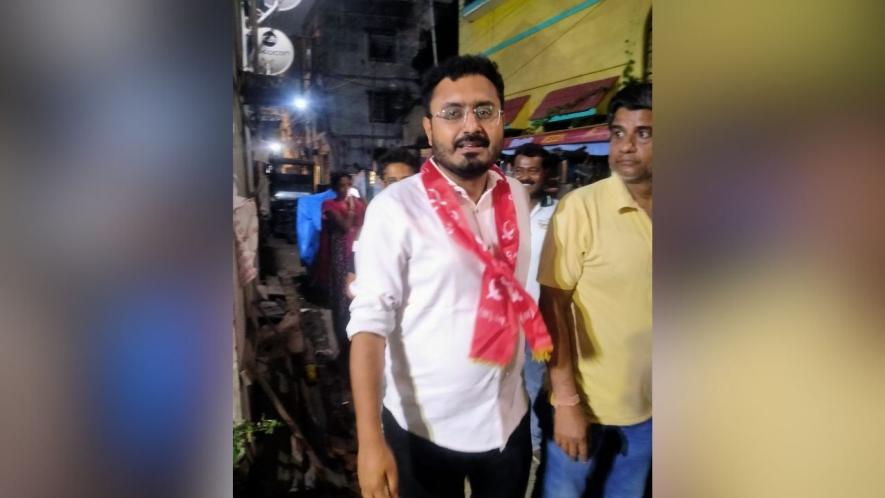
Former SFI General Secretary Mayukh Biswas during campaign in Dumdum.
KOLKATA: At a workers' colony in Uttarpara, Hooghly district, a woman in her 50s stopped Minakshi Mukherjee mid-sentence. “The school roof collapsed two monsoons ago. Our children study under a tarpaulin.” Mukherjee, a CPI(M) candidate and a familiar face during student and youth agitations, noted this down. “This,” she told the small crowd gathered around her, “is what never makes it to television debates.”
Across West Bengal, as the Assembly election campaign moves into full swing, a thread of candour — sometimes weary, sometimes combative — runs through the Left Front's ground effort. While the ruling Trinamool Congress (TMC) and the Opposition Bharatiya Janata Party (BJP) trade accusations in a media cycle that rarely strays from the binary of 'Didi versus Delhi,' Left candidates are attempting a different kind of campaign: longer on specifics, shorter on spectacle.
The Binary the Left is Running Against
The slogan in Left Front rallies this season is 'Save Bengal' — a phrase the CPI(M), which leads the Left Front, has tried to fill with concrete content rather than rhetorical heat. Left candidates are quick to point out that the phrase has a different meaning depending on where you are standing. In Cooch Behar, it refers to what Students’ Federation of India (SFI) state president Pranay Karjee calls a climate of “bomb blasts, threats, and terror.” In the Sundarbans, youth leader Samya Ganguly frames it as the erosion of the region's syncretic cultural traditions alongside the absence of proper bridges and roads.
Bikashranjan Bhattacharya, senior advocate and former Rajya Sabha MP, who is contesting from Jadavpur on a CPI(M) ticket, puts the broader argument plainly: governance in Bengal, he says, has been reduced to patronage dispensed along religious and factional lines. “We are not here to offer you allowances in exchange for votes,” he told a gathering of residents in South Kolkata last week, adding “We are here to talk about policy — about what a government is actually supposed to do.”
Factories Closed, Schools Crumbling: The Hooghly Stretch
In Uttarpara, Mukherjee is running against Shirshanyo Bandyopadhyay, son of TMC MP Kalyan Banerjee, in what the Left considers a test of whether industrial constituencies can be reclaimed from what it describes as “dynastic TMC politics.” The constituency carries the memory of Bengal's manufacturing past — textile mills, engineering units — and the present reality of closures and contracting employment.
“Factories have shut, roads have not been repaired for years, and the school your child attends doesn't have a functioning roof,” Mukherjee said at a campaign meeting in a narrow alley lined with cycle-repair shops. “If you turn on the news tonight, none of this will be mentioned. They will discuss which leader said what about whom. That is why we walk the streets — because if we don't talk about this, no one will.”
Jute Mills and Labour in Noapara
Gargi Chatterjee, CITU (Centre of Indian Trade Unions) leader and CPI(M) candidate in Noapara, North 24 Parganas, campaigns on foot, often after walking several kilometres through settlements adjoining shuttered or partially working jute mills. Workers, some still in work clothes, were seen garlanding her at gate meetings. The conversation invariably turns to wages — unpaid for months in some cases — and to provident fund dues that workers say have not been deposited.
Chatterjee does not deflect these complaints. Her campaign has become, in effect, a mobile grievance register: she carries a notebook, takes down names, and follows up. Workers who have dealt with her through the union say this continuity matters. “She was here before the election,” said a mill worker outside a gate in Titagarh, adding “That makes the difference.”
North Bengal: Communal Tension and SFI Candidate
Cooch Behar district has seen repeated incidents of intimidation, bomb-throwing and factional clashes in recent election cycles. SFI leader Pranay Karjee, contesting on a CPI(M) ticket, campaigns in this atmosphere with a message that tries to straddle security and solidarity.
“People here are tired of being told that Bengal needs to be saved from one party or the other,” Karjee told this writer after a public meeting near the town centre. “They need jobs, they need safety, and they need to know that their neighbours — regardless of community — are not their enemies. That is the only fight worth having.”
Sundarbans: Bridges, Culture, and the Long Walk
In Raidighi, South 24 Parganas, Samya Ganguly campaigns in a landscape shaped by water — tidal rivers, narrow ferries, and islands – and where road connectivity remains a generation-old demand. The son of veteran Left leader Kanti Ganguly, he has worked to establish his own identity in the constituency, focusing on two converging threads: the demand for permanent bridges over key river crossings, and the defence of the Sundarbans' composite religious culture.
“This delta has always had dargahs and temples within walking distance of each other,” Ganguly said at a village meeting near a river embankment. “That is not just heritage. It is how people have survived here — together. Anyone who tries to break that is an enemy of the Sundarbans, whatever flag they carry,” declared.
Ballygunge and Dum Dum: Youth, and the Education Fight
Two of the Left Front's younger candidates carry the specific weight of contesting against incumbents who hold ministerial portfolios in education. In Ballygunge, Aafreen Begum — a 28-year-old PhD scholar in education at Jadavpur University — is running against TMC minister Sovandeb Chattopadhyay. In Dum Dum North, former SFI general secretary Mayukh Biswas faces state education minister Bratya Basu.
The symbolism is deliberate. Both candidates have made the condition of public education — teacher recruitment scams, deteriorating school infrastructure, and the erosion of the state university system — the centrepiece of their campaign. “I study education policy every day,” Begum said at a campaign meeting in Ballygunge. “I know what is broken and why. And I know that the minister responsible for this is the one I am standing against.”
Biswas, who led campus-level mobilisations against the teacher recruitment irregularities before entering this electoral contest, carries similar credibility with students and young voters. His campaign events in Dum Dum draw a noticeably younger crowd.
The Weight of a Difficult Decade
The Left Front's organisational depth in Bengal is a fraction of what it was during its 34-year run in government. Booth committees that once operated in every ward are patchy or absent in constituencies the party lost heavily in 2011 and after. Candidates acknowledge this openly.
“We are not the party that controls the administration here anymore,” Mukherjee said in Uttarpara. “So, we have to earn every vote with argument, not with access to government money or government fear. In some ways, that is cleaner. In other ways, it is much harder,” she adds.
What the CPI(M) does retain — selectively, and largely in its candidate selection for this cycle — is a number of credible individuals with roots in specific movements: labour, student, legal, cultural. The question voters in each constituency are being asked to weigh is whether that credibility, and the issues they speak of, outweigh the transactional logic of supporting whichever larger force that seems most likely to win.
Get the latest reports & analysis with people's perspective on Protests, movements & deep analytical videos, discussions of the current affairs in your Telegram app. Subscribe to NewsClick's Telegram channel & get Real-Time updates on stories, as they get published on our website.