





Won’t Tolerate US Arm-Twisting of Indian Farmers, Says SKM; Month-Long Protest Plan
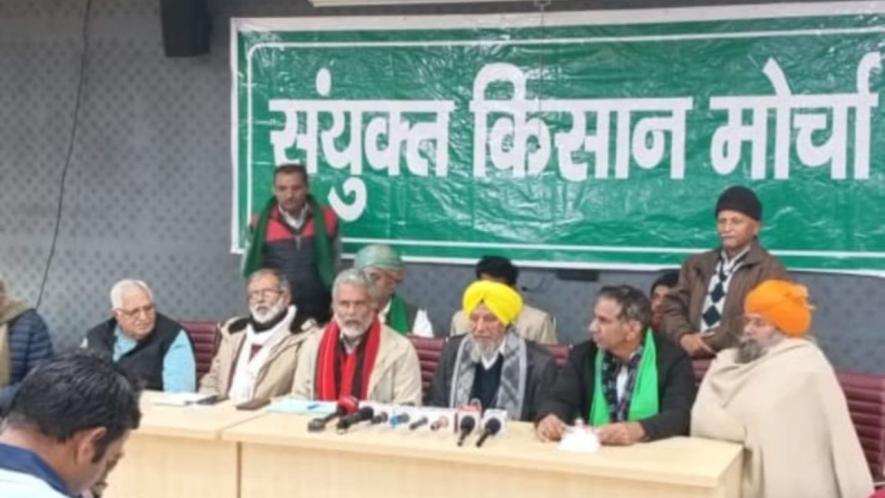
New Delhi: The Samyukta Kisan Morcha (SKM), a collective of farmers unions that spearheaded historic struggle against three farm laws, on Monday called for nationwide successive actions on January 16 January and February 12 in protest against some Central legislations that it terms as “fatal to peasantry and working class.”
Addressing a press conference in the national capital, Joginder Singh Ugrahan, general secretary, Bharatiya Kisan Union Ekta Ugrahan, said that the SKM meeting discussed four pivotal issues that pose serious threats to farmers and the workers -- repealing of MGNREGA with VB-G-RAM-G, the Draft Electricity Amendment Bill, the Draft Seeds Bill and the four Labour Codes.
The farmers’ unions maintain that the latest seeds Bill is aimed at handing over seeds production to the corporate sector and ripping apart the country’s food security.
Addressing the media, Krishna Prasad, finance secretary, All India Kisan Sabha (AIKS), said farmers were being compelled to hit the streets after this government created an alienating environment for them. It brought and passed the Viksit Bharat Guarantee for Rozgar and Ajeevika Mission (Gramin) even when farmers and Opposition MPs demanded further discussion on its implications.
“The latest thing is that the government has come to such a tight spot that the United States has started making threatening interventions in India, violating Indian sovereignty as well. We today passed a resolution warning the government that if you surrender before US pressure, then the entire country will wake up and will fight it, and we will never surrender the rights of the farmers, especially in agriculture and also in the dairy sector," he added.
The AIKS leader said: “The American government is putting pressure on India to open up sectors, like how they opened kapas (cotton). There was a 7% import tax on cotton that has been totally withdrawn. So, the US is demanding there should be no tax for importing milk products and soybean, maize—whatever they are unable to sell in China, they want to dump in the Indian bazaar. We will never allow this. If the government agrees to sign a free trade agreement with the US, that means the government is not with the people of India, not with the farmers of India, not with the workers of India, but with foreign multinational corporations."
SKM Action Plan
The SKM has called for a series of protest actions beginning January 16, to be observed as all-India Resistance Day, supported by trade union platforms. This will be followed by tractor and motorcycle parades on January 26, to mark Republic Day as a day of “democratic assertion.”
On February 12, farmers will join the all-India general strike called by central trade unions, demonstrating “unprecedented worker-peasant unity through mass street protests across every state”.
The Morcha issued a stern warning that any attempt by the government to pass the electricity privatisation Bill—despite its 2021 assurance to consult the SKM before doing so—will be met with immediate nationwide resistance the very next day.
Commenting on the recent free trade agreements with New Zealand, and England, the SKM maintained that these agreements were “instruments of foreign corporate interests, designed to flood Indian markets with imported agricultural products such as milk, soybean, maize, and apples at reduced or zero tariffs.”
It pointed to the devastation already inflicted on cotton farmers, who receive between Rs 5,000 and 6,000 per quintal despite an MSP (minimum support price) requirement of Rs 12,700 under the Swaminathan Commission's C2+50% formula—a promise the current government made but has failed to honour.
Drawing strength from the historic 2020-21 farmers' agitation at the borders of Delhi, Prasad said the movement's power lies not in organisations or leaders but in the ordinary farmers who mobilised from villages with their tractors and sustained the protest for over a year.
“They reminded the government of the electoral consequences it faced in 2024, when its ambitious target of 400 seats was reduced to 240. Looking ahead, we express absolute confidence that this new phase of agitation will surpass all previous movements, rooted in ground-level mobilization, constitutional values, and the unified determination of India's producing classes to protect their rights and livelihoods against corporate capture,” he added.
Commenting on the repeal of the rural job guarantee scheme, MGNREGA, Ashish Mittal, general secretary, All India Kisan Mazdoor Sabha, said: “The Centre committed a massive fraud with MGNREGA. They turned it into a Central Act and dumped all the responsibility on the states. The states don’t have the money, yet they claim loudly that they are making it a guarantee scheme.”
Mittal added that in Uttar Pradesh, the ruling Bharatiya Janata Party (BJP) gave a slogan that “earlier there was corruption, but now there is no corruption in this law.” He alleged that in the past 11 years, the UP government itself had been involved in MGNREGA corruption. “Corruption isn't in the law; it's in the implementation. Many political questions are also being linked to this because they intend to launch a political campaign to mislead people,” he added.
He further added that “similarly, regarding electricity, they are attacking different areas in various districts (in UP). In very small pockets, they are installing smart meters—digital meters. They have announced the end of subsidised electricity. Earlier, domestic users were given electricity at cheaper rates, while those using it for business were charged more to subsidise the others. Now, the plan they’ve made is to privatise everything and have a single rate. Even with a single rate, they’ve introduced the concept of 'peak hour rates'—meaning when demand is high, we will charge more—which is a market-driven policy. This is a basic public facility for which land was taken from farmers across the country to set up coal plants, and dams were built, submerging farmers' lands. When they laid wires for transmission, they went through farmers' fields.”
Referring to the all-India strike call by trade unions, Mittal said: "There is an announcement for an industrial strike on February 12. So, we have decided to mobilise in every district and region in whatever way possible because we will be present there in large numbers to support the workers. Our demands are also included. These three action plans are on this agenda."
Get the latest reports & analysis with people's perspective on Protests, movements & deep analytical videos, discussions of the current affairs in your Telegram app. Subscribe to NewsClick's Telegram channel & get Real-Time updates on stories, as they get published on our website.