





West Bengal: Feb 12 Strike Hits Many Sectors Hard
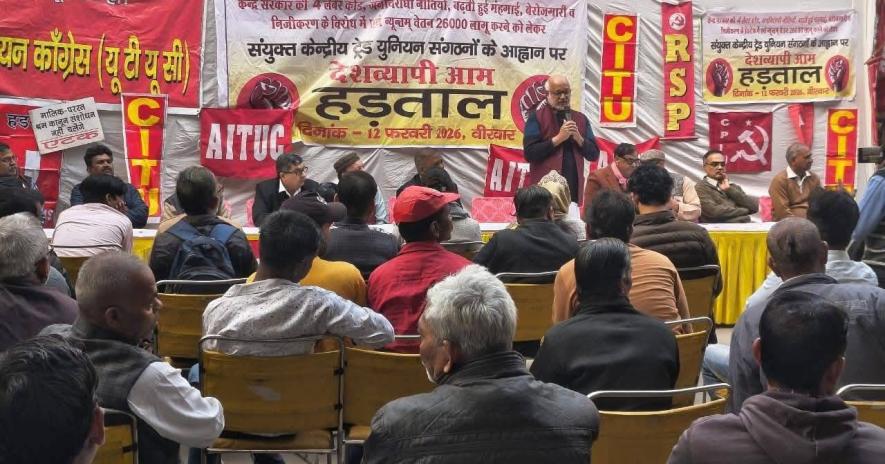
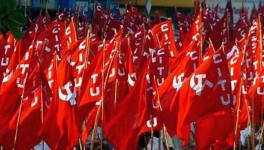
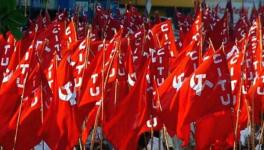
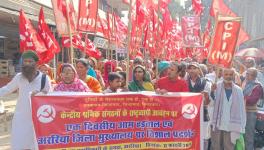
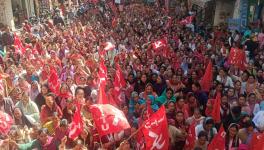
Kolkata: In a state where the ruling party usually plays the role of union buster across sectors, the February 12 general strike called by 10 central trade unions and several independent federations, saw many protest actions, Alongside the working people, farmers, too rallied around the picketeers, largely belonging to the Centre of Indian Trade Unions (CITU) in the rural West Bengal in large numbers. Over 300 rallies were held by the Samyukta Kisan Morcha across the state in support of the strike call.
In West Bengal, the strike was largely industrial. In the tea sector of North Bengal, where the plucking season is now over and a lean period of pruning the trees is being carried out, with 90% of tea workers on annual leave, those there for regular maintenance jobs boycotted work.
In the jute sector, over close to 90% of jute workers joined the strike, picketing before the mill gates in multiple locations, according to CITU sources. In the coal sector, 50% of the coal workers joined the strike, while in the cement industry there was about 40% worker participation, with a 100% strike rate in the Ultratech Cement plant.
The state’s steel sector saw 12% worker participation, but in steel captive mines, the strike was 100 %effective, said CITU sources.
As regards scheme workers, 85% of the Integrated Child Development Scheme or ICDS workers did not join work on Wednesday, while in the banking sector, the strike was near-total, with few State Bank of India branches remaining open.
Union sources also claimed 90% strike efficacy in the insurance sector and 40% in BSNL strike. In DVC (Damodar Valley Corporation), 35% of workers, all contractual, joined the strike, and the construction sector saw 40% worker participation.
In new sectors, such as IT, 35% of the workers joined the strike while 20% of gig workers too struck work despite oppressive steps to deter them.
The wholesale hub of the Burrabazar Posta area wore a deserted look with about 50% mutia mazdoors joining the strike. About 90% of the brick kiln workers joined the strike effectively closing the sector, while 60% of cold storage workers, too, stayed away.
In the logistics sector, 20% of the workers, 5% of the state electricity board workers, 35% of the CESC workers did not join work, CITU sources said.
The strike was total in Birla Textiles, about 60% workers struck work in Texmaco, and 100% in engineering major Bridge and Roof.
The medical and sales sector in West Bengal was completely closed. In the sponge iron factories, over 40% strike rate was reported, while in Kolkata Port, about 50% of workers in the first shift and nearly 100% workers in second shift joined the strike. In Haldia Port 30% strike was reported. About 6,000 picketing points were noted throughout the state and about 100 picketeers were arrested by the state police, the trade union said.
In the evening, transport workers stopped vehicles breigly in the evening and burnt copies of the four labour codes.
Since secondary and higher secondary examinations are on in the state, CITU said that transport workers were asked to carry on their work and join a token strike for 10 minutes on the road in the evening.
The leaders of the 10 central trade congratulated the workers for joining in the strike in large numbers across the state, while admitting that there was “some confusion” about the strike being an industry strike and not a general strike, as in the other states.
Get the latest reports & analysis with people's perspective on Protests, movements & deep analytical videos, discussions of the current affairs in your Telegram app. Subscribe to NewsClick's Telegram channel & get Real-Time updates on stories, as they get published on our website.