





Unravelling The Growth Paradox in India on May Day

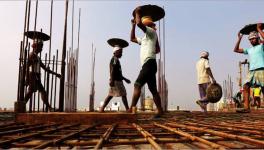
India wears its tale of economic expansion with pride. With GDP growth of 6.5% in 2024 and estimates of 6.8–7% in 2025, the sixth largest economy aspires to become the third largest economy by 2031. Upon closer inspection, however, a startling paradox becomes apparent: about 85% of the workforce is in the unorganized sector, i.e., over 450 million workers work without contracts and security as their fundamental rights, which the rest of the economy takes for granted. These are the hands that construct roads, sew clothing, pour concrete, grow crops, and prepare meals in comfortable homes. The growth story does not even include them as footnotes. The reality is also reflected in ranking of Human Development Index of India, as it ranks 130th among 193 countries at global level. According to the World Inequality Report 2026, India’s richest 10% population controls 65% of all wealth, while the top 1% controls over 40%. Moreover top 10% capture 58% of national income, while the bottom 50% receives just 15%, top 1 % holds 23% income.
Insecurity of Informal Labour: No Contracts, No Rights
About half of India's GDP is generated in the informal sector, and as a conservative estimate, over 80% of all workers do not even have written contracts of work. The data picture thus reveals fundamental reason behind the growing unrest among workers in India, as over 94% of informal workers earn less than Rs. 10,000 per month. When a labourer falls sick, there is no paid leave. When they age, there is no pension. In the absence of any social and economic security, workers are losing their patience amidst growing life expenses as, according to National Health Accounts data, 52% of healthcare expenses in India are paid out of pocket, one of the highest rates in the world, while public health spending accounts for just one-thirty-fifth of GDP (roughly 1.9% of GDP). Only about 12% of India's workforce is covered by any form of social security (EPFO, ESIC, or pension schemes).
The ‘Gendered’ Crisis
The crisis wears a woman’s face. Among informal workers, nearly 90% of women lack any form of job security. Over the last decade, real wage trends reveal brutal discrimination. Salaried women saw real wages fall by 12.5% (from Rs 10,121 to Rs 8,855) between 2017-18 and 2023-24, which is double the decline faced by men (6.4%). The self-employed women experienced a staggering 32% collapse in real wages (Rs 4,348 to just Rs 2,950). Female self-employed earnings even fell in nominal terms, from Rs 5,935 to Rs 5,497. Women are disproportionately concentrated in domestic work, garment export zones, and agricultural piecework, all sectors with no paid leave, no maternity benefits, and frequent wage theft.
Survey data consistently reveals that women workers are least likely to have written contracts, most likely to be paid below minimum wage, and most vulnerable to sexual harassment at workplaces that lack any redressal mechanism. Economic growth that bypasses half its workforce is not growth; it is patriarchal extraction of her labour.
The Caste-based Division of Labour
No analysis of Indian labour is complete without confronting caste. Data from the Periodic Labour Force Survey (PLFS) and National Sample Survey Office (NSSO) paints an unyielding picture. Dalit (Scheduled Caste) workers comprise over 20% of the labour force but hold less than 5% of formal, regular salaried jobs in the private corporate sector. The majority remain confined to manual scavenging (despite a ban), leather work, sanitation, and construction jobs with no contracts or security. Adivasi (Scheduled Tribe) workers face the highest rates of landlessness and bonded labour. Over 70% of Adivasi workers are casual labourers or self-employed in subsistence agriculture, with real wages that have fallen 1.3% annually for a decade. OBC workers, while somewhat better represented, are overwhelmingly in informal self-employment or casual work. Less than 15% of OBC workers have regular salaried jobs with any benefits.
It is noteworthy that Caste and gender intersect lethally in such an oppressive affair. Dalit women earn the lowest average daily wages of any social group, often less than Rs 200 per day in rural India, compared to upper-caste men who earn over Rs 450.
Even when Dalit or Adivasi workers secure formal employment, they face systematic wage discrimination. A 2022 study found that upper-caste workers earn 30-40% more than Dalit workers with identical qualifications in the same industries. The informal sector operates entirely without caste-based legal protections, so upper-caste employers routinely pay lower wages to Dalit and Adivasi workers for the same work.
The protests in Noida, Gurgaon, and Surat are overwhelmingly led by Dalit and OBC workers, who are the majority on factory floors. Their demands for fair wages and 8-hour workdays are also demands for caste justice. The state, however, refuses to see it.
The Wage Collapse: A Lost Decade
Between 2017-2024, the average daily wage for casual workers increased from Rs 294 to Rs 433 reflecting a nominal growth of just 4.3% per annum. When inflation is factored in, real purchasing power has stagnated and, for the bottom 50% of rural workers, declined by 0.8% per year between 2019 and 2024.
But the last decade tells a far grimmer story. Across India, real wage growth has remained virtually flat at just 0.01% annual growth over the last five years. Between 2014 and 2023, real wages for labourers stagnated, and between 2019 and 2024, they declined. It is observed that the real monthly wages of salaried male workers fell 6.4% (Rs 12,665 to Rs 11,858) while real wages of salaried female workers declined by 12.5% (Rs 10,121 to Rs 8,855). It is also declined for self-employed male by 9% (Rs 9,454 to Rs 8,591) and for self-employed female by 32% (Rs 4,348 to Rs 2,950) · In rural areas the average annual pay was just Rs 91,151 reflecting Rs. 7596 per month for informal hired workers. Similarly, the real wages of agricultural labourers declined by 1.3% each year under the current government. Thus, the real earnings of casual daily workers grew from Rs 250 to merely Rs 297 per day.
Further, the employment trends are equally alarming. The share of workers with regular wages dropped from 22.8% (2017-18) to 21.7% (2023-24), while the proportion of self-employed, often a distress category, rose from 52.2% to 58.4%. Agricultural sector absorbed 19% more workers as other sectors failed to generate quality jobs.
‘Profits’ Over ‘People’: The Inhumane Shift
From the same factories where workers are demanding fair wages and an 8-hour day, corporate profits have skyrocketed. Net profits of Indian companies soared almost threefold, from Rs 2.5 trillion in 2020‑21 to Rs 7.1 trillion by 2024‑25 as per a RBI Study. While profits climbed 22.3% in the Financial Year 2024-2025, employment grew by a mere 1.5%, as per a SBI study of 4,000 listed companies. This is not a boom, it is a transfer of wealth from labour to capital, squeezing livelihood of workers.
The global finance capital in terms of gross FDI inflows reached a record $81 billion in FY25, a 14% year-on-year increase. Yet net FDI, the capital that actually stays, plunged 96% to just $353 million, as $51.5 billion left the country as profit repatriation and disinvestment, the highest in a decade. Private equity‑Venture capital investments rebounded 9% to $43 billion in 2024, but foreign institutional investors pulled out over Rs 2.1 lakh crore from Indian equities in 2025 after withdrawing Rs 1.21 lakh crore in 2024. The foreign capital flows in, extracts profits, and flows out, while workers see nothing. Corporate profits are soaring, but none of it reaches the hands of workers that actually built this growth.
The State’s Response: Conspiracy, Not Conscience
The streets of Noida have exposed a deepening crisis. As living costs surged after disruptions in global fuel supply, factory workers protested, with clashes escalating into tear gas use, stone-pelting, and arson. The unrest has spread across Gurgaon, Faridabad, Panipat, Bhiwadi, Barauni, Surat, and Bulandshahr, where workers are demanding fair wages, 8-hour workdays, and basic social security. Rising prices, especially of cooking gas (LPG), which saw a price increase of over 25% in 2023-24 have become the tipping point for long-standing issues. Retail inflation in food items hovered around 7-8% for much of 2024.
In response, the state has viewed this not as a conscience but as a conspiracy. Legitimate protests have been presented by the federal and state governments as law-and-order issues, prompting police action, the arrest of union leaders, and the prosecution of individuals for allegedly inciting workers. However, employees don't need to be provoked. They have the right to demonstrate against abhorrent working conditions and pitifully inadequate pay.
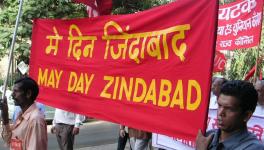
History won't label those who were arrested as criminals including the organizers, domestic assistants, and factory floor workers who spoke up against the exploitation and harassment. The Haymarket martyrs of 1886 were similarly detained, suppressed, and referred to as troublemakers. And it's exactly because of them that May Day exists.
What Labour Day Demands
A worker cannot have decent livelihood if they cannot afford gas to cook, borrow money for health expenditure because they do not have an ESI card, or save nothing because they do not have a provident fund. An economy that suppresses the purchasing power of its largest demographic, where over 90% of the labour force (over 500 million people) earns less than Rs 10,000 per month cannot claim to have achieved inclusive growth and development. The market ignores them as workers. It then punishes them as workers.
On this Labour Day, as we salute the workers who built every road we drive on, every building we occupy, every garment we wear, the salute must mean something beyond a social media post and a public holiday. An urgent need of five progressive labour reforms with an active role of welfare state to ensure descent employment and livelihood conditions of the Indian workers on the occasion of May Day:
(1) Recognizing that social security is not charity, it is the right of every worker who contributes to national output. (2) Enforcing written contracts for all, because 80% without contracts is not a statistic, it is a scandal. (3) Universal social protection, which currently covers barely one in eight workers. (4) Caste and gender audits of every enterprise in public and private sectors (including foreign firms/companies).
(5) A statutory living wage that accounts for inflation, not a minimum wage that keeps workers poor.
In conclusion on this May Day, the question is not why the workers have come to the streets rather why it took this long, and what we are willing to change so they do not have to come back.
Trishna Sarkar & Narender Thakur are at Department of Economics, Dr. Bhim Rao Ambedkar College, University of Delhi. Views are personal
Get the latest reports & analysis with people's perspective on Protests, movements & deep analytical videos, discussions of the current affairs in your Telegram app. Subscribe to NewsClick's Telegram channel & get Real-Time updates on stories, as they get published on our website.