






Rajesh Exports: India’s Global Gold Giant Under Citizen Scrutiny
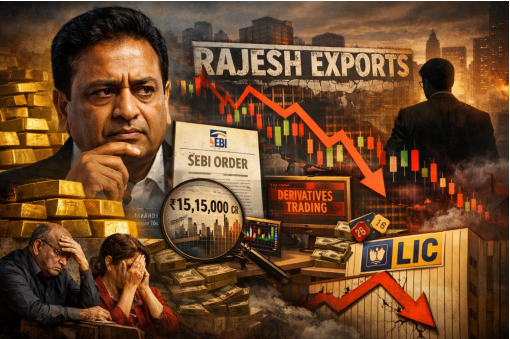
On June 3, 2026, the Securities and Exchange Board of India (SEBI) issued its interim order that shook the foundations of Rajesh Exports — India’s listed jewellery giant and global gold refiner through its Swiss arm, Valcambi SA. The order alleged that the company had inflated revenues of ₹15.15 lakh crore, misrepresented subsidiary accounts, and blurred the line between corporate capital and promoter speculation.
The very next day, June 4, the market delivered its verdict: Rajesh Exports’ shares hit the 5% lower circuit, trapping retail investors and eroding citizen savings. Public sector LIC, holding a 10.8% stake, saw policyholder wealth erode by an estimated ₹300 crore as the collapse unfolded. What had long been hidden in balance sheets and audit reports suddenly became visible in red arrows on trading screens.
This article is not an opinion. It is an attempt at investigative inquiry built on verifiable records: SEBI’s filings, National Financing Reporting Authority or NFRA’s probe, shareholding disclosures, and banking risk frameworks. Each section dissects the mechanics of misrepresentation — from Valcambi’s negligible standalone revenues versus inflated consolidated accounts, to ₹11,487 crore in promoter derivative trades recorded as company sales, to Canara Bank’s ₹509 crore distressed loan now on auction.
The forensic lens reveals how governance failures cascade: auditors endorse illusions, regulators delay, banks misallocate credit, and institutions, such as LIC, absorb risks that mutual funds avoided. The result is systemic fragility borne by citizens — retail investors trapped in lower circuits, policyholders losing wealth, and taxpayers absorbing hidden banking losses.
Rajesh Exports has rebutted SEBI’s findings, telling Indian Express that the regulator had confused consolidated revenue with EBITDA of Valcambi SA, a Swiss subsidiary, and that the matter was a ‘communication gap.
Under accounting standards, revenue refers to gross inflows from ordinary activities, while EBITDA measures earnings before interest, tax, depreciation, and amortisation. This difference matters greatly — confusing revenue with EBITDA can exaggerate the scale and distort perception. SEBI’s interim order, however, alleged misrepresentation of subsidiary accounts, making this a contested issue still under examination.
This scandal is, therefore, framed from a citizen’s perspective, asking:
- Whose failures led to this erosion of wealth?
- Why did SEBI take so long to act?
- Which banks financed this empire, and what risks remain hidden?
- What reforms are needed so that citizens are not left paying the price again?
The matter remains under probe. SEBI’s interim order is under further examination, NFRA has initiated its probe, and Rajesh Exports has publicly contested the findings. As investigations proceed, more facts may emerge — but the citizen’s lens already reveals systemic cracks that demand accountability.
The Revenue Mirage
At the core of SEBI’s interim order lies a staggering figure: ₹15.15 lakh crore, reported as consolidated revenue by Rajesh Exports. Regulators, however, found a mirage — numbers that shimmered with scale but concealed a troubling mismatch.
Rajesh Exports is not a simple jewellery manufacturer. Its Indian identity is a listed company headquartered in Bengaluru, operating domestic manufacturing and retail through Shubh Jewellers. Its global identity is anchored in Switzerland, where Valcambi SA refines nearly a third of the world’s gold.
On paper, the Indian entity consolidates Valcambi’s operations, presenting itself as a vertically integrated giant spanning refining, manufacturing, wholesale, and retail. In practice, however, the subsidiary accounts tell a different story — Valcambi’s standalone revenues are negligible compared with the massive figures Rajesh Exports reports in India. This dual constitution — Indian listed company vs. Swiss refining arm — is the source of both scale and confusion.
Inflated Revenues
-
SEBI’s probe revealed that 97–99% of consolidated revenues were attributed to overseas subsidiaries, primarily Valcambi SA.
- Yet Valcambi’s standalone accounts showed negligible revenues, far removed from the massive figures reported in consolidation.
- The mismatch suggested that Rajesh Exports was inflating its top line, projecting scale and stability that did not exist.
By presenting inflated revenues, Rajesh Exports is said to have created the impression of being a global behemoth controlling a third of the world’s gold flows. This illusion reassured investors, lenders, and institutions — masking weak cash flows and misrouted funds.
For citizens, the impact was direct: trust in numbers translated into investment decisions, exposing them to hidden risks. On paper, Rajesh Exports’ reported revenues of $82 billion in FY26 appeared to rival nearly one-third of India’s IT exports. In reality, GDP (gross domestic product) is measured by value added, not gross turnover. Inflated figures distorted perceptions of India’s economic strength rather than its actual output.
Revenue vs EBITDA: The Distinction
Imagine a shopkeeper who proudly tells customers, “I sold ₹10 lakh worth of goods this month.” That’s revenue — the total inflow from sales. But when asked how much he actually earned after paying suppliers, rent, and wages, the figure shrinks to ₹1 lakh. That smaller number is closer to EBITDA — a measure of operating profit.
Confusing the two is like mistaking the shop’s turnover for its takehome earnings. It makes the business look far larger and stronger than it really is.
Rajesh Exports has rebutted SEBI’s findings by claiming the regulator mixed up these categories. SEBI’s interim order, however, went further — alleging misrepresentation of subsidiary accounts, making this not just a definitional debate but a contested issue under active scrutiny.
Misclassification Defence: Buying Time, Avoiding Fraud
Rajesh Exports’ argument does not correct the inflated revenue mismatch. The Swiss subsidiary’s negligible turnover remains unexplained. What the company’s defence does achieve is strategic reframing:
- It buys time, turning the charge into a technical dispute.
- It avoids the fraud label, suggesting misunderstanding rather than deliberate inflation.
- It shifts the burden of proof back onto SEBI, delaying reputational and regulatory fallout.
SEBI’s Findings
-
The regulator concluded that Rajesh Exports misrepresented subsidiary accounts, failing to disclose accurate financials.
- The order highlighted noncooperation in forensic audits and incomplete records, delaying regulatory action.
- SEBI’s language underscored the seriousness: disclosures were allegedly misleading to investors and the market at large.
For ordinary investors, numbers are the only window into a company’s health. When those numbers are inflated, the window becomes a mirror — reflecting back illusions instead of reality. Rajesh Exports’ revenue mirage was not just a technical discrepancy; it was a breach of trust that left citizens exposed to losses they could neither foresee nor prevent.
Promoter Derivatives Trading
If inflated revenues created the illusion of scale, SEBI’s interim order revealed something more troubling: promoter speculation allegedly disguised as corporate activity. The regulator alleged that Rajesh Exports’ promoters blurred the line between company funds and personal trading, exposing shareholders to risks they never consented to.
Alleged Diversion of Funds
-
SEBI identified transactions amounting to ₹926 crore routed through promoter accounts.
- More significantly, the order noted ₹11,487 crore in personal derivative trades by Rajesh Mehta, recorded as company sales.
- These trades suggested that company resources were allegedly used to back speculative bets, inflating revenues while concealing risk.
Promoters appeared to treat the listed entity as an extension of their personal trading desk. This undermines the principle of fiduciary responsibility — that promoters must act in the interest of all shareholders. For citizens, this meant their savings were exposed to speculative losses without disclosure or consent.
The regulator noted that such practices misrepresented the company’s financial position. By recording personal trades as corporate transactions, Rajesh Exports allegedly distorted its books and misled investors. SEBI’s language underscored the seriousness: this was not a clerical error, but a breach of governance norms.
From a banking perspective, such practices distort credit appraisal models. When lenders assess repayment capacity, they rely on reported revenues and cash flows. If those figures are inflated by speculative trades:
- Risk weights assigned to loans are understated.
- Provisioning requirements under the Expected Credit Loss (ECL) framework are delayed.
- Ultimately, depositors and taxpayers absorb the hidden losses when defaults surface.
For ordinary investors, promoter speculation translates into hidden risk. Citizens buy shares expecting growth from jewellery sales and gold refining, not exposure to derivatives trading. When promoters gamble with shareholder capital, the losses are borne by policyholders, retail investors, and pension funds — those least equipped to absorb them.
Auditor Accountability and Regulatory Delay
If promoters speculated with shareholder capital, the question is: who signed off on the books, and why did regulators wait so long to act? The answer lies with both the auditors — the gatekeepers of financial truth — and SEBI, whose delayed intervention allowed losses to accumulate.
Rajesh Exports’ auditors certified consolidated accounts showing ₹15.15 lakh crore in revenues, despite glaring mismatches with subsidiary statements. Valcambi SA, the Swiss refining arm, reported negligible standalone revenues, yet consolidated figures ballooned. No red flags were raised, no qualifications inserted. By signing off, the auditors gave legitimacy to numbers that reportedly misled investors, lenders, and regulators alike — now under scrutiny in an NFRA probe notice.
The silence of the auditors was compounded by regulatory inertia. A shareholder complaint was lodged with SEBI in March 2024, as reported by Business Standard newspaper, highlighting receivables outstanding for over two years. Yet SEBI’s interim order came only in June 2026 — more than two years later. This gap is not procedural neutrality; it is regulatory delay. By acting late, SEBI allowed losses to accumulate and confidence to erode.
The NFRA has now stepped in to examine these lapses. Its mandate is to enforce stricter standards and penalise negligence. This case could become a test of whether NFRA can hold auditors accountable in highprofile corporate scandals, and whether audit silence will finally carry consequences.
For citizens, auditors and regulators are the unseen guardians of trust. When they fail, the consequences are not abstract — they are measured in lost savings, trapped investments, and shaken confidence. Audit silence and regulatory delay together magnified the damage.
From a banking perspective, misrepresentation cascaded into the credit system. When auditors endorse inflated revenues and regulators delay intervention, banks misjudge repayment capacity, underprovision for defaults, and ultimately pass losses onto depositors and taxpayers. Accountability, therefore, lies not only with auditors but also with regulators who failed to act in time.
Citizen Loss Through Shares
The collapse of Rajesh Exports was not confined to balance sheets — it struck directly at citizen wealth. On June 5, 2026, the company’s shares hit the 5% lower circuit at ₹103.92, down from ₹109.38 the previous day, according to National Stock Exchange (NSE) data. From a 52‑week high of ₹237.88 — and an all‑time peak of ₹1,029 in 2023 — the fall represents a 90% erosion of value.
Wealth Erosion in Numbers
-
LIC’s exposure: Holding a 10.8% stake, LIC’s passive stewardship compounded citizen losses
- Mutual funds: Avoided Rajesh Exports for over a decade, citing governance concerns.
- FIIs: Reduced holdings from 17.6% in March 2023 to 14.2% in March 2026.
- Retail investors: ~1.94 lakh shareholders trapped in the lower circuit, unable to exit.
- Total public wealth erosion: SEBI estimates ~₹12,725 crore lost since 2023.
Circuit Breaker Trap
The lower circuit mechanism, designed to prevent panic selling, became a cage. With only sell orders and no buyers, retail investors were frozen into losses. For citizens, this safeguard offered no protection — it symbolised helplessness in the face of systemic failure.
Complaints about receivables were lodged with SEBI in March 2024, yet the interim order came only in June 2026. This delay meant investors continued trading under false impressions for two years. By acting late, SEBI allowed losses to deepen and confidence to collapse.
For citizens, the scandal was not about accounting definitions or corporate structures. It was about real money lost in real time. Savings diminished, policyholder wealth eroded, and trust in financial governance broken.
From a banking perspective, the circuit breaker episode shows how market safeguards can fail in practice. Mechanisms designed to protect investors instead locked them into losses, proving that regulatory tools must be tested against the lived reality of citizen investors, not just in theory.
Responsibility Framework
The Rajesh Exports scandal is not the failure of one company alone. It is the failure of an ecosystem — promoters, auditors, regulators, banks, and institutions — each with a duty, each with a lapse.
Promoters: Allegedly inflated revenues and blurred corporate boundaries, diverting shareholder capital into personal derivative trades. Citizens’ savings were exposed to risks they never consented to.
Auditors: Certified consolidated accounts showing ₹15.15 lakh crore in revenues, despite glaring mismatches with subsidiary statements. Their silence legitimised misrepresentation and magnified losses.
Regulators: SEBI received complaints in March 2024, but issued its interim order only in June 2026. This delay is not procedural neutrality — it is regulatory inertia. By acting late, SEBI allowed losses to accumulate and confidence to erode.
NFRA has now stepped in, but accountability must extend to regulators themselves. Audit silence unchecked for years is a regulatory lapse as much as an audit failure.
Banks lent against illusions. Canara Bank’s ₹509 crore distressed loan is evidence of how inflated revenues distorted credit appraisal models. Once exposures sour, depositors and taxpayers absorb the hidden risks.
LIC and Institutions
LIC quintupled its stake to 10.8%, even as mutual funds avoided Rajesh Exports for over a decade. Fiduciary duty was compromised by passive stewardship, resulting in compounded citizen losses.
Each lapse compounded the others, leaving ordinary citizens — retail investors, policyholders, and depositors — to bear the brunt. Accountability must, therefore, be collective, not selective.
From a banking perspective, this scandal illustrates how misrepresentation cascades through the financial system: inflated revenues mislead auditors, auditors mislead regulators, regulators delay, banks misallocate credit, and institutions remain passive. The result is systemic fragility, borne by citizens who trusted the safeguards meant to protect them.
The Reform Mandate
Reform is not optional; it is the only way to restore trust. The Rajesh Exports scandal has shown that when every safeguard fails — promoters speculate, auditors stay silent, banks lend recklessly, regulators delay, and institutions remain passive — citizens pay the price. Each actor in this chain must now carry a clear mandate: to act faster, disclose more, and protect public wealth before losses accumulate.
- SEBI: Move from reactive to proactive. Complaints filed in March 2024 should not have taken until June 2026 to trigger an interim order. The two‑year delay was regulatory inertia that magnified citizen losses.
- NFRA: Enforce accountability. Audit silence must invite penalties, not pass unchecked. This case is a test of whether NFRA can hold auditors accountable in highprofile scandals.
- Banks: Lend with discipline. Inflated revenues cannot justify credit. Credit appraisal models must be stresstested against forensic audits, shielding depositors and taxpayers from hidden risks.
- LIC and institutions: Guard citizen wealth actively. Stewardship means vigilance, not passive absorption of losses. LIC’s decision to quintuple its stake while mutual funds avoided Rajesh Exports raises questions of fiduciary responsibility.
- Citizens: Demand transparency. Simplified audit summaries and investor education can empower individuals to spot red flags early, reducing dependence on delayed regulatory action.
Reform must be tested not in theory but in practice — against the hidden exposures that ripple through India’s banking system. While probes are on, the citizen’s verdict is already clear — without systemic accountability, scandals will recur, eroding not just wealth but confidence in the institutions meant to safeguard it.
The Bank Finance Gambit
The scandal did not stop at shareholders. Inflated revenues and misrepresented accounts also misled lenders, pulling banks into the vortex. When banks lend against illusions, the eventual losses ripple through the financial system, burdening depositors and taxpayers.
In May 2026, Canara Bank invited bids to sell a stressed corporate loan of ₹509.37 crore to Rajesh Exports. The bank is the sole lender to the company and has already filed a bankruptcy petition, awaiting NCLT’s directions. The sale process is being conducted through the Swiss Challenge Method, with BOB Capital Markets as the process advisor.
This was not a routine working capital facility — it was a distressed debt exposure, reflecting repayment capacity that was no longer trusted. For citizens, this was not just a corporate default; it was a reminder that public sector banks carry risks that can spill into the wider economy.
Unlike typical large corporates, Rajesh Exports did not have a consortium of lenders. Canara Bank alone carried the exposure, magnifying its risk. Yet the broader lesson remains: inflated revenues reassured lenders, masking weak cash flows. When one bank misjudges, the systemic tremors are absorbed by depositors and taxpayers.
Banking Expertise Lens
From a governance perspective, this episode illustrates how misrepresentation distorts the credit system:
- Risk weights under Basel norms are understated when inflated revenues are accepted at face value.
- Provisioning rules under the Expected Credit Loss (ECL) framework are delayed, leaving balance sheets vulnerable.
- Capital adequacy ratios appear stronger than they are, masking systemic fragility.
Ultimately, bank losses are rarely contained within boardrooms. They are absorbed through higher provisioning, reduced lending capacity, or taxpayerfunded bailouts. Citizens thus pay twice: once as shareholders losing wealth, and again as depositors or taxpayers carrying the hidden burden of reckless lending.
The bank finance gambit shows how corporate misrepresentation cascades into the credit system. When lenders fail to question inflated numbers, they expose not just their balance sheets but the entire public to hidden risks. For citizens, the scandal is not only about lost investments — it is about the fragility of institutions meant to safeguard their money.
Citizen’s Verdict
The Rajesh Exports scandal is more than a corporate misstep; it is a mirror reflecting systemic fragility. Promoters allegedly speculated with shareholder capital, auditors signed off on inflated accounts, regulators delayed despite early complaints, banks lent against illusions, and institutions like LIC absorbed risks that mutual funds had long avoided. Each lapse compounded the others, leaving citizens to pay the price.
For retail investors, the collapse was immediate — trapped in lower circuits and watching savings vanish. For policyholders, LIC’s exposure compounded losses. For depositors and taxpayers, Canara Bank’s ₹509 crore distressed loan showed how misrepresentation cascaded into the credit system.
The citizen’s verdict is clear: when governance fails, citizens always pay first.
This remains a developing story. More facts may emerge, but the lessons are already visible. Without systemic accountability — across promoters, auditors, regulators, banks, and institutions — scandals will recur, eroding not just wealth but confidence in the very safeguards meant to protect it.
The writer is a CAIIB (Certified Associate of the Indian Institute of Banking and Finance), has 37 years of work experience in the private sector and in a nationalised bank, and is the ex-All India Deputy General Secretary of the All India Bank Officers’ Confederation.
Get the latest reports & analysis with people's perspective on Protests, movements & deep analytical videos, discussions of the current affairs in your Telegram app. Subscribe to NewsClick's Telegram channel & get Real-Time updates on stories, as they get published on our website.