





Purity, Power, Rebellion: Women in Web of Brahmanical Patriarchy
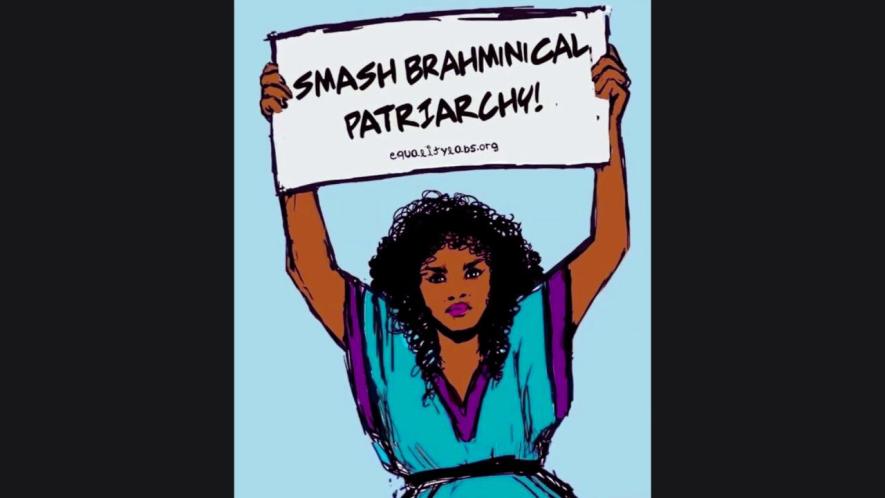
File Image
In the mid-1850s, in the open verandahs of homes in Buldhana, Maharashtra, a woman named Tarabai Shinde wrote fiercely against brahminical patriarchy in her book, Stree Purush Tulana. How did she gain the leisure and freedom to write at a time when women were barely allowed to express their opinions? Well, Shinde was taught to read and write by her father and followed a matrilocal marriage system, which was ahead of her time.
Fast forward to mid-February 2027, a social media influencer woman of the 21st century stands in the midst of a crowd in Delhi University campus, surrounded by people shouting “Brahmanvad Zindabad.”
What is the connection between these two events? It’s that this woman was supporting the very system that Tarabai Shinde was targeting—a system of defiance and endorsement. This forces us to confront the uncomfortable reality that social systems don’t persist solely due to external enforcement; these endure because these are internalised, reproduced, and sometimes defended by those who are disadvantaged by them.
Feminism has evolved over the years and has included intersectionality. However, what still remains inadequately addressed in popular conversations is the intersectionality of caste and gender. While women across communities face oppression, caste profoundly shapes the intensity and nature of that oppression.
The centuries of struggle and contributions of figures like Savitribai Phule and Jyotirao Phule, who championed women’s education and attacked Brahmanical dominance, laid the groundwork for social transformation. Pandita Ramabai exposed the plight of high-caste widows, while Fatima Sheikh worked to expand access to education for marginalised communities.
Most powerfully, B.R. Ambedkar provided a structural analysis of caste that revealed how deeply gender was embedded within it. Even though we are almost equal on paper, society in the 21st century still depicts a not-so-clear picture of equality.
Dalit women still remain the most oppressed among the oppressed with gender-based violence in the form of sexual exploitation, abuse, and harassment by those from oppressor castes and by those within their communities. However, since caste, patriarchy, and gender power relations prevail in India, Dalit women and girls are predominantly targeted by men belonging to the oppressor caste.
Often, these caste-driven atrocities are perceived as a message to dehumanise Dalit women and teach a lesson to the entire Dalit community. As a result, the already entrenched narrative that women must remain subservient to the caste-assigned conduct and norms is further reinforced subtly and overtly by society.
But what interesting is women under Brahminism are oppressed among the dominants. Well, let us first look at what Manu has to say; Manusmriti, which gives legitimacy to the varna system, making it an enclosed system, keeping brahmins at the top of the hierarchy, has not been tender even on upper caste women. He claims all women to actually be shudras.
For Manusmriti, it is the nature of women to seduce men and for that reason the wise are never unguarded in the company of females. When creating women (mind you, women of all castes), Manu allotted to women a love of their bed, of their seat and of ornament, impure desires, wrath, dishonesty, malice, and bad conduct.
Manu claims that in childhood, a female must be a subject to her father, in youth to her husband, when her lord is dead, to her sons; a woman must never be independent. Wife, a son, and a slave, these three are declared to have no property; the wealth which they earn is acquired, for him, to whom they belong.
When she becomes a widow, Manu allows a woman her maintenance, never allows her to have any dominion over property. A woman under the laws of Manu is subject to corporal punishment and Manu allows the husband the right to beat his wife. “A wife, a son, a slave, a pupil and a younger brother of full blood, who have committed faults, may be beaten with a rope or a split bamboo”. In other matters, women were reduced by Manu to the same position as the Shudra.
A rebel against this, Tarabai Shinde opposed Manusmriti's guidelines that placed women under the total control of fathers, husbands, and sons at different stages of life, robbing them of their agency. Perhaps, her book, Stree Purush Tulana was a reaction to a newspaper article in Pune Vaibhav, an orthodox newspaper that supported the caste and gender system. The article was written attacking a young brahmin widow Vijayalakshmi, who was sentenced for execution for aborting her illegitimate child fearing public disgrace and ostracism. She fiercely condemned brahmin practices against widows, who faced severe restrictions while men were allowed to remarry.
Rejecting the idea of streedharma, Shinde rejected the idea of pativrata, which made women unpaid slaves of men. She termed this a disease that had affected all castes and religions but was particularly deeply ingrained in Brahminism.
In many Shudra and lower-caste communities, widow remarriage was allowed, women were not forced into extreme austerity and could rebuild their lives. Lower-caste women worked in fields, participated in labour, earned wages, moved more freely in public spaces, giving them slight financial and social freedom.
Coming to the contemporary times, while walking around my village, a lady told me to inform someone that she would not attend a function because she was “touched by a crow.” I had no idea and didn’t bother asking her the meaning behind it. After some years, I was told by some of my peers that in many orthodox households, women were not allowed in the kitchen or even get their shadow near the praying room in their own home while having periods. Even centuries later, we still succumb to the idea of purity and pollution. In many of the South Indian households, women are not allowed to even touch another person during her periods, and are forbidden from attending any religious functions, no matter how big or small.
These practices have spread across all castes over a period of time, largely due to the interpretation of Brahmanical practices to gain better social positioning.
Lower caste women in the 18th and 19th century were actually allowed to remarry. But a brahmin widow would either remain celibate her whole life after her husband’s death or marry her brother-in-law to keep the women within caste boundaries.
According to Mahatma Phule, these practices were later adopted by some communities like sonars or jewellers of Konkan or Maharashtra, who started forbidding their women from remarrying, started imitating rituals of the sacred thread and called themselves Daivadnya Brahman in the hope of gaining higher status in the society. Thus, brahminical patriarchy was spread across castes, upper or lower, imitating those who were considered superior in order to gain their respect.
Historian Uma Chakravarti specifically mentions how “women were the crucial elements for maintaining the boundaries of these closed groups. The purity of women is essential for maintaining the purity of the caste group and therefore women’s sexuality is strictly channelized into the acceptable institutions of marriage and motherhood; wherein both, caste purity is maintained and patrilineal succession is ensured. If these traditional structures break down and miscegeny (the mixing of castes) takes place, the brahminical texts view this to be Kaliyuga, a period of great moral degradation characterized by broken families, corrupt women and mixing of castes.”
To prevent this from occurring, women’s subordination was institutionalised in a variety of ways. On one hand, coercion was exercised by her family, the state and religious authorities. On the other hand, an ideology of consent was propagated. This included spreading ideas such as pativrata or the chaste wife and women’s duty to their husbands (streedharma) as opposed to giving in to their innate nature (streeswabhava) which was promiscuous and fickle minded.
By creating an ideological hegemony of consent, brahminical patriarchy could ensure that women remained closely guarded and therefore maintain the caste system. If we were to say ‘brahmanvad zindabad’ as a women, we would have to do it in our heads, sitting behind four walls of our houses while washing our husband’s dirty dinner dishes.
The fact that women in India and across the world get to have a stand or an opinion is courtesy to figures who fought against religious or caste orthodoxy, maybe against the unequal legality of state laws, against witch hunt or against the societal dominance of a particular gender or suppression of those specifically under one caste or community.
Women have been used as tools to maintain this rigid hierarchy. Ambedkar gave an argument on how the caste system is actually engineered and controlled through control over women. Child marriage was introduced to prevent women from choosing partners freely. If girls were married before puberty, they would not develop independent choice, their sexuality would be controlled and caste boundaries would remain intact. Thus, child marriage was not a mere baseless tradition but a structural tool of caste enforcement.
Ambedkar discusses practices like Sati (burning women on the pyres of their dead husbands) or forced widow celibacy as methods of dealing with “surplus women.” If widows exist and cannot remarry within caste, they threatened caste endogamy. Therefore, society either eliminated them physically (sati), or eliminated them socially (lifelong widowhood).
Women thus suffered doubly: first as members of a particular caste, and second as women within patriarchal households. Before you think of feminists ideas promoting Westernised narrative, acknowledging that some of the very anti-feminist ideas have actually been borrowed by the West, like adopting surnames of men after marriage. During World War 1, men in the armies had to adopt a surname for pension benefits post which the British started addressing even women with their husband’s last name. This simultaneously also became a legitimate indication of caste, eventually becoming normalised across the subcontinent. So, rejecting to take up husband’s name would actually be going back to traditions instead of defying it.
As the society progresses and we still strive for cliched equal opportunities, we still somewhere see the one’s people have fought for and continue to fight over centuries, giving slogans supporting the very system that had oppressed them.
Patriarchy does not only continue with the commands of the patriarch but rather through continuing endurance of those commands by women who have not given in to this mindset. The change and progress, though somewhat achieved, needs a complete change in the mindset, because a system so deeply engraved can only be changed by changing one’s mindset.
The writer is a post-graduate student in Political Science at University of Delhi. The views are personal.
Get the latest reports & analysis with people's perspective on Protests, movements & deep analytical videos, discussions of the current affairs in your Telegram app. Subscribe to NewsClick's Telegram channel & get Real-Time updates on stories, as they get published on our website.