





Sharia, Manusmriti or Indian Constitution?
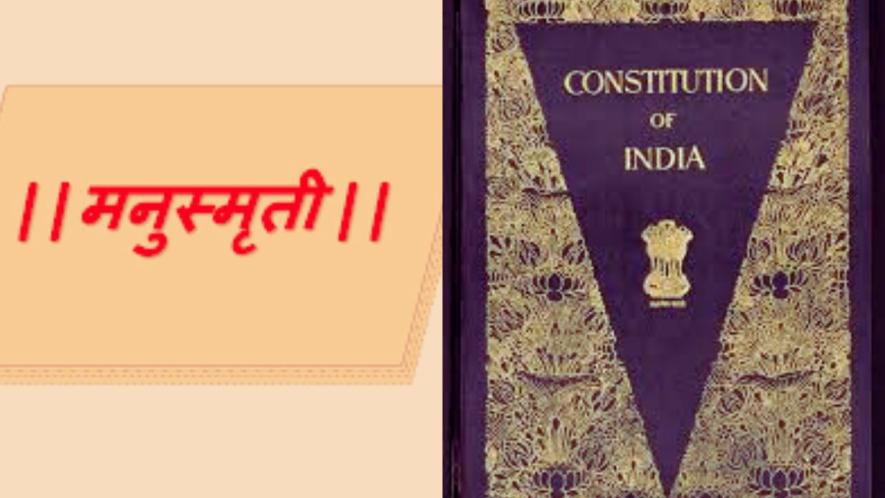
The Indian Constitution has been the outcome of the values which emerged during our freedom struggle. The Constituent Assembly, broadly a representative of India, formulated the Indian Constitution, which is the guide to our national life. The Constitution calls for democratic society based on ‘Liberty, Equality, Fraternity and Social Justice.’
There was a section of political opinion mainly formed by conservative Hindus and those arguing that India should become a Hindu nation; who opposed it right from the start. The leaders of Hindu nationalist politics, supported by the conservative sections of society’s opinion; articulated by an article in Organiser, the RSS mouthpiece, which opposed the Indian Constitution; saying that there is nothing Indian about it and it will not be accepted by the Hindus. Savarkar, went on to say that Manusmriti is the Constitution today. In this spirit, Swami Avimukteshwaranand recently stated that Manusmriti is above the Indian Constitution.
This stream is not the only one to undermine the Constitution and showing the primacy of the ‘word of God’ or sacred scriptures. Maulana Mufti Shamail Nadwi has made a similar statement. This Maulana has come to prominence in the past few days after his debate with poet Javed Akhtar on “Does God Exist”.
In a viral clip, the Mufti asserts that “Muslims erred by accepting secularism and the supremacy of national institutions over Shariah, criticizing democracy and the notion of placing the nation (desh) above religion. He questions whether believers should passively accept court verdicts conflicting with Islamic law. These statements, while presented as theological opinions, have been interpreted by critics as undermining India's constitutional secularism and promoting religious supremacy.”
While Manusmriti is a compilation representing the values of Brahmanism, the dominant stream within Hinduism, Sharia is based on multiple things. Sharia (Arabic: the path) is the Islamic legal-ethical system derived from:
“Qur’an, Hadith (sayings/actions of Prophet Muhammad), Ijma (consensus of scholars) and Qiyas (analogy)”. It guides personal conduct and law, not just punishments. In practice, Sharia is interpreted through schools of jurisprudence (Sunni: Hanafi, Shafi‘i, Maliki, Hanbali; Shia: Ja‘fari), so there is a diversity within the legal system of Sharia.
Out of the nearly 55 Muslim majority countries, Sharia shapes the laws etc. only in Saudi Arabia, Iran and Afghanistan fully. Partly, it is implemented in a few other Muslim majority countries. In India, it forms a base in matters of Muslim personal laws only.
So, what does one do with the changing times and social patterns, which have occurred over a period of centuries when these laws were devised. Those doing politics in the name of religion in India harp on bringing in Manusmriti. In many Muslim countries, Sharia is not implemented or implemented only in part.
Can Sharia be above the Constitution, as the Mufti claims? Legal luminary Faizan Mustafa in a video argues that in every country, the Constitution is supreme. The Constitution does consider Sharia in many countries and integrates some aspects of that in their Constitutions.
So, what is the status of democratic institutions in Muslim majority countries? There are different degrees of ‘democracy’ in these countries. At the moment many social sites are criticising the Mufti for encouraging Muslims not to follow the Constitution, which is an anti-patriotic act. On the other hand, many are praising him for upholding the Sharia. It is interesting to note that during the medieval period of Indian history, the Muslim Kings did not make Sharia obligatory for the state.
While Mufti Shamail has one opinion, there are others like Asghar Ali Engineer, a foremost scholar of Islam in India, who have a different idea about the role of Sharia vis-a-vis the Constitution. Engineer harps on Shura (mutual consultation) to argue that democracy and related principles are possible in the contemporary world. He says a Quranic concept – and modern-day representative democracy – merely a human concept, may not be exactly similar. However, “the spirit of modern democracy and the Qur’anic injunction to consult people is the same”.
As per Engineer, “New institutions keep on developing and human beings, depending on their worldly experiences, keep on changing and refining these institutions. And in the contemporary world, the concept of Shura should mean democratic process and constitution of proper democratic institutions of which elections are a necessary requirement.”
The Qur’anic text not only gives the concept of Shura (democratic consultation) but “does not support even remotely any concept of dictatorship or authoritarianism”.
In India’s freedom struggle, which was based on democratic principles and aimed at democratic institutions; a very tall Islamic scholar, Maulana Abul Kalam Azad, and a dedicated Muslim leader, Khan Abdul Gaffar Khan (to name the few), strove for the values and institutions of a democratic secular country.
Just a few years ago, Muslim women, through the Shaheen Bagh movement, demonstrated their democratic strength in protecting the community from the fear of disenfranchisement.
What is needed in contemporary times? In India, Muslims, who are being targeted by Hindutva politics, have become a besieged community. Conservatism among the Muslim community is, therefore, rising. The major issue confronting them is to save their rights as citizens using modern institutions.
Even in Islam, there are various streams of laws and systems of jurisprudence. Since this is part of Sharia, in that case what Sharia recommends will be another contentious issue. Since Muslims are a minority in this country, they already have personal laws, which are again being opposed.
Today, the Hindu Right-wing is the dominant retrograde tendency trying to bring to the fore the values of Manusmriti. Such assertions, which want to promote inequality in the garb of religion, are not welcome. We need to also look to some European countries where religion is on the backfoot.
We are living in contradictory times. On the one hand, human society has developed the principles of dignity and equality, as represented in the United Nations charter, and on the other, the religious Right-wing has become stronger in the past few decades.
While the Mufti is knowledgeable in the concepts of Islam, the need to accept the trends of contemporary society and values of democratic institutions is also necessary.
The writer is a human rights activist, who taught at IIT Bombay. The views are personal.
Get the latest reports & analysis with people's perspective on Protests, movements & deep analytical videos, discussions of the current affairs in your Telegram app. Subscribe to NewsClick's Telegram channel & get Real-Time updates on stories, as they get published on our website.