





Pulling Out All Stops to Keep Colonialism Afloat
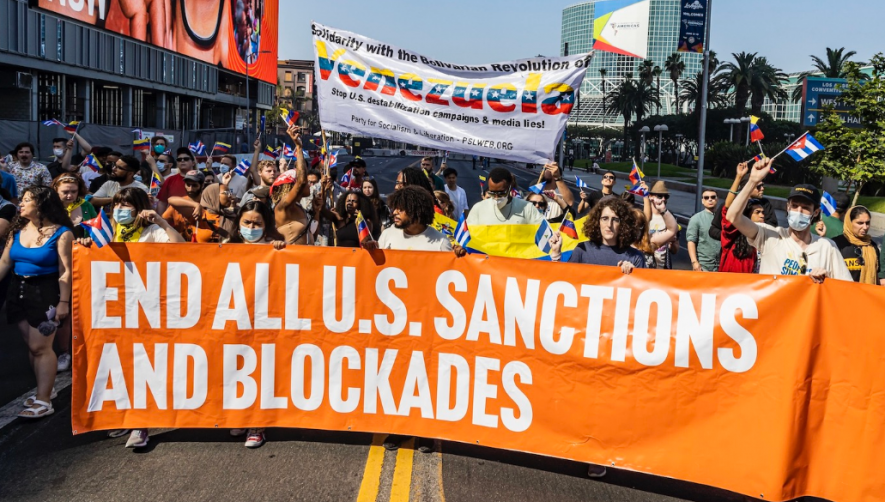
Activists participating in the People's Summit for Democracy rallied outside the Los Angeles Convention Center in June 2022 to demand lift sanctions against countries like Cuba and Venezuela. Photo: Midia Ninja
Post-war imperialism was founded upon a basic contradiction, which becomes clear when we compare it with the pre-World War I period. The leader of the imperialist world in any period typically fulfils its leadership role by running an overall balance of payments deficit vis-à-vis other major countries to which capitalism is getting diffused. This is so for several reasons: it has to make capital exports to help the diffusion of capitalism; it has to keep its markets open for goods produced by these newly-industrialising countries to which capitalism is getting diffused; it has to undertake military expenditure to maintain its hegemony; and it has to periodically fight actual wars.
The leader’s running a balance of payments deficit for all these reasons is almost an inexorable law of capitalism. Accordingly, the leading capitalist country of the pre-WWI period, Britain, had an overall balance of payments deficit, taking its current and capital accounts together, vis-à-vis the other emerging capitalist countries of that period, namely, Continental Europe, the United States, Canada, Australia, New Zealand and South Africa. But while running this deficit Britain did not get into any external debt; on the contrary, it had a net creditor’s position vi-a-vis the world as a whole.
This was made possible because of its tropical colonies of conquest (as distinct from its temperate colonies of settlement), and it happened in two ways: first, by Britain selling in these captive colonial markets its goods, which were being increasingly ousted by competition from capitalist producers in the newly-industrialising countries. This ousting occurred both in the markets of the new industrialisers and also in Britain’s own home market.
Second, Britain simply appropriated, without any quid pro quo, the entire net foreign exchange earnings of these colonies, the part that corresponded to their commodity export surplus to these newly-industrialising countries. (This phenomenon was called the “drain of wealth” by the Indian anti-colonial writers and was noted by Karl Marx in a letter to the Russian Narodnik economist N.F. Danielson in 1881).
Britain thus managed to maintain its leadership role without facing any difficulties because it could fall back on its colonial empire to sustain that role. For instance, Britain’s overall balance of payments deficit vis-à-vis Continental Europe and the United States in 1910, taking both current and capital accounts together, was 95 million pounds (out of a total of 145 million pounds with all countries with whom Britain had a deficit); of this as much as 60 million pounds came from only one colony, namely India (see S.B.Saul, Studies in British Overseas Trade); in addition, of course, it had similar extractions from the West Indies, Malaya and other colonies.
Now, the basic contradiction of post-war capitalism consisted in the fact that the leading imperialist country of this period, the United States, did not have any such colonies. It could neither access colonial markets, which constituted, to use S.B. Saul’s words, “markets on tap”, nor use any colonies as sources of loot. Fulfilling its leadership role in the absence of any British-type colonial empire, required therefore its getting increasingly into debt. We thus had this bizarre situation where the leading capitalist country of the world also became over time the most indebted country in the world.
This did not, of course, matter immediately since the rest of the world was perfectly willing to hold on to the IOUs pouring out of the US, namely the American dollars or dollar-denominated assets, as the dollar was considered to be “as good as gold”.
There was a brief setback to this belief when there was a rush to exchange dollars for gold in the early 1970s: the dollar was exchangeable for gold at $35 per ounce of gold under the Bretton Woods system and this provided scope for people to move away from the dollar and move into gold when there was an upsurge of inflation all across the world.
But after the gold convertibility of the dollar was officially ended and the Bretton Woods system abandoned because of this, the confidence in the dollar gradually returned and wealth-holders once again went on holding American dollars without any complaints. The US leadership of the capitalist world thus remained intact even after the end of the Bretton Woods system.
While this meant avoidance of any crisis arising from the basic contradiction of functioning without colonies, there always remained, however, the possibility of a future crisis, since this contradiction itself persisted. The confidence in the dollar arose among other things from the belief that the inflation rate within the US would never be so high as to induce wealth-holders to move away from the dollar to some commodity. And this belief in turn was rooted in the conviction that the dollar price of labour power would always remain within bounds through the existence of sufficient unemployment, and the price of the most important current input, oil, would remain restrained though the imposition of US hegemony over the oil-producing world. The possibility of these conditions getting undermined however always remained.
The US hegemony over the oil producing world became threatened as several oil producers like Iran, Russia and Venezuela got into antagonistic relations with it and even became targets of sanctions by it. Because of the sanctions, they began entering into arrangements with other countries to sell their oil in currencies other than the dollar. This began to erode the dominance of the dollar and portended a possible crisis in the future.
Besides, the very fact of becoming more and more embroiled in debt, even if this debt is readily held, is not a prospect that the US relished. The prevailing situation, therefore, was becoming increasingly unacceptable to the US and the Donald Trump administration finally decided to curtail altogether the balance of payments deficit of the US and hence reduce the debt it incurs at the margin.
Trump’s imposition of tariffs on imports from the rest of the world is one manifestation of this desire to curtail the payments deficit. The decision to sell American energy which earlier used to be stored within the US itself is another manifestation; and the drive to acquire colonies, especially those endowed with rich mineral resources, so that these resources can be looted (as the tropical colonies earlier could be through the “drain”) to pay for the US balance of payments deficit is another. This is not to say, of course, that other motives did not underlie each of these decisions; it is simply to highlight one important common motive.
Liberal opinion tends to blame Trump for the current ultra-aggressive stance of the US and there is no doubt that a major difference exists between Trump and the other Presidents, in so far as Trump is a neo-fascist while the other at worst could be considered only arch-conservative. But to single out Trump as the sole villain is to turn a blind eye to the frailties of the system as a whole.
What Trump’s action against Venezuela demonstrates is not just his aggressive intent, but also the fact that capitalism functions properly only when it is sustained by direct colonies; and Trump understands this in an intuitive manner. Neo-liberalism and other such ways of controlling the world’s resources by the metropolis, which have been the instruments used until now, are not half as effective as direct colonial rule.
This indeed is the exact opposite of what liberalism believes, which is that the subjugation of people through colonial oppression might have occurred in the past but is not intrinsic to capitalism, that capitalism can function in a peaceful manner through international cooperation, just as it can maintain class cooperation and a welfare state in the metropolis. Trump’s behaviour deviates from this idealised picture of capitalism not because he is a nasty person but, above all, because this idealised picture itself is untenable and Trump’s nastiness fits in with the contemporary requirements of capitalism.
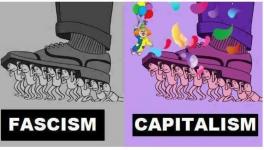
This implies that it is capitalism, not Donald Trump, that is pushing mankind to an extraordinarily dangerous situation. Historical advances such as democracy, decolonisation and the welfare state, which had been made through the struggles of the working people against the system at a time when it was vulnerable because of the socialist challenge, are being sought to be rolled back, now that this challenge appears to have abated. But the very aggressiveness of capitalism, its very effort to roll back the historical advances made by the people, only underscores the necessity of socialism.
Rosa Luxemburg’s assertion that mankind faced a stark choice between socialism and barbarism is being amply vindicated today by Trump’s desperate shenanigans to keep imperialism afloat.
Prabhat Patnaik is Professor Emeritus, Centre for Economic Studies and Planning, Jawaharlal Nehru University, New Delhi. The views are personal.
Get the latest reports & analysis with people's perspective on Protests, movements & deep analytical videos, discussions of the current affairs in your Telegram app. Subscribe to NewsClick's Telegram channel & get Real-Time updates on stories, as they get published on our website.