





‘Piracy’, Says Venezuela on US Seizure of Its Oil Tanker
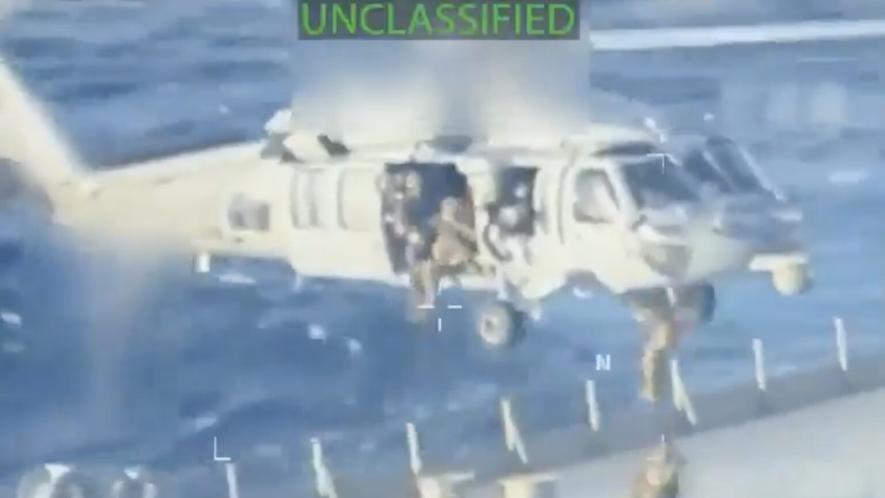
US forces seize Venezuelan oil tanker. Photo: Screenshot
The United States continues its offensive against Venezuela. On December 10, International Human Rights Day, US President Donald Trump reported that military personnel boarded and seized the Venezuelan oil tanker “Skipper”. “We just seized a tanker off the coast of Venezuela, a big tanker, a very big tanker; in fact, the biggest one ever seized.”
When Trump was asked what his country would do with the seized Venezuelan oil, he said, “Well, I guess we’ll keep the oil.”
According to Pam Bondi, attorney general of the United States, the oil tanker was seized because it was transporting “sanctioned oil from Venezuela and Iran”. Bondi claimed that the FBI, the Coast Guard, the Department of Defense, and the National Security Investigations Service participated in the operation.
Bondi said: “For several years, the tanker has been sanctioned by the United States for its involvement in an illicit oil transportation network that supports foreign terrorist organizations.”
The condition of the Venezuelan ship’s crew is unknown.
“International piracy”
The Venezuelan government quickly responded to the incident, describing the seizure of the ship as “blatant theft and an act of international piracy.” Furthermore, Caracas stated that such actions are consistent with Trump’s desire to seize Venezuelan oil: “In his 2024 campaign, [Trump] openly stated that his goal has always been to take Venezuelan oil without paying anything in return, making it clear that the policy of aggression against our country is part of a deliberate plan to strip us of our energy wealth.”
Thus, Caracas asserts that the White House’s argument about an alleged fight against “drug trafficking” and the so-called Cartel of the Suns (led, according to the United States, by the Venezuelan government) is meaningless and instead reveals Washington’s true intentions: “The real reasons for the prolonged aggression against Venezuela have finally been exposed. It is not migration, drug trafficking, democracy, or human rights. It has always been about our natural resources, our oil, our energy, the resources that belong exclusively to the Venezuelan people.”
In addition, the Venezuelan government announced that it will take measures to recover the assets that belong to the Venezuelan people: “The Bolivarian Government reaffirms that it will appeal to all existing international bodies to denounce this serious international crime, and will defend its sovereignty, natural resources, and national dignity with absolute determination. Venezuela will not allow any foreign power to attempt to take away from the Venezuelan people what belongs to them by historical and constitutional right.”
For his part, Venezuelan Interior Minister Diosdado Cabello said of the incident: “They are thieves, pirates, murderers. What they want is to steal our oil.”
In addition, several media outlets have reported that the action also affects Cuba, where the ship was presumably headed. Cuba is in dire need of Venezuelan oil due to the US blockade imposed on the Caribbean island, with Venezuela being one of the few countries that dares to send crude oil to Cuba, despite heavy sanctions on both countries attempting to prohibit the same.
Cuba’s Foreign Ministry released a statement on December 12 echoing that the seizure of the ship has “a negative impact on Cuba and intensifies the United States’ policy of maximum pressure and economic strangulation, with a direct impact on the national energy system and, consequently, on the daily lives of our people.”
The statement adds that the move is yet another chapter in the US “efforts to prevent Venezuela from exercising its legitimate right to freely use and trade its natural resources” with other nations, including Cuba. Building off of the sanctions targeting Venezuela’s transportation of fuel to Cuba in his first term, Trump has now exacerbated the situation with “the use of military force to attempt to impose its dominance over Our America.”
A long history of sanctions
It is also not the time that the United States has seized Venezuela’s sovereign assets. In February 2025, the US government seized a Dassault Falcon 200 aircraft belonging to the Maduro government in the Dominican Republic. It was the second aircraft that the US government ordered seized, the first being a Dassault Falcon 900EX.
In addition, since 2019, the US Office of Foreign Assets Control has sanctioned several shipping companies and vessels involved in the transport of Venezuelan crude oil to Cuba. Furthermore, the US blocked the operations of nearly 15 aircrafts belonging to Petróleos de Venezuela (PDVSA), the country’s largest state-owned oil company, and froze its assets.
Two weeks ago, the sale of PDVSA’s US subsidiary, CITGO, was finalized to a US investment management fund, six years after it was seized by the United States in the Guaidó-era asset seizure. Some eight billion US dollars of Venezuela’s foreign assets had also been seized by different international banks since 2019, under the justification that they do not recognize the government of Nicolás Maduro.
Over the past 10 years, the United States has imposed over 1,000 economic and trade sanctions and prohibitions on Venezuelan institutions, companies, and individuals, also known as unilateral coercive measures. The measures, especially the sanctions targeting the oil sector, provoked an acute economic crisis in the country.
However, this is the first time that the United States has used military force to seize Venezuelan state property. Videos show US forces descending from helicopters and forcibly taking over the ship. This constitutes a new type of military operation in the Caribbean, no longer just (illegal) air strikes against private boats (in which at least 87 people have been killed), but directly against the South American country’s energy and transportation infrastructure, which clearly exacerbates the conflict between the two countries.
Furthermore, experts say that the event will likely have a negative knock-on effect for Venezuela’s economic situation, as companies may be more cautious about transporting Venezuelan crude oil (whose main destination is China) due to the risk of seizures and sanctions. Following the event, oil prices rose slightly.
According to CODEPINK: “This maritime aggression is part of a much wider campaign of economic coercion and outright theft that Venezuela has been subjected to for years. After stripping the country of one of its largest revenue sources, the Trump regime has expanded the operation on land, in the air, and across the Caribbean. It’s all the same strategy: starve the country economically, attack it militarily when politically convenient, and bully it into submission.”
Courtesy: Peoples Dispatch
Get the latest reports & analysis with people's perspective on Protests, movements & deep analytical videos, discussions of the current affairs in your Telegram app. Subscribe to NewsClick's Telegram channel & get Real-Time updates on stories, as they get published on our website.