





Life & Struggle of Border Workers Amid India-Bangladesh Trade Crisis
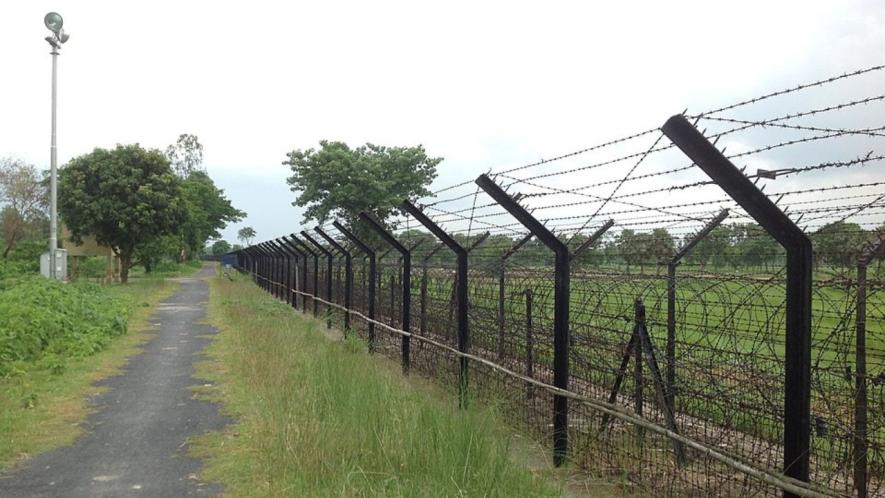
Indo Bangladesh Border, Dakshin Denajpur. Image Courtesy: Wikimedia Commons
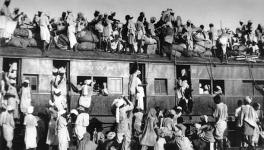
The year 1971 is not only an unforgettable chapter in the history of Bangladesh, but also a landmark moment in the history of South Asia as a whole. The brutal repression by the Pakistani military, denial of language and cultural rights to the people of East Pakistan, deprivation of political rights, and deep economic discrimination ultimately led to a prolonged struggle, culminating in the birth of Bangladesh. The Liberation War was not merely a fight for the independence of a nation; it was a struggle for freedom, human rights, and identity.
India played a significant role in this historic struggle. Millions of refugees took shelter in border states such as West Bengal, Tripura, and Assam. The then Central government of India, relying on the sympathy and solidarity of the Indian people, undertook the massive responsibility of supporting these refugees. Indian armed forces directly participated in the war, and with the surrender of Pakistani troops in December 1971, Bangladesh achieved independence.
This history continues to hold an honoured place in the collective memory of the people of Bangladesh. As a result, for a long period after Independence, India–Bangladesh relations progressed largely along a path of friendship.
Successive governments in Bangladesh—whether under military rule or democratic governance—have maintained at least a minimum cordial relationship with India. Although extremist and communal forces opposed to the spirit of independence have consistently attempted anti-India conspiracies, such forces never became the dominant current at the state level.
Over the past 54 years, bilateral cooperation between India and Bangladesh has steadily deepened in areas including cultural exchange, trade, power infrastructure, and natural resource management. One of the key pillars of this cooperation has been the border land ports.
Land Ports: The Lifeline of Local Livelihoods
Among the several land ports along the India–Bangladesh border, Petrapole in the Bongaon sub-division of North 24 Parganas and Ghojadanga in the Basirhat sub-division in West Bengal hold exceptional importance.
Since 1972, these two ports have stood as symbols of economic connectivity between the two nations. Over the years, trade through these ports not only increased in volume but also intensified the daily struggle of thousands of working people whose lives are built on sweat and hard labour.
Thousands of workers—loaders, helpers, dock workers, and porters—earn their livelihood through relentless physical labour. Every drop of their sweat becomes part of each truck carrying goods across the border. Similarly, thousands of transport workers, truck drivers, and owners have sustained their families entirely around these land ports.
Beyond labour alone, the local economy of entire regions has thrived around these ports. Numerous hotels and lodges emerged to accommodate traders and drivers from distant places. Eateries remain crowded daily with working people. Vehicle repair garages operate round-the-clock as trucks and lorries demand constant upkeep. Local markets bustle with customers, and petrol pumps witness continuous traffic of heavy vehicles.
Together, these land ports are not merely administrative or commercial centres—these represent the bread and livelihood of thousands of families, the education of their children, and medical care for elderly parents. These ports form the nucleus of a vast cycle of life where labour, hope, effort, and dreams are renewed every single day.
Political Instability and Its Fallout
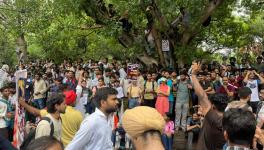
Over the past one-and-a-half years, Bangladesh has experienced dramatic political upheaval. Initially led by university and college students through protests against reservation quotas, the movement rapidly spread across society. Soon after, political manoeuvring led to the sudden collapse of the elected government. Years of democratic institution-building were dismantled almost overnight, resulting in a power vacuum that was filled by an interim administration.
This transition further destabilised the social and political fabric of the country. Fundamentalist and communal forces gradually gained influence and began expressing overt anti-India rhetoric. When turmoil erupts across the border, its heat inevitably reaches this side as well—a truth reinforced again.
The impact on India-Bangladesh relations was severe. Rail and road connectivity between the two nations came to a standstill. Trains that once symbolised friendship and trade ceased operations. Trucks that regularly transported export-import goods suddenly stood idle. The entire trade mechanism was plunged into silence.
The worst affected were ordinary people in the border regions. Thousands of daily wage workers—loaders, porters, helpers—lost their livelihoods overnight. Transport operators, truck owners, and drivers saw their incomes collapse. Shops, hotels, lodges, tea stalls, garages—once bustling with activity—fell into paralysis. Markets fell silent, workshops were shuttered.
This political shift did not merely shake Bangladesh; it deeply disrupted the lives of people on the Indian side of the border as well. Livelihoods vanished, and the assurance of normal life disappeared. An invisible fear now hangs in the air—nobody knows when normalcy will return.
Corporate Control: Trade for Whose Benefit?
Efforts were made at the diplomatic level to partially resume trade between India and Bangladesh. While initial discussions raised hopes, those hopes were quickly betrayed. The decisions taken prioritised corporate interests over the livelihoods of ordinary people.
It was decided that Bangladesh’s major export items—jute and jute products, ready-made garments, leather, and handicrafts—would no longer enter India via land routes. Instead, they would be routed through major seaports such as Nhava Sheva in Mumbai or Kolkata Port. Similarly, essential Indian exports—foodgrains, onions, medicines, and necessities—would also move via sea routes.
Thus, the historically significant land-based trade routes got virtually dismantled.
The immediate victims were workers in border areas. Local land ports like Petrapole and Ghojadanga became effectively non-functional. Loaders, helpers, drivers, transport owners, hotel operators, food vendors, mechanics—entire livelihoods collapsed overnight. Once lively port zones descended into a deathly silence.
Trade continued, but now under tight corporate control. Profits accumulated in the hands of large corporate houses—Adani, Ambani, and others—while multinational corporations and big capital expanded their wealth. Meanwhile, the very workers whose labour sustained border trade for decades were left without means to survive.
This amounted to a double blow for workers: first, political instability shut down work; later, even when trade resumed, they were completely excluded. Corporate-controlled trade structures inflicted glaring injustice upon labour and livelihoods.
A single question now echoes across the border regions:
“What is our crime? Are we destined to be sacrificed for corporate profit?”
Role of Trade Unions
In this crisis, the only consistent voice of resistance has been that of the Centre of Indian Trade Unions (CITU). From the very first day, CITU stood by the workers, organising protests, delegations, and negotiations with the administration. But instead of cooperation, the authorities imposed obstacles.
When a CITU delegation from North 24 Parganas attempted to submit a memorandum to the District Magistrate on a pre-announced date, the memorandum was refused, as conveyed by the police. This exposed the anti-worker, corporate-serving nature of the Bharatiya Janata Party-led Central government and the Trinamool Congress–run state government that follows its line.
Yet, the workers declared from the protest site that these fragmented struggles would soon unite into a larger movement—one that will compel both state and central governments to retreat from corporate servitude and return to a constitutional welfare state.
Corporate Control vs Local Economy: Road Ahead
The central conflict is clear: should border trade sustain local economies, or be monopolised for corporate profit?
The government has chosen the latter path. This choice has deepened not only economic distress but also social instability.
History teaches that no workers’ struggle goes in vain. What appears fragmented today will unite into a broader movement tomorrow. If border workers and common people build a united mass movement around the issue of livelihood, corporate domination can indeed be challenged.
The crisis faced by workers at Petrapole and Ghojadanga is not merely a regional issue—it reflects the condition of the entire working class of the country. Where the State prioritises corporate interests over the basic right to livelihood, struggle becomes the only option.
Despite countless obstacles, this struggle will not fail. It will usher in a new dawn—where the lives and livelihoods of border workers are not sacrificed at the altar of corporate profit, but where human rights and dignity prevail.
The writer is a leading trade union organiser in West Bengal and the working president of Bengal Chatkal Mazdoor Union.
Get the latest reports & analysis with people's perspective on Protests, movements & deep analytical videos, discussions of the current affairs in your Telegram app. Subscribe to NewsClick's Telegram channel & get Real-Time updates on stories, as they get published on our website.