





Ecuador: Noboa Pledges New Security Plan After Most Violent Year in History
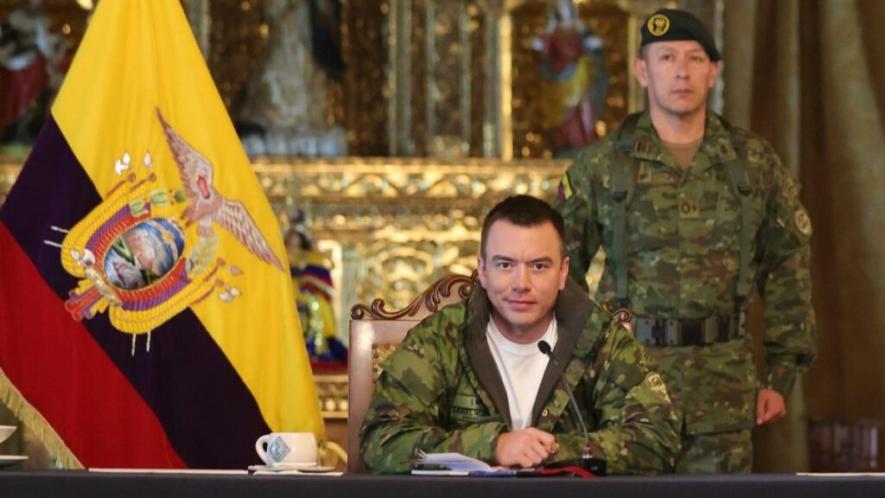
President Daniel Noboa at the Cabinet meeting in January. Photo: Ecuadorian Presidency
In January 2024, a group of hooded individuals entered the premises of TC Televisión in Guayaquil, Ecuador’s most important port city. At the same time, several attacks took place in the city by people identifying themselves as members of one of several Organized Crime Groups (GDO) that have been fighting for control of the routes across Ecuadorian territory used to export drugs for several years.
Following these attacks, Daniel Noboa’s right-wing government declared internal armed conflict, which allowed it to mobilize the Armed Forces against the GDO. Under the pretext of defending the population from crime, he called a referendum in 2024, in which the Ecuadorian people gave him the support he sought on issues related to strengthening the state’s control and armed forces. Under a so-called “Plan Fënix” for security, which was never revealed, Noboa promised to reduce violence and eradicate the GDO from the country. But the opposite has happened.
Not only have the GDO increased their economic power and diversified their activities beyond drug trafficking (including arms trafficking, illegal mining, and other illicit businesses), but there is no clear perspective on how the state can confront a power that has clearly interfered in various social functions and the state apparatus itself.
Ecuador is currently the world’s leading exporter of cocaine, which is produced on a massive scale in neighboring Colombia and Peru. This has led to violence between large organized crime groups, causing a sharp increase in crime and violence in the country.
One of the most violent countries in the world
2025 was the most violent year in the country’s history: nearly 9,216 murders, representing a 32% increase compared to 2024. This means that Ecuador has a chilling violent death rate of 50.91 per 100,000 inhabitants.
This makes it the country with the second-highest homicide rate in Latin America (only behind Haiti) and one of the most violent in the world.
Noboa attempted to repeat the maneuver in 2025, calling a referendum to supposedly tackle crime. According to him, the problem in fighting drug trafficking lies in the legal structure and the absence of foreign troops. However, this time the Ecuadorian people clearly said NO. In a historic referendum, Noboa suffered a quadruple defeat, after which the path long sought by his economic group to eliminate the 2008 Constitution’s protective provisions and replace it with a neoliberal one, aligned with the demands of the International Monetary Fund and Washington, the great ally of the Ecuadorian presidency, was closed. Likewise, the possibility of installing foreign military bases in Ecuador, another of Noboa and company’s deepest desires, was denied.
A new security plan?
However, time is not on their side. Ecuadorians remain distressed and fed up with living in fear, continuing to demand solutions from politicians who promised to resolve the country’s worst security crisis. Noboa is also aware that local elections are approaching, followed by national elections. Several experts are betting that Noboa will seek re-election.
Thus, after a long absence from the country (he is the current president who has spent the most time outside the country in Ecuador’s history), Noboa returned to Ecuador to propose a new plan to reduce violence and crime. According to the president, the old political groups used the GDOs to act politically. But he has also made a clear statement by stirring up the waters of Andean diplomacy.
One of the first actions taken by the government, in Trump style, was to increase tariffs on Colombian products by 30%. Colombia responded by eliminating the sale of energy to Ecuador. According to the Ecuadorian government, Colombia is not properly guarding the border crossings through which tons of cocaine enter the country. Bogotá has said that the security problem lies with Ecuador, not Colombia.
Noboa has recently said that only an international alliance could tackle drug trafficking in the region, although several experts have criticized whether imposing tariffs is the best way to bring about coordination and interstate alliance between several Latin American countries.
Within the borders, Noboa said that a strategy involving various agencies is needed, such as the authority that investigates money laundering (UAFE), intelligence agencies, the National Police, and the Armed Forces.
And while this is not the first time that the government has announced the coordination of several institutions, it is the first time that it has promised the immediate purchase of seven helicopters, a multipurpose logistics vessel, new radars, scanners, and drones for border control. According to Defense Minister Gian Carlo Loffredo, 180 million USD will be invested in the acquisition of security equipment. He also promised to tighten controls against illegal mining.
Interior Minister John Reimberg also said that construction of the so-called Carcel del Ecuentro and a new prison will be completed by 2027, with a capacity to hold 15,000 inmates. For his part, Julio José Neira, director of the Financial and Economic Analysis Unit (UAFE), promised that the sources of financing for organized crime that sponsors violence, arms sales, and political corruption will be cut off. According to Neira, politicians and local governments that are allegedly receiving financing from illegal groups have already been identified.
In total, Noboa promised on national television a record investment of 230 million USD to tackle crime, which he said requires “cooperation and political determination.” Some critics of the government fear that, under the pretext of tackling crime by politicians financed by the GDOs, political persecution will begin.
The truth is that Noboa will have to act quickly if he wants to retain the support that enabled him to become president. Ecuadorians are no longer waiting for Noboa to act; they are demanding immediate results. Pessimism is not usually a good indicator for politicians in power. According to a survey by the Center for Specialized Studies Research (CIESS), about 72% of Ecuadorians see a negative future, and 60% of the population disapproves of Noboa’s administration.
Whether Noboa’s new security plan arrives on time or delivers the promised results will determine the political future of his right-wing neoliberal project. Poor execution of the plan or a failure to reduce violence could increase disapproval of Noboa, which could lead to the early termination of a project that promised to last several presidential terms.
Courtesy: Peoples Dispatch
Get the latest reports & analysis with people's perspective on Protests, movements & deep analytical videos, discussions of the current affairs in your Telegram app. Subscribe to NewsClick's Telegram channel & get Real-Time updates on stories, as they get published on our website.