





Protests Against US-Israeli War on Iran Continue Across Europe
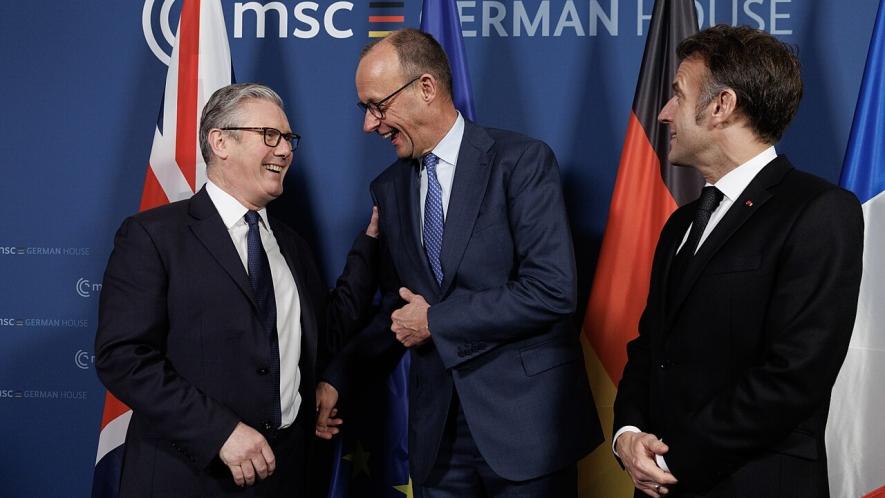
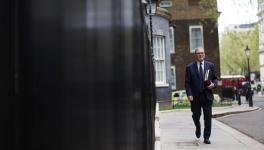
Prime Minister Keir Starmer, French President Emmanuel Macron, and German Chancellor Frederich Merz at the Munich Security Conference in February 2026. Photo: No. 10 Downing Street
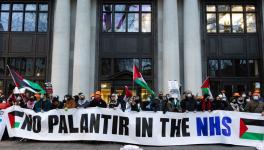
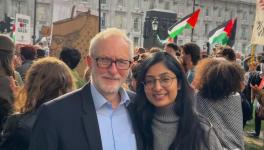
On Saturday, March 7, over 30,000 people joined a demonstration in London protesting the illegal war waged by the United States and Israel against Iran. Thousands more took to the streets in other European countries, including Germany and Austria, all demanding an end to the war and for governments’ to respect sovereignty and international law.
The event in London, organized by a coalition of anti-war and international solidarity groups, came amid several ongoing petitions calling on Keir Starmer’s government to steer away from complicity in the attacks, and statements by left and trade union leaders warning Britain risks following a catastrophic path. On the day of the protest, Stop the War Coalition’s Chris Nineham said it was disgraceful that Starmer’s government allowed British bases and resources to be used to promote chaos in West Asia.
“The overwhelming majority in this country think what is happening is madness, completely oppose Trump’s wars, and believe that the British government should have nothing to do with them,” he added. According to recent polls, only a quarter of the British public supports US attacks on Iran, while 59% oppose them.
Despite public discontent, the Labour government has cleared the use of some of its bases, including those on Cyprus, for US armed forces. Critics have associated this move with the government’s relationship to the Trump administration, which can be summarized as giving Donald Trump anything he wants. Lindsey German from Stop the War called out this failed strategy, insisting the British Prime Minister should “stop appeasing Donald Trump all the way to World War III.”
“He [Donald Trump] must be living in a fantasy world if he thinks that anyone is going to surrender to his politics and his bombing,” German said during the demonstration. “People will resist his bombing because it is completely illegal and unjust. It is a war crime of barbaric proportions.”
“Defensive,” “preventative” deployments
Keir Starmer’s government has not been the only one avoiding clear condemnation of the illegal attacks. The authorities of most major EU countries, like Italy and France, have on one hand made statements suggesting that the legal status of the attacks on Iran might be opaque and insisting they are not taking part in them, but then proceeded to deploy their own naval capacities to Cyprus after the bases that Starmer cleared for US use for “defensive” actions suffered attacks.
As Italian far-right Prime Minister Giorgia Meloni tried to spin this, the frigates were deployed in an act of “European solidarity” and “prevention.” Despite this act, Meloni stated, “our line is very clear. Italy is not part of this conflict and does not intend to become part of the conflict.” Several progressive groups have pointed out flaws in this narrative, insisting that such actions make European countries complicit in the assaults.
Others, notably German Chancellor Friedrich Merz, have not only avoided condemning attacks on Iran, but also suggested that international law should not necessarily apply in this case, considering how much grief the country has given the West – even failing to succumb to the sanctions imposed. According to some reports, Merz’s positioning has fueled tensions in the coalition government, and apparently the public is not thrilled about it either.
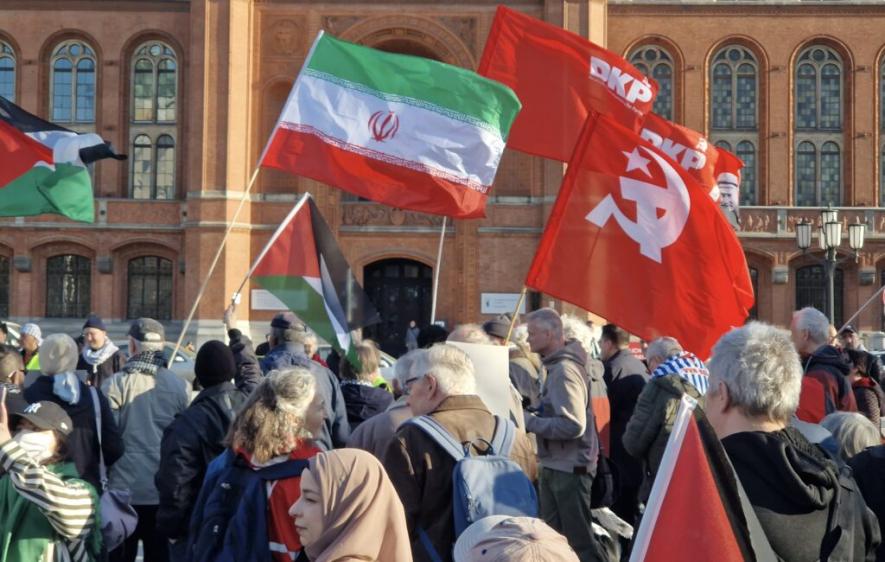
Iran solidarity rally in Berlin, Germany. March 6, 2026. Photo: Laurențiu Dragota/DKP Berlin
Ahead of a recent solidarity rally in Berlin, the German Communist Party (DKP) said the Chancellor’s position should be condemned “because it stands alongside the aggressors.”
“The aggressive actions of Trump and Netanyahu’s war governments and the de facto support from Chancellor Merz are incompatible with international law and peaceful foreign policy that benefits our country” the DKP stated, adding that the government’s approach so far “negates the lessons of two world wars and the liberation of Europe from Hitler’s fascism.”
“Iran is responsible for the root causes of this situation,” say EU officials
While the positioning of European countries’ elected “leadership” has frustrated anti-war campaigners, it is overshadowed by the interpretations offered by EU officials. On March 9 and 10, during discussions with diplomatic corps, three of the EU’s most visible faces – António Costa, Kaja Kallas and Ursula von der Leyen – all expressed their thoughts on the war on Iran.
In relatively short remarks, they managed to: cast aside the so-called rules-based order – considering it is no longer “the only way to defend our [European] interest,” according to von der Leyen – reiterate the vision of a region that “deters” and “projects power,” and suggest that the ongoing attacks have been provoked: “Iran is for sure responsible for the root causes of this situation,” Costa said.
In these and other statements, EU officials have repeatedly shown they have yet to come to terms with their bloc’s fading influence, and that they are not ready to use what limited influence remains to prevent more destruction. Instead, their behavior underscores the timeliness of Lindsey German’s remark that “regime change should start at home,” as she called for people in Britain and other European countries to mobilize and resist complicity in yet another devastating and illegal war.
Courtesy: Peoples Dispatch
Get the latest reports & analysis with people's perspective on Protests, movements & deep analytical videos, discussions of the current affairs in your Telegram app. Subscribe to NewsClick's Telegram channel & get Real-Time updates on stories, as they get published on our website.