






Crimes Against Women: Justice, Not Tougher Laws, Tests Governance in Bengal
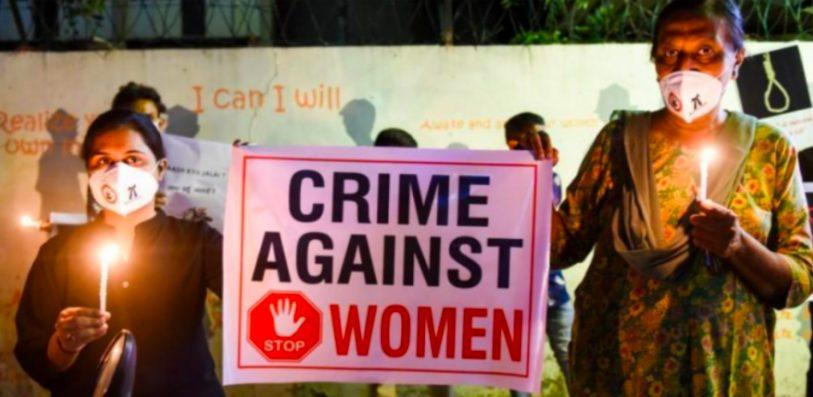
Representational Image. Image Courtesy: The Leaflet
The trajectory of every horrific crime against a woman in India is painfully familiar. The streets are full of protests; political parties exchange accusations and governments promise to pass stricter laws and harsher penalties. It is understandable and necessary that the call be for prompt justice. But once the headlines fade, a trickier question remains unanswered: Are governments bolstering the institutions that actually deliver justice, or are they simply responding with tough rhetoric?
Today, West Bengal is at a crossroad. Law and order have re-emerged as a central theme in the state’s political discourse, prompted by the recent outcry over crimes against women. Opposition parties have accused the government of failing to ensure public safety, while the ruling elite promises tougher enforcement and a faster response to offenders.
As the state gears up for yet another politically significant period, the focus has shifted from overall governance to the government’s ability to ensure women’s safety. But governance is not just about how strongly a government speaks after a tragedy. And it must be measured by whether victims get justice, grieving families are held accountable and institutions function effectively before, during and after a crime. This difference is important because India has many strict criminal laws.
The Criminal Law (Amendment) Act of 2013, introduced in the wake of the Nirbhaya case, greatly expanded legal safeguards for sexual violence. Subsequent amendments increased penalties, including in some cases death penalty for crimes involving minors. Governments pledged zero tolerance for crimes against women and fast-track courts were created to speed up trials.
But these legislative changes have not stopped cases of rape, sexual assault and gender-based violence from shocking the nation. These crimes are endemic, and what is an institutional problem cannot be solved by legislation alone.
Stronger governance is often seen by political leaders as meaning harsher punishment. Over the past few years, Uttar Pradesh has been projecting a governance model based on strict law and order. The political narrative is increasingly characterised by visible policing, fast arrests, and public messaging highlighting strict enforcement. Similar demands are now resonating in West Bengal, where every major crime triggers demands for tougher policing and stricter legal action.
But one can't judge a criminal justice system by the harshness of its punishments. The real test begins much earlier. Justice begins when a victim, or in the most tragic cases, the victim's family, enters a police station. Were they able to file an FIR immediately, or under duress? Was the crime scene locked down properly? Was evidence collected quickly? Were witnesses protected from pressure? Were the investigators trained and equipped to carry out a professional investigation? Did the prosecutors have a strong case based on evidence, or were they simply responding to public pressure? Was the case heard within a reasonable length of time by the courts?
If any of these steps go wrong, justice becomes more and more impossible to achieve. For families who have lost daughters, sisters or wives to sexual violence, justice is about more than a conviction. The emphasis is on dignity throughout the legal process. It’s about not having to battle bureaucratic indifference while mourning. One important thing to know is that investigations are done professionally and are not subject to politics, media hype or administrative delays.
For the survivors, the challenges are no less formidable. Many people still endure social stigma, fear of retaliation, economic dependence and being questioned over and over again, which can become traumatic. Medical examinations are delayed, there is a lack of forensic infrastructure and trials take a long time, which often discourages victims from pursuing their case any further.
A justice system that is inaccessible or inefficient can undermine even the most stringent criminal laws. These are not problems confined to West Bengal. These highlight flaws in India’s criminal justice system. However, the changing political landscape of West Bengal provides an opportunity to re-define what effective governance is all about.
Instead of announcing tougher laws, political parties could compete over better investigations for higher conviction rates, rather than coming up with harsher punishment in public debate. Investments in forensic laboratories, specialised units for crimes against women, modern evidence collection, witness protection mechanisms and psychological counselling for survivors seldom feature in political speeches. But these reforms are probably going to have a bigger long-term effect on justice than another legislative change to increase punishment.
It is useful to compare with Uttar Pradesh because it reveals a national trend rather than presenting a model to copy or reject. Administrators across India are increasingly looking to show their strength through visible policing and strong messages about law and order. While decisive action against offenders is certainly important, democratic governance cannot rely on display of State power alone.
It has to build public trust. Citizens judge governments not just by the number of arrests announced following a crime, but by whether justice is consistent, impartial and timely. Selective outrage, inconsistent investigations or long delays erode confidence much more than the lack of another stringent law.
Prevention is also crucial. Women's safety cannot be based solely on criminal law. Urban infrastructure that helps reduce violence includes safe public transport, functional street lighting, gender-sensitive policing, school education, workplace safeguards and accessible emergency response systems. Governments frequently find it easier to promise tougher punishment after a crime than to make steady investments in prevention, which receives much less political attention.
So, the conversation has to move from punishment to accountability. All big crimes raise hard institutional questions. If the police had stepped in earlier, could the incident have been prevented? Were complaints previously ignored? Were officials held accountable for failures? Were investigative errors rectified? Were lessons fed into future policing practice? Without institutional learning, every tragedy risks becoming another round of outrage followed by legislative promises. The changing political narrative in West Bengal offers an opportunity to end that cycle.
The state needs stronger institutions and not tougher laws. It requires police forces equipped with modern investigative tools, prosecutors trained to handle sexual violence cases, forensic facilities able to process evidence without delay, courts reducing pendency, and support systems that place victims and grieving families at the centre of the justice process, rather than as participants in an endless legal battle.
The real test of governance is not how many new laws are passed after public protests. It is whether those seeking justice—whether survivors rebuilding their lives or families mourning those they have lost—can trust the State to respond with competence, compassion and fairness.
This is West Bengal’s challenge today. Its political future may be shaped by promises of tougher action. But its democratic credentials will ultimately depend on something much more lasting: whether justice becomes faster, fairer and more accessible for those who need it most.
The writer is a columnist, political ecology researcher with prior experience as an ESG analyst. The views are personal.
Get the latest reports & analysis with people's perspective on Protests, movements & deep analytical videos, discussions of the current affairs in your Telegram app. Subscribe to NewsClick's Telegram channel & get Real-Time updates on stories, as they get published on our website.