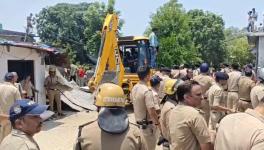






Bengal: Red Flags Stand up Against BJP Bulldozers to Defend Hawkers
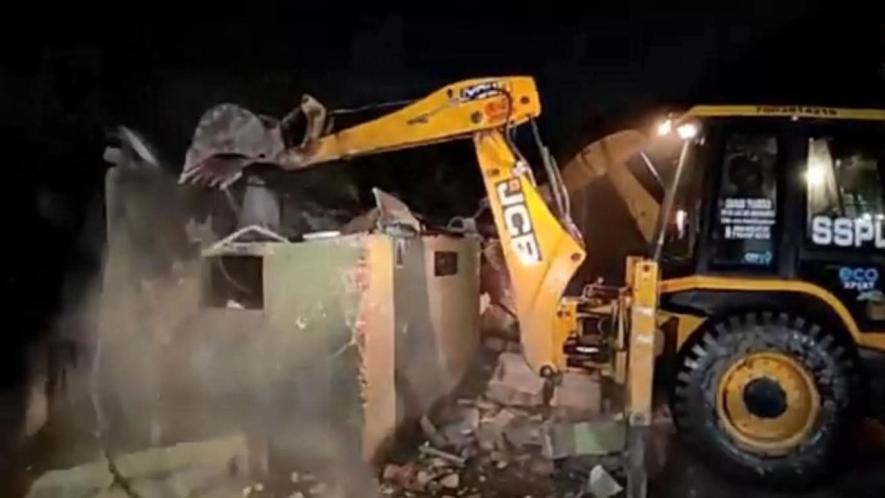
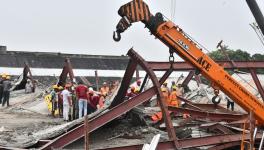
Bulldozer action at Dum Dum station area.
In a significant interim relief for thousands of small traders and railway hawkers, the Calcutta High Court has stepped in to halt the Railway authorities’ ongoing eviction drive, which has involved the use of bulldozers in several railway market areas.
Acting on petitions filed by the Centre of Indian Trade Union (CITU)– affiliated Railway Hawkers’ Union and associations representing small businesses, the Calcutta High Court on Wednesday (June 10) ordered temporary suspension of the eviction process in the railway markets of Naihati, Dankuni and Konnagar until June 17.
Justice Hiranmay Bhattacharya, while issuing the order, directed that neither the Railway authorities nor the state government would be permitted to carry out any forcible eviction at these three locations until June 17.
An intense and deeply controversial eviction drive against hawkers and small traders is currently unfolding across railway stations and adjoining areas throughout West Bengal. The operation has drawn sharp criticism from those who see it as a humanitarian crisis rather than an administrative exercise.
Only a few months ago, the state's current Chief Minister, Bharatiya Janata Party (BJP) leader Suvendu Adhikari, served as the leader of the Opposition in the Assembly. During that period, he repeatedly declared that he would stand in front of bulldozers and resist any attempt to evict hawkers through force. Today, critics allege that under his administration, the state police, Railway Protection Force and Central security personnel are carrying out widespread evictions with bulldozers across the state. According to those opposing the drive, shops are being demolished without due process or adequate rehabilitation measures, leaving countless families facing an uncertain future overnight.
Just five days ago, a dramatic late-night eviction operation was carried out in Jadavpur, where hawkers were forcibly removed from their places of business. There was heavy security deployment.
During protests against the eviction, Left activists reportedly stood in front of the bulldozers in an attempt to prevent the demolition. Several protesters were allegedly assaulted and left bleeding during the confrontation. Among those detained were CPI(M) leaders Srijon Bhattacharya and Sujan Chakraborty, and numerous Left activists.
For the authorities, the operation is being presented as an exercise in clearing railway land. For thousands of affected families, however, it has meant the loss of livelihoods built over decades. As bulldozers move through market areas, scenes of anguish and uncertainty have emerged, with many small traders and hawkers left without any visible means of survival.
While the machinery of eviction rolls on, devastated families are left counting their losses. The cries of those suddenly deprived of their livelihoods stand in stark contrast to the official narrative of development and enforcement. Across affected communities, a common refrain can be heard: “What kind of Bengal is this?” For many, each new morning now seems darker than the night before.
Against the backdrop, hawkers and small traders view the recent directions of the Calcutta High Court as a significant and hopeful development. However, CITU leaders say they have little faith in either the state government or the Railway authorities. Instead, they are preparing to intensify both the legal battle and the struggle on the streets, Ujjal Sarkar, a CITU leader, told this reporter.
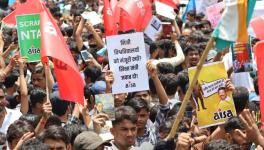
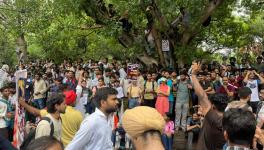
As the confrontation deepens, red flag marches, protest rallies and public meetings have become an almost daily occurrence across Bengal. The key demand remains unchanged: “No eviction of hawkers and small traders without proper rehabilitation”.
“We are now placing our trust in the movement led by the red flag alone. Left activists have stood beside us, risking their own safety and spending sleepless nights in this struggle. Today, they are the ones who feel like our own family”, said Jaydeb Maji, a tea stall owner near Konnagar railway station, and Nizamuddin Bayen, a pavement vendor who sells plastic toys.
For Jaydeb Maji, the crisis carries a painful irony. He recalls voting for BJP in the hope of defeating the Trinamool Congress (TMC), and even joined the victory celebrations, his face covered in saffron-coloured powder (gerua abir). Today, however, a dark shadow hangs over his family’s future.
“If my stall is demolished, how will my family survive?” he asked, his voice heavy with anxiety. “It was the Left activists who stood in the way and tried to stop the eviction. The TMC has simply disappeared,” he added.
BJP’s Slogan and Reality
After coming to power, BJP has proclaimed “Trust in, Fear Out”, but in practice it is the poor and marginalised who are being made to live in fear, alleged Gargi Chatterjee, a CITU leader. “Now, bulldozers have been deployed at several railway stations, with the Railway authorities and police jointly carrying out eviction drives against hawkers” she said.
According to Chatterjee, sustained protests led by Left- affiliated trade unions have so far succeeded stalling such eviction drives at a few railway stations. “But for how long can they be stopped?” she said.
Accusing the BJP of pursuing an aggressive and all-encompassing agenda, Chattetjee said, “The moment BJP came to power in the state, it adopted a sweeping approach that has consistently targeted the livelihoods of ordinary people. Under the banner of the “Amrit Bharat Station” project, railway stations are being transformed into glittering modern facilities. The bulldozer-driven eviction of hawkers is part of an attempt to clear the way for corporate interests, like Adani and Ambani, while snatching away the daily bread of thousands of poor families.”
The CITU leader alleged that the “modernisation” drive has come at the cost of some of the most vulnerable sections of society, many of whom depend entirely on hawking for their survival. In the face of such a grave crisis, can we remain silent spectators? This struggle is far from over, it will grow stronger and more determined in the days ahead, added Chatterjee.
Several hawkers of Howrah, Sealdah, and Dumdum station told this reporter that their association with the Railways goes back many years. “Our connection with the Railways is not just about earning a livelihood. Over time, we have developed a deep bond with passengers as well. We are often the first to assist them in times of need and regularly contribute to their safety and well-being. Did the Railway and State administration consider this once before carrying these eviction drives”. said Santanu Ghorui, a banana-selling hawker at Howrah Station.
Breaking down, Dipak Haldar, a hawker who sells chhola- bhatora at Sealdah station, said, “Please note this down. My entire family members voted for BJP. The day after the election victory, I joined the celebratory procession, covered in saffron colours. BJP leaders had assured us that no hawker would have to pay extortion money to continue earning a living at the station. They promised an atmosphere of trust, where fear would no longer exist. But today, it feels as though we have been uprooted completely. We had heard of “Bulldozer Raj” elsewhere. Now we have seen it for ourselves.”
Holding back tears, he added, “Today, we are forced to say the opposite of what we were promised: “Fear In, Trust Out.”
Evicted Without Rehabilitation
Barely a month since BJP assumed power in West Bengal, the new administration has launched a series of eviction drives in the name of administrative action. From the removal of pavement hawkers to the demolition of what authorities describe as ‘illegal structures’ using bulldozers. These operations have emerged as one of the defining features of the new government’s approach to governance.
Across Kolkata and several districts, many residents are openly voicing their concerns. “It has not even been one month, and people are already witnessing the true face of this government,”, said several protesters and affected vendors.
The eviction drives carried out in and around the railway station areas of Howrah, Sealdah, Dum Dum, Sonarpur, Memari and Uttarpara have not merely resulted in the destruction of hawkers’ stalls. Behind every demolished structure lies a larger story-- the daily struggle for survival, the source of food and income for lakhs of people.
Several passengers, too, voiced strong objections to the railway authorities’ concerns over the quality of food sold by hawkers on station platforms. Regular commuters like Angshuman Haldar, Yadav Mishra, Mansur Choudhury who travel daily between Naihati and Sealdah for work at Moulali area at a private company, told this reporter, “The inexpensive puffed rice, luchi and vegetable curry sold by hawkers at various stations are what many of us eat every-day. We have never faced any health problems because of it. Now these hawkers have been removed, where are we supposed to buy food at affordable prices?’’
When questioned whether the removal of hawkers would lead to the closure of food stalls and other shops at railway stations. “Of course not”, they said in chorus. “Instead, large companies will be allowed to set up business on the platforms. In fact, that process has already begun. But how will poor and lower-income passengers afford the higher prices charged at such outlets?’’
To attack such people and drive them out in this manner is extremely inhumane, said Sajol Modak at Dum Dum Station.
Many displaced vendors also pointed out what they described as a stark contradiction in the present double engine government approach. “The Prime Minister’s life story has often been published with the claim that he once sold tea at a railway station. Yet. it is under this government that one of the most organised drives against railway hawkers has been carried out.’’
The hawkers further noted that during election campaigns of Bengal, photographs of the Prime Minister buying and eating jhalmuri from street vendors were widely circulated in the media. “But after BJP’s electoral victories, the very vendors whose livelihoods symbolised the struggles of ordinary working people are being evicted. Is this not the height of hypocrisy?’’ they asked.
Binoy Mondal, a puffed rice trader at Sealdah Koley Market, told this reporter that a large section of his customers were hawkers who sold jhalmuri while moving through train compartments or from platforms across the station. Since their eviction, they have virtually stopped coming to purchase puffed rice from him, causing his own sales to collapse.
He pointed out that the crisis extends far beyond the hawkers. “It is not only hawkers who have suffered” he said, “Countless others whose livelihoods depend on them have also been pushed into uncertainty”.
The relationship between railway hawkers and the Indian Railways stretches back decades. Hawkers have long been an integral part of the culture of rail travel, serving passengers across stations and train compartments while earning an honest livelihood. Over the years, they have repeatedly demanded official recognition of their work and their role in the railway ecosystem.
Late-Night Bulldozers at Dum Dum Station
While eviction drives were resisted at stations including Ballygunge, Ranaghat, Belgharia, Halisahar, Jagaddal, Dum Dum Cantonment, Barasat, Baruipur and Palashi through sustained protests by CITU, the authorities finally struck at Dum Dum station on May 30 (Saturday), shortly after midnight. Bulldozers rolled into the station premises and nearly 500 hawker stalls were demolished. Watching their livelihoods being reduced to rubble, many hawkers and their family members broke down. “We were not given even a moment’s notice” said Sujoy Karmakar, Bibhas Nandi, Bidisa Haldar and several hawkers.
As news of the operation spread, CITU leaders rushed to the spot and held discussions with railway officials. On Saturday morning, the Station Manager had reportedly assured hawkers that no immediate eviction would take place. Reassured by that promise, many of them had opened their stalls as usual and later returned home, unaware of what was to come.
By midnight, the area had been sealed off by bulldozers, central security forces and police personnel. Trade union leaders appealed to the railway authorities not to destroy the livelihoods of poor working people. Veteran former MP Tarit Baran Topdar reached the site and urged railway officials to halt the demolition, saying he would raise the matter with both the Railway Minister and Prime Minister, but his appeals went unheeded.
Far from being silenced, the evictions have fuelled a growing wave of protests. Demonstrations, rallies and resistance campaigns against the displacement of hawkers are continuing across railway stations and localities throughout Bengal, as affected families and their supporters vow to carry forward the struggle for rehabilitation and right to livelihood.
The writer covers the Jangalmahal region for ‘Ganashakti’ newspaper in West Bengal.
Get the latest reports & analysis with people's perspective on Protests, movements & deep analytical videos, discussions of the current affairs in your Telegram app. Subscribe to NewsClick's Telegram channel & get Real-Time updates on stories, as they get published on our website.