





Climate Change: India’s Missing Policy Debate on Informal Workers
File Image
India’s climate narrative is often shaped by high-sounding renewable energy targets, transitions to electric mobility, international climate diplomacy and green industrial growth. Solar parks, net-zero pledges and pathways to sustainable development are often the buzzwords of policy-makers. One critical aspect that is often overlooked from conventional climate policy-making is what happens to the millions of informal workers who view climate change not as an abstract environmental phenomenon but as an everyday labour crisis?
Climate change is not a future threat to the survival conditions of India’s casual workers; it already impacts them. Heatwaves, flooding, erratic monsoons, air pollution and extreme weather events are present realities with implications for livelihoods, wages, mobility, health and economic security.
The issue is especially urgent given that informal workers constitute about 90% of India’s workforce. Street vendors, sanitation workers, construction workers, delivery workers, domestic workers, agricultural migrants, garbage pickers and daily wage earners lack consistent social security provisions. Climate vulnerability thus has a direct bearing on worker precarity. Even with this reality, the climate conversation in India is still disproportionately focused on infrastructure and technology. While adaptation strategies are mainly focused on disaster management, urban planning, and agricultural resilience, labour vulnerability is often ignored in climate governance discussions. Climate policy’s exclusion of informal workers highlights a larger structural issue: India continues to see climate change primarily as an environmental issue, not a socio-economic and labour crisis.
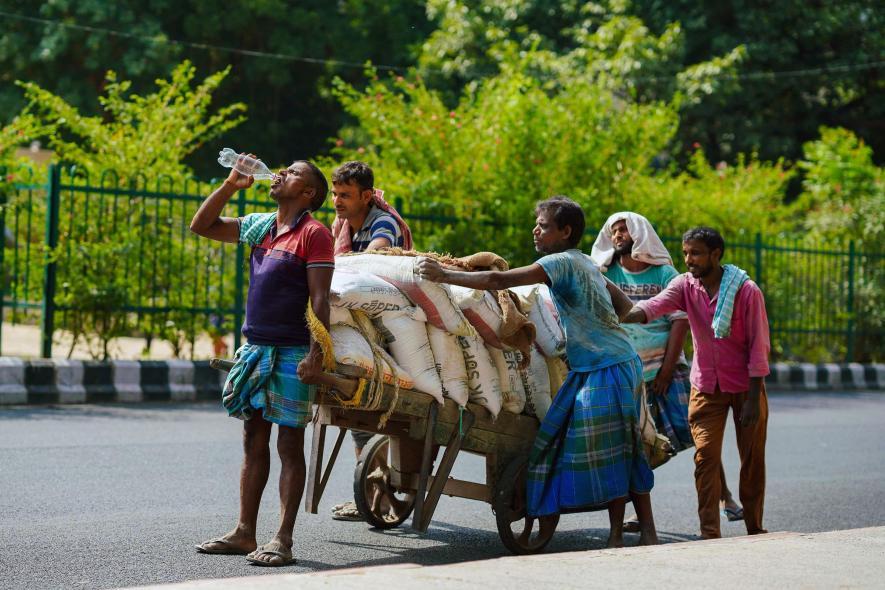
The effects of this disconnect are more and more apparent in Indian cities. Informal labour is one of the most visible examples of how climate change disproportionately impacts people, due to extreme heat. The heatwaves are lasting longer and becoming more intense in places such as Delhi, Kolkata, Ahmedabad, Hyderabad and Chennai. But the most vulnerable to the heat are those whose jobs depend on working outside.
Construction workers work long hours in the blinding sunlight with little access to cooling infrastructure or medical protection. Street vendors slog away near the heat of the road and the bustle of the markets. Delivery workers working in the digital platform economies face the elements, with their income dependent on meeting daily targets and algorithmic performance metrics. Sanitation workers and waste pickers continue to work in dangerous circumstances with little protection. For these people, a missed day of work because of extreme heat can mean lost vital cash for food, rent, and life.
The International Labour Organisation has long warned that heat stress could have an outsized impact on the productivity of work in countries, such as India. But productivity figures alone obscure the more profound human impacts. Informal workers are often caught between health and income. And so, climate vulnerability is inextricably linked to economic fragility.
Street vendors operate along hot roads and in crowded marketplaces. As the payment for the workers hired by digital platform economies to deliver the goods is linked to daily targets and algorithmic performance metrics, they have to endure adverse weather conditions. Sanitation workers and waste pickers continue to work in dangerous conditions with little protection. For these workers, a day out of work due to extreme heat often means missing vital cash for food, rent and survival.
The burden is even greater for women working informally. Climate change often affects gendered inequalities in income, mobility, access to healthcare and unpaid care responsibilities as well as domestic workers, home-based workers and women working in informal urban services. Women often do more of the domestic work in their families during heatwaves or flooding, while still working for low pay outside. Yet, rarely are there gender-sensitive labour protections for informal workers in climate adaptation programs.
Another illustration of how climate change has increased job insecurity is urban flooding. Flooding in Indian towns wreaks havoc on infrastructure and destroys the fragile economic ecosystems informal workers depend on. Daily wage earners lose money if transport and markets are shut down. The street vendor lost his inventory and his stall. Waste pickers and sanitation workers are more prone to disease and to drinking unsafe water. Migrant labourers in informal settlements are frequently displaced due to a lack of institutional support.
The Covid-19 outbreak has already exposed the structural invisibility of India’s informal labour sector. The migrant labourers who travelled hundreds of kilometres during lockdowns showed how much India’s economy relies on insecure and unprotected labour practices. Climate change is intensifying many of the same risks. But the lessons from the pandemic have not yet been properly incorporated into climate policymaking.
Part of the problem lies in the nature of India’s urban development approach. Indian cities continue to grow despite very unequal spatial arrangements in which informal workers live and work in climate-vulnerable situations. Informal communities typically lack basic infrastructure for housing, drainage, electricity, cooling and healthcare. Heat stress is, therefore, more than a climatic issue; it is also a housing and urban inequality issue.
The plight of migrant workers walking hundreds of kilometres during lockdowns revealed how much of India’s economy depends on insecure, unprotected labour practices. Many of those same risks are being worsened by climate change. But the pandemic lessons have not been fully internalised in climate policymaking yet.
Some of the problem is with the nature of the approach to urban development in India. Indian cities are still expanding in a highly unequal spatial pattern where informal workers live and work in climate vulnerable conditions. Informal communities are usually deprived of basic infrastructure, such as housing, drainage, electricity, cooling and healthcare. Heat stress is thus not only a climate issue, but also a housing and urban inequality issue.
The climate future of India will not be determined by the number of solar parks in India or the extent of its renewable energy ambitions. It will also depend on whether its policies respect the workers who keep its cities running in worsening environmental conditions. Informal workers are not helpless victims of climate change but are a part of India’s urban economy and social life. Yet they remain largely invisible in national climate governance.
The question of whether climate change affects informal labour remains unanswered. It already does. The big question is whether India’s climate policies are ready for the inequalities in its labour economy. Until then, India’s climate adaptation will be incomplete and the brunt of a problem they had little hand in creating will continue to be borne by the country’s most vulnerable workers.
The writer is a columnist and climate researcher with experience in political analysis, ESG research, and energy policy. The views are personal.
Get the latest reports & analysis with people's perspective on Protests, movements & deep analytical videos, discussions of the current affairs in your Telegram app. Subscribe to NewsClick's Telegram channel & get Real-Time updates on stories, as they get published on our website.