





Birth Anniversary: Why Marx Still Matters in India
India is growing fast. Its workers are not.
This is the contradiction that defines the present. Highways expand, startups scale, and wealth accumulates at unprecedented speed. Yet those who sustain this growth continue to work without security, without protection, and often without dignity. This is not a temporary imbalance. It is structural. That is why Karl Marx still matters.
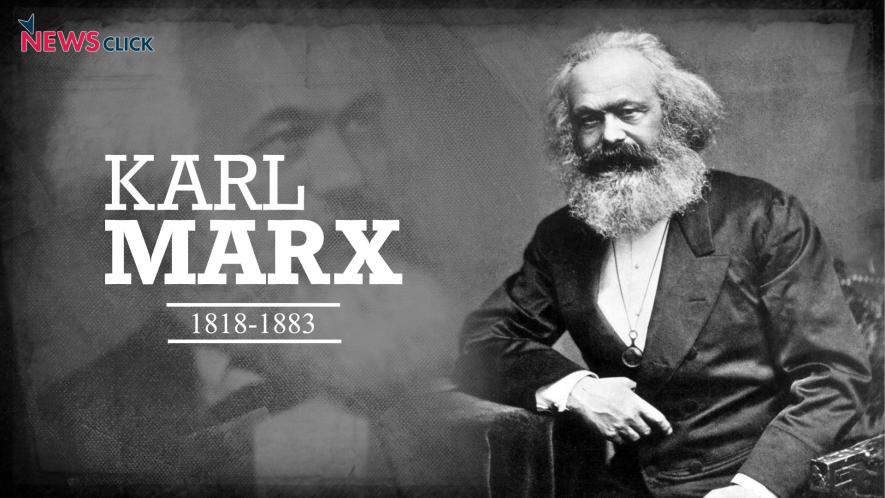
Marx, who was born on May 5, 1818, asked a simple question: who owns, who works, and who profits. In India today, the answers are increasingly unequal. Ownership concentrates. Labour fragments. The widening distance between the two is not a side effect of growth. It is how growth is organised.
The scale of this imbalance is stark. According to Oxfam, the top 1% in India owns more wealth than the bottom half combined. The top 10% controls the overwhelming majority of resources. Growth is visible. Its distribution is not. As India’s most respected historian, Irfan Habib, has argued, economic inequality in India has long been rooted in unequal control over resources and labour.
This concentration coexists with a labour structure defined by insecurity. Over 85% of India’s workforce operates in the informal sector, without contracts or social protection. Even within formal employment, informalisation is expanding. Stability is no longer guaranteed by having a job.
India is not facing a shortage of work. It is facing a shortage of work that can sustain a life.
More than half of the workforce is self-employed, and a significant share is engaged in unpaid labour. What is often presented as entrepreneurial energy is, in reality, economic compulsion. The line between employment and survival has blurred.
Consider a delivery worker in a major Indian city. He logs into an app he does not control. His earnings fluctuate according to algorithms he cannot see. Fuel prices rise. Incentives change without warning. A single accident can erase months of income. The platform grows. The worker absorbs the risk.
This is not flexibility. It is structured insecurity.
As Marx observed, “the worker becomes poorer the more wealth he produces.” The insight is not rhetorical. It describes a system where value is created at one end and captured at another—where labour is essential, but security is optional.
Supporters of the current model argue that growth will eventually correct these imbalances. That prosperity will spread. That time will do the work of policy. But the evidence suggests otherwise. Data from the Periodic Labour Force Survey shows that while headline unemployment appears moderate, urban unemployment remains persistently higher, and underemployment is widespread. Even minimal or irregular work is counted as employment.
The economy is generating jobs. It is not generating security.
This is not a failure of growth. It is a feature of how growth is structured.
Marx’s relevance lies here—not as ideology, but as diagnosis. When ownership concentrates and labour disperses, inequality does not resolve itself. It reproduces — quietly, efficiently, and often invisibly — through markets, institutions, and everyday practices.
Language helps sustain this process. Insecurity is reframed as flexibility. Lack of protection becomes efficiency. Risk is individualised, while profit is centralised. These are not neutral descriptions. They are ways of making structural inequality appear natural, even inevitable.
The consequences extend beyond income. Economic instability shapes decisions about education, health, and mobility. It shortens time horizons and weakens demand. A workforce that cannot plan cannot accumulate. An economy built on such labour cannot sustain broad-based prosperity.
Policy responses have largely focused on expansion—more infrastructure, more platforms, more schemes. These have produced visible gains. But they have not altered the underlying distribution of risk and reward. Growth, in its current form, depends on labour it does not secure.
In India today, inequality is not simply persisting alongside growth. It is being produced by it.
Marx does not offer a blueprint for resolving this contradiction. But he does clarify its logic. He shows how ownership, labour, and power align—and why, once aligned, they tend to reproduce the same outcomes.
The question, then, is no longer whether India is growing. It is whether that growth can sustain the people who make it possible.
If those who produce value remain excluded from its benefits, the imbalance will not correct itself. It will deepen. An economy that grows without securing its workers does not just risk inequality. It risks exhausting the very foundation on which its growth depends.
The writer is a researcher in South Asian history, specialising in socio-political dynamics, minority experiences, and marginalised voices. The views are personal.
Get the latest reports & analysis with people's perspective on Protests, movements & deep analytical videos, discussions of the current affairs in your Telegram app. Subscribe to NewsClick's Telegram channel & get Real-Time updates on stories, as they get published on our website.