





Bengal: Buddhadeb, Biswas Remembrance Brings Together State’s Cultural Soul, Politics
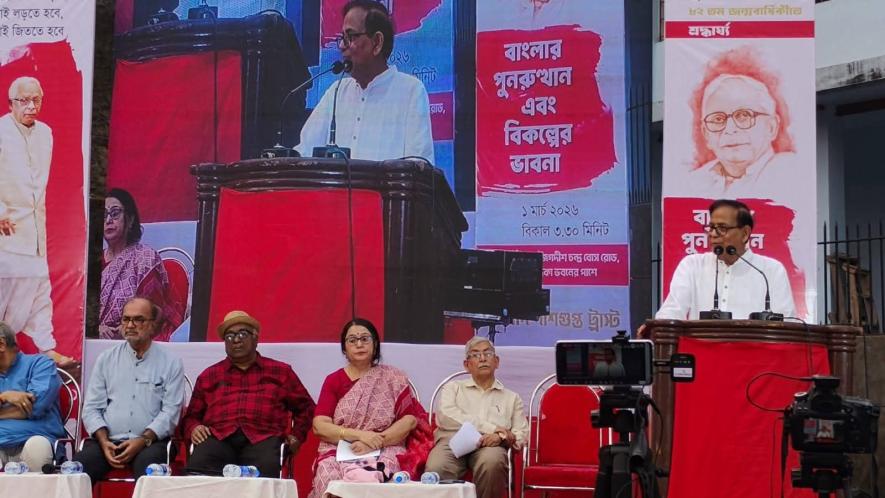
Kolkata: On March 1, Kolkata’s Acharya Jagdish Chandra Bose Road became the stage for a rare confluence of culture, politics, and memory. The 82nd birth anniversary of former West Bengal Chief Minister Buddhadeb Bhattacharya was observed with elan, drawing together artistes, intellectuals, activists, and political leaders. The day also coincided with the birth anniversary of former CPI(M) state secretary Anil Biswas, ensuring that the gathering was not merely commemorative but deeply reflective of Bengal’s Left legacy.
The programme, organised on land purchased by the Promode Das Gupta Memorial Trust, carried symbolic weight. This plot is slated to house a socio-cultural centre dedicated to Bhattacharya—a space envisioned as a hub for alternative discourse and cultural resistance. In many ways, the day’s events foreshadowed the centre’s mission: to blend Bengal’s cultural heritage with its political conscience.
A Tagorean Prelude
The event began on a Tagorean note, befitting Bhattacharya’s lifelong admiration for Rabindranath Tagore. IPTA (Indian People’s Theare Association) artistes opened with stirring performances, followed by Rabindra Sangeet exponent Agnivo Bandhyopadhyay, whose soulful renditions of Tagore’s songs set the tone for the evening. Elocutionist Urmimala Basu recited Tagore’s poetry, reminding the audience of the poet’s enduring relevance in times of social and political upheaval.
Later, Jayanti Soren and Sukumar Ghosh carried forward the cultural thread, ensuring that the programme remained rooted in Bengal’s artistic traditions. The choice of Tagore was deliberate: his works have long served as a bridge between culture and politics, offering both solace and inspiration to generations of Bengalis.
Rejuvenation of Bengal: Alternative Discourse
The cultural overture gave way to a high-powered discussion titled “Rejuvenation of Bengal – An Alternative Discourse.” Moderated by lawyer and Rajya Sabha MP Bikashranjan Bhattacharya, the panel brought together CPI(M) state secretary Mohd Salim, economist Ratan Khasnobish, former Prasar Bharati CEO Jawhar Sircar, activist and former IAS officer Anita Agnihotri, child health specialist Dr. Arun Singh, and folk song exponent Ranjan Prasad.
In his address, Salim declared that “democracy is at stake in Bengal,” warning against the rise of a “threat culture” that silences dissent. He called upon citizens to unite against fear and wrongdoing, framing the struggle in both local and global terms. Drawing parallels with Iran and Venezuela, Salim argued that the fight for sovereignty and independence was being undermined worldwide, and Bengal must resist similar erosions at home.
Giving a bureaucrat’s perspective, Sircar, known for his candid comments, compared Bhattacharya’s administration with the present regime. “I used to quarrel with Buddhadeb Bhattacharya,” he recalled, “but today dissent would mean a transfer to Sandeshkhali.” His remarks highlighted the shrinking space for dialogue within governance. Sircar also lambasted the rampant corruption, pointing to false job cards in MGNREGA (rural job guarantee scheme) and the conspicuous wealth of some local leaders. His critique underscored the erosion of decentralisation and the complicity of police in grassroots corruption.
Speaking on the overall economic decline, Khasnobish painted a sobering picture of Bengal. Once ranked third nationally in per capita income during the Left Front era, Bengal now lags behind Odisha. He lamented the plight of scheme workers who were manhandled by police while attempting to submit deputations in Kolkata. The economist suggested that the state’s economic decline was not merely statistical but deeply tied to governance failures and disregard for workers’ dignity.
Speaking on gender disparity, activist and former IAS officer Agnihotri noted that women in the unorganised sector faced meagre wages, lack of basic facilities, such as toilets and crèches, and risked losing their jobs if they complained about harassment. She reminded the audience that rejuvenation could not be achieved without addressing systemic inequities faced by women workers.
Child health specialist Dr. Singh emphasised the need to prioritise maternal and child health. “Within the family pyramid, mothers and children are at the lowest rung,” he observed. He linked Bengal’s rejuvenation to education, arguing that true progress lies in building “real people” through equitable access to learning and healthcare. His call echoed Bengal’s historic role as a leader in education and social reform.
Country song exponent Ranjan Prasad infused the gathering with music, performing anti-imperialist songs that resonated with the crowd. His performance was not mere entertainment but a reminder of Bengal’s tradition of using art as a vehicle for political resistance. “There must be an action plan to rejuvenate Bengal and Leftism,” he urged, tying cultural expression to political renewal.
A Legacy in Transition
The choice of venue—a plot destined to become a socio-cultural centre dedicated to Bhattacharya—was itself symbolic. It signalled a commitment to institutionalising alternative discourse, ensuring that Bhattacharya’s legacy was not confined to memory but actively shapes Bengal’s future.
Speakers repeatedly invoked Bengal’s past as a frontrunner in industry, culture, education, and political thought. From the resonance of slogans like “Vietnam, Vietnam” to the intellectual ferment of the Left Front era, the refrain was: Bengal must reclaim its role as a beacon of solidarity and resistance.
The day’s events underscored the intertwining of culture and politics in Bengal’s identity. Tagore’s songs, IPTA’s performances, and Prasad’s anti-imperialist music were not mere embellishments but integral to the discourse. They reminded the audience that Bengal’s political imagination has always been nourished by its cultural soul.
Rekindling the Spirit of Resistance
As the programme drew to a close, the mood was one of nostalgia and resolve. Nostalgia for a time when Bengal led the nation in cultural and intellectual pursuits, and resolve to rejuvenate that spirit in the face of contemporary challenges.
The anniversary observance was more than a tribute to Buddhadeb Bhattacharya and Anil Biswas. It was a call to action—a reminder that Bengal’s legacy of resistance, solidarity, and cultural richness must be rekindled to confront the crises of democracy, corruption, and inequality.
In the words of Dr Singh, “Education should build real people in the state.” That sentiment captured the essence of the day: a belief that Bengal’s rejuvenation lies not in statistics or slogans alone, but in nurturing its people, culture, and conscience.
Get the latest reports & analysis with people's perspective on Protests, movements & deep analytical videos, discussions of the current affairs in your Telegram app. Subscribe to NewsClick's Telegram channel & get Real-Time updates on stories, as they get published on our website.