





Belem COP30 --- The Zero COP!
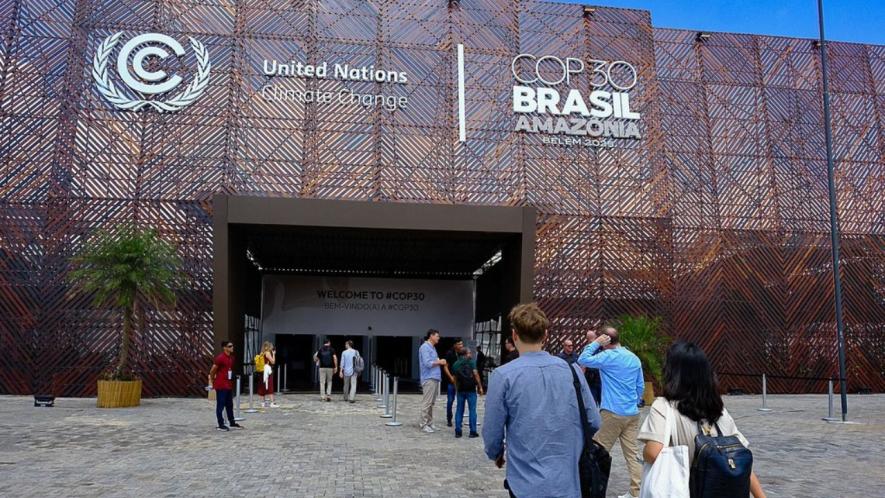
Image Courtesy: Flickr
The COP30 in Belem, Brazil, held in November, had been preceded by a decided lack of momentum in international climate action and in the global negotiations process. Therefore, not much was expected of it, as commented in these columns earlier when the COP was set to begin.
In anticipation of the weak outcomes, COP30 had been billed variously as the “implementation COP,” the “indigenous peoples COP”, given its venue at the entry to the great Amazon rain forest and its many thousand original inhabitants, or even bravely as the “COP of truth,” as proclaimed by President Lula da Silva of Brazil.
In contrast, people’s expectations and demands for urgent climate action remained undiminished, with over 80,000 people in attendance, including around 58,000 registered delegates, making it the largest COP attendance after COP28 in Dubai.
However, when COP30 closed after the nowadays obligatory extra day to enable stitching up some kind of agreement, the two-week conference had delivered literally almost no progress on any of the major fronts, in terms of tackling the dangerously high greenhouse gas (GHG) emissions or the resultant mounting climate impacts affecting millions of people.
Read Also: Belem COP30: Implement What?
On key issues, there were only a few facesaving promises of future steps and even some retrograde pronouncements after much wrangling, prompting some commentators to call this the most divisive COP ever. For the most part, the cans were kicked down the road on almost all issues. This was truly a zero COP.
Emissions Reduction Ambition
On what should have been the paramount issue at COP30, shockingly little attention was paid. The world is way behind on what needs to be done to combat climate change. A prolonged and rigorous three-year scientific global stocktake (GST) mandated under the Paris Agreement has completed its task and was even reviewed at COP29 in Baku last year. The United Nations Environment Programme or UNEP has also since assessed that emissions gap between the global goal and current emission trends. Even the final COP30 text notes that global carbon dioxide emissions should decline from 2019 levels by 43% and 60% by 2030 and 2025, respectively, to meet the internationally agreed goal of restricting global temperature rise to 1.5C.
The UNEP notes, however, that total global emissions are continuing to rise and will decline by only 12% even if all countries adhere to the emission reduction commitments contained in their Nationally Determined Contributions (NDCs).
Yet, far from making any concerted effort to address this failure and drive up emission reduction ambitions, virtually no effort was made to discuss or review the current status of NDCs submitted, and catalyse some action by different countries, especially the developed countries, such as the European Union, Japan, Canada, and Australia, to undertake deeper emission cuts.
The final “global mutirao” agreement --- a Brazilian term meaning a multi-stakeholder deliberation --- only promises to “keep 1.5C within reach,” but kicks the can down the road to two poorly defined unofficial and voluntary future processes outside the COP process but led by the COP30 and COP31 presidencies, termed a “Global Implementation Accelerator” (GIA) toward a “Belem Mission 1.5C.”
The GIA would be held during the inter-sessional meeting in Bonn in mid-2026 and a report presented at COP31, while the three presidents of COP29-31 will similarly assess and report on progress on all measures agreed on so far for the Belem Mission. Not many will bet on these ventures proposed by the COP30 president as a desperate last-minute measure to salvage something from the Belem Conference.
Even here, though, the final text highlights the dark clouds hovering overhead. The final text draws attention to the fact that carbon budget left to enable the 1.5C goal is “small and being rapidly depleted,” with 80% having already been exhausted historically.
For the first time, the agreed COP text also tacitly acknowledges the bitter reality that there is likely to be an overshoot of the 1.5C target, meaning that global temperatures may well rise above that level even if temporarily, and calling for limiting “both the magnitude and duration of any [such] overshoot.”
It did not go unnoticed that India, currently the world’s third largest emitter, although with extremely low per capita emissions, shockingly failed to submit its updated NDC even though it has had time since February 2025!
Forests
A new initiative on mitigation came from Brazil, championed by President Lula, focusing on preventing deforestation. The proposal gained particular salience because of the Amazonian setting of COP30. The initiative comes at a time when the world’s forests are now absorbing the historically least amount of carbon dioxide (CO2) due to deforestation under pressure of land clearance for plantation, mining or other economic activity as well as forest fires. Significant parts of the Amazon itself, and perhaps soon the entire Amazon forest tracts, are on the verge of flipping from a net sink or absorber of CO2 to a net emitter, majorly weakening efforts to control global emissions.
Brazil’s proposal for a Tropical Forests Forever Facility (TFFF) was to form a trust fund, hosted at the World Bank, which would receive funds from public sources so as to leverage a larger corpus from private entities targeting total of $120 billion.
The funds would be invested, other than in fossil-fuel based activities, to generate returns at par with market rates such that preservation of forests would be as economically valuable as destroying them for other uses. An important provision was that 20% of the funds would be earmarked for indigenous peoples and other forest dwelling communities. Brazil kicked off TFFF with a contribution of $1 billion.
Efforts to make this part of the main body of the COP decisions failed, however, although Norway and Germany pledged similar amounts. German Chancellor Friedrich Mertz paid a customary short visit to the COP and released a statement upon return to Germany that seemed to suggest criticism of the standards of facilities in Belem not matching those available in Germany. This drew much disapproval in Brazil and around the world, and appeared to push Chancellor Mertz into donating $1 billion to TFFF, prompting several commentators to remark on such a costly apology!
The proposal suffered the fate of several other key issues up for decision at COP30, and got kicked down the road to a “roadmap” to be worked out later.
Fossil Fuels
An issue of key concern for emissions reduction which stirred up a major storm in Belem was on measures to reduce the role of fossil fuels, which account for around 70% of all GHG emissions and close to 90% of CO2. Initial draft texts suggested pathways to “transition away” from fossil fuels, and championed by the EU, was vociferously opposed by Saudi Arabia and other “petro-states,” India and the Like-Minded Developing Countries coalition, including the Africa Group and China.
This may sound counter-intuitive, given the reality that decarbonisation of the global economy must necessarily involve moving away from fossil fuels. This is also explicitly recognised in the Global Stocktake. However, how the issue is contextualised and framed is important. India, for instance, despite acerating renewable especially solar energy to 50% of installed capacity, is likely to remain dependent on coal-fired power generation for electricity actually produced for a considerable length of time yet.
The history of earlier recent COPs would throw light on this. COP26 in Glasgow was compelled to change the phraseology of its agreement from “phasing out” to “phasing down” fossil fuels, further toned down in COP29 in Baku. At Belem, there was a concerted revolt at what was perceived as attempts to impose energy transition pathways in isolation from other factors on developing countries.
After much often heated discussion, in what must be seen as a strange outcome, the final text has no mention of fossil fuels at all!
On the other hand, there was important emphasis placed on just transition, a concept embracing sustainability, equity, inclusion and human development along with energy efficiency and decarbonisation.
Once again, though, there was little effort put in within the COP process on fleshing out this idea, and COP30 finally accepted the COP President Andre Correa do Lago’s proposal to initiate a “roadmap” after and outside the formal COP framework to work out how such a transition could be achieved.
Adaptation & Finance
Two issues came to dominate at Belem, which seemed to animate delegates, particularly from developing countries the most: adaptation and finance, both intimately related.
The issue of how much comparative weight should be placed on adaptation and mitigation has been prominent in the international negotiations almost from the outset, with trends favouring first one then the other. With climate impacts growing in severity and magnitude, posing huge costs on nations in terms of lost lives, livelihoods, ecosystems and infrastructure, the urgent need for adaptation and building resilience along with finance for the same has come to dominate thinking in developing countries, which is reflected at successive COPs.
Adaptation actions pose a conceptual difficulty in the COP framework. Whereas mitigation or emissions control calls for national actions contributing towards national outcomes, outcomes of national adaptation actions are also national. Therefore, while funding from developed to developing countries is called for, how is accountability and transparency regarding national adaptation actions to be ensured without trampling on sovereignty?
The previous few COPs and inter-sessional meetings, including COP29, have worked on this issue, partly through trying to define a set of indicators to be addressed in adaptation actions under the Global Goal for Adaptation (GGA). An initial set of thousands of indicators were whittled down to 100 at Belem with an aim to further define 59 voluntary non-intrusive indicators and other measures to be concretized later. It thus appears that the GGA will fructify as a programme soon.
Finally, it all came down to finances, the dominant theme at Belem. Earlier COPs had seen the quantum of finances expected from developed to developing countries rise to $300 billion annually. Although even this amount is not materialising, pressure was mounted to triple the flow of funds and to increase the component of grant-based public funds rather than loans so as to ease the burden on poorer nations.
After much wrangling, the final COP30 text did incorporate the aspirational goal of tripling finance flows including public and private finances, and a goal of raising $300 billion of public finance by 2035, pushing the date forward from 2030. But this is to be discussed under a two-year work programme.
With so much work now pending and half-done, there is much to be done in forthcoming inter-sessionals and the coming COPs. The big question is whether, and how, lost momentum will be recovered. And how much worse will climate changes become meanwhile.
The writer is with the Delhi Science Forum and All India Peoples Science Network. The views are personal.
Get the latest reports & analysis with people's perspective on Protests, movements & deep analytical videos, discussions of the current affairs in your Telegram app. Subscribe to NewsClick's Telegram channel & get Real-Time updates on stories, as they get published on our website.