





Assembly Elections: Two Bengals, Two Narratives
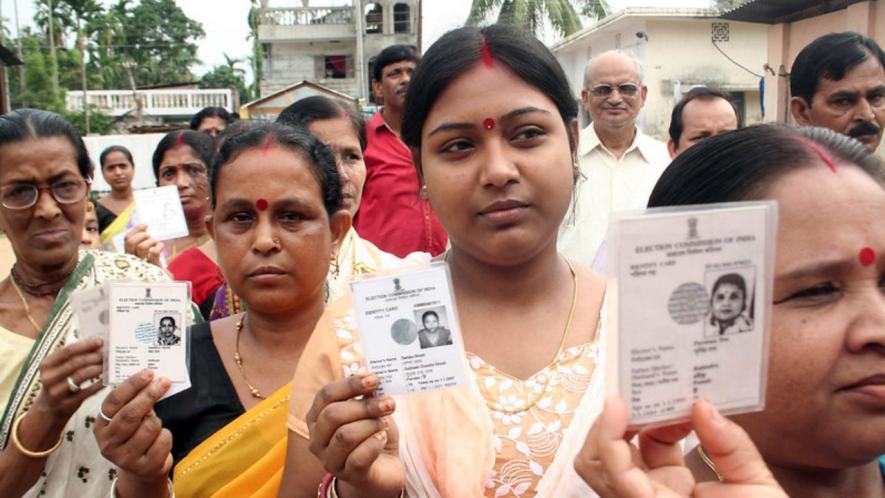
Representational image. Image Courtesy: Flickr
Kolkata: On a single Saturday (March 15), the contest for Bengal's political soul played out in two cities simultaneously — one was a carefully manufactured spectacle of power, the other a pointed dismantling of it. The 2026 Assembly election has arrived, and the battle for narratives has begun in deadly earnest.
There are days in Indian politics when the stagecraft is so obvious, and yet so consequential, that it demands to be called out rather than merely reported. Saturday, March 14, was one such day in West Bengal.
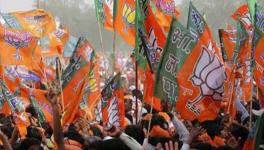
At the Brigade Parade Ground in Kolkata — a venue soaked in the history of Bengal's Left movement, a ground where millions once gathered under red banners to hear former Chief Minister Jyoti Basu and CPI(M) leader Harkishen Singh Surjeet — Prime Minister Narendra Modi arrived draped in saffron, flanked by party machinery, and backed by a media apparatus that has long mastered the art of manufacturing crowd optics.
Simultaneously, 300 kilometres to the north, in Siliguri, CPI(M) state secretary Mohd. Salim stood before a different gathering and delivered something increasingly rare in the era of managed political spectacles: a sharp, historically grounded counter-argument.
The contrast between the two events was not merely visual. It was ideological. It was a window into the competing visions of what Bengal's political future should look like — and, more urgently, who it should serve.
The Brigade Maidan Spectacle
Modi's presence at Brigade was the culminating event of the Bharatiya Janata Party’s (BJP) Parivartan Yatra — a statewide mobilisation drive built on one central promise: change. The choice of the Brigade Parade Ground was no accident. For decades, the ground has been the Left's sacred political stage, the space where the Communist Party of India-led Left Front demonstrated to all of India that it could move masses. By attempting to occupy that very space, the BJP was sending a message: “we have come not merely to compete with the Trinamool Congress (TMC), but to inherit Bengal's political history itself.”
The problem, as several observers noted with quiet satisfaction, was that the inheritance was thin. Video footage and ground reports from multiple sources painted a consistent picture: the turnout fell well short of what BJP's own mobilisation machinery had promised. Significant stretches of the ground were visibly sparse. Yet the imagery that circulated on television channels and social media told a different story — tightly cropped shots, aerial angles chosen carefully, and BJP's own formidable media cell working overtime to ensure that the optics were farther from the reality.
"The visuals were stronger than the actual turnout — and that gap, between perception and presence, is precisely what defines BJP politics in Bengal today,” said an observer.
This is not a minor observation. Political confidence in a state like Bengal is partly self-fulfilling: if a party appears strong, fence-sitters move toward it. The BJP understands this dynamic better than any other party currently operating in the state, and it deploys this with clinical precision. Saturday's rally, thin crowd and all, was designed as a signal — not to the people in the ground, but to the people watching at home.
Modi's address was combative and unambiguous. “The end of TMC (Chief Minister) Mamata Banerjee’s ruthless government is inevitable,” he declared, positioning BJP as the singular force capable of ending what he described as a “decade of violence, misrule and institutional decay” under TMC.
PM Modi inaugurated infrastructure projects worth Rs 18,680 crore — including the 231-km Kharagpur-Morgram Economic Corridor, the redevelopment of six railway stations under the Amrit Bharat Station Scheme, the flagging off of the Purulia–Anand Vihar Terminal Express, and a clutch of port and highway investments — presenting the Union government as a benevolent patron being blocked from fully serving Bengal by a “hostile and corrupt” state administration.
It was a well-rehearsed performance. The problem, as Salim argued, was not the performance itself. The problem is who wrote the script.
Salim's Dissection: Two Sides, One Coin
In Siliguri, CPI(M) leader Salim was not interested in matching spectacle with spectacle. His address was something becoming rare in contemporary Indian politics — a sustained, historically anchored argument that refused the terms of the debate being set by both BJP and TMC.
His opening move was to name what most journalists and political commentators routinely leave unexamined: the BJP, Salim reminded his audience, was the very 'inceptor' of Banerjee's political career as an independent force.
This is documented history. Banerjee founded the TMC in 1998. She served as Union minister in not one but two governments led by BJP’s Atal Bihari Vajpayee. After the Gujarat riots of 2002, when the conscience of the nation was convulsed by what had been permitted to happen under Modi's watch as Chief Minister, Banerjee sent him flowers. Not a letter of protest.
"They are two sides of the same coin, secretly in cohesion," Salim told the crowd in Siliguri — and the “charge is not rhetoric. It is political archaeology."
Salim's argument cuts deeper than the familiar accusation of a 'secret understanding' between BJP and TMC, though he made that charge too. What he said was something more structurally significant: the BJP-TMC binary was a manufactured political terrain that served both parties and eliminated space for a genuine ideological alternative. By framing every election as a referendum between saffron and white-and-blue, both formations benefit. The BJP consolidates the Hindu nationalist vote by positioning itself as the only force capable of defeating Mamata, while TMC consolidates its Muslim minority and Bengali sub-nationalist vote by positioning itself as the only wall standing between Bengal and BJP. In this arrangement, the Left is squeezed from both sides, he argued.
What Salim refuses to accept — and what makes his politics uncomfortable for the current media consensus — is the premise of the squeeze itself.
LPG Question: Where Macro Meets Kitchen
If Modi's rally was about mega-infrastructure and electoral ambition, Salim's address was a deliberate descent into the granular realities of household economics. The recent hike in domestic LPG cylinder prices — a Union government decision — was the CPI(M) leader’s chosen instrument of contrast.
“The recent increase in domestic cooking gas prices is a direct attack on the poor and middle class,” he said. In a state where a large proportion of the population lives on tight margins, where working-class families in the urban periphery and rural hinterland are already squeezed by inflation, stagnant wages and the residual economic disruptions of the pandemic years, the LPG hike is not an abstraction. It is felt, every morning, when a family decides what it can and cannot afford to cook.
“What good is a new road,” Salim asked the gathering in Siliguri, “if a mother cannot afford to cook her children a meal?” The BJP's development narrative in Bengal, as across India, tends to operate at the level of the ribbon-cutting and the aerial photograph. It is a politics of the inaugurated, not the inhabited.
The Cultural Slip and What It Reveals
There was one moment from Modi's Brigade address that Salim seized upon, and it deserves more attention than it has. During his speech, the Prime Minister mispronounced the name of Ramakrishna Paramhansa — the 19th-century mystic and spiritual teacher who is among the most revered figures in Bengal's modern cultural memory, the guru of Swami Vivekananda, and a symbol of the Bengal Renaissance, whose influence extended across the subcontinent.
For a leader who has constructed his entire political identity around Hindu cultural pride, spiritual nationalism, and an intimate relationship with India's religious heritage, this was more than a slip. It was a revelation. Bengal's relationship with Ramakrishna Paramhansa, Swami Vivekananda, Rabindranath Tagore and the broader intellectual and spiritual tradition of the Bengal Renaissance is not merely sentimental. It is constitutive of Bengali identity across religious and political lines. To mispronounce the name of Ramakrishna in front of a Kolkata audience is to reveal, in one unguarded moment, the depth of the distance between Delhi's political imagination of Bengal and Bengal's own understanding of itself.
Salim termed this 'a saffron spectacle devoid of substance.' He alleged that the event had been funded through Union government resources, and that trains were arranged from Bihar and Jharkhand to supplement the crowd. These are charges that require verification — but their political logic is consistent with a pattern that has been documented repeatedly at BJP events across multiple states.
The Left's ‘Long Game’
It would be dishonest to present Salim's counter-narrative as an equal political force to BJP's Brigade mobilisation in terms of current electoral arithmetic. The reality is harder.
For over a decade, Bengal's politics has contracted into a bipolar contest. Voters who are dissatisfied with TMC's governance — its patronage networks, its record of political violence, its tolerance of corruption within the party structure — tend to see BJP as the only viable alternative. However, the Left's argument about collusion, however historically well-grounded, has struggled to translate into votes.
Yet there are signals that the contraction is not permanent. Rallies led by the Democratic Youth Federation of India have drawn significant and notably young crowds. In select Assembly segments, the Left's performance in recent local body elections has shown signs of recovery.
In a political environment where both TMC and BJP carry heavy baggage — one from years in power, one from its own record at the Centre — the Left's argument that it represents a cleaner, more consistent alternative has space to grow, if it can be made credibly and consistently.
The 2026 Assembly elections will not be won on a single Saturday. These will be won or lost across thousands of booths, in millions of conversations, in the slow accumulation of trust or its erosion. What Saturday showed is that both the Modi machinery and the Left's cadre politics understand this — and that the contest for Bengal's narrative has entered its most intense phase.
"One Bengal gathered at Brigade, chanting Modi's name. Another Bengal listened to Salim in Siliguri, and heard a different story entirely. The question is which Bengal is larger — and which story, in the end, will hold," said an observer.
If nothing else, March 15 confirmed what anyone paying close attention already suspected: the struggle for Bengal is not between BJP and TMC. It is between two entirely different visions of politics in this state, who it should serve, and what kind of future it is.
The curtain has risen. The election has begun.
Get the latest reports & analysis with people's perspective on Protests, movements & deep analytical videos, discussions of the current affairs in your Telegram app. Subscribe to NewsClick's Telegram channel & get Real-Time updates on stories, as they get published on our website.