





Assam Floods: Disaster Came Too Fast for Communities to Prepare
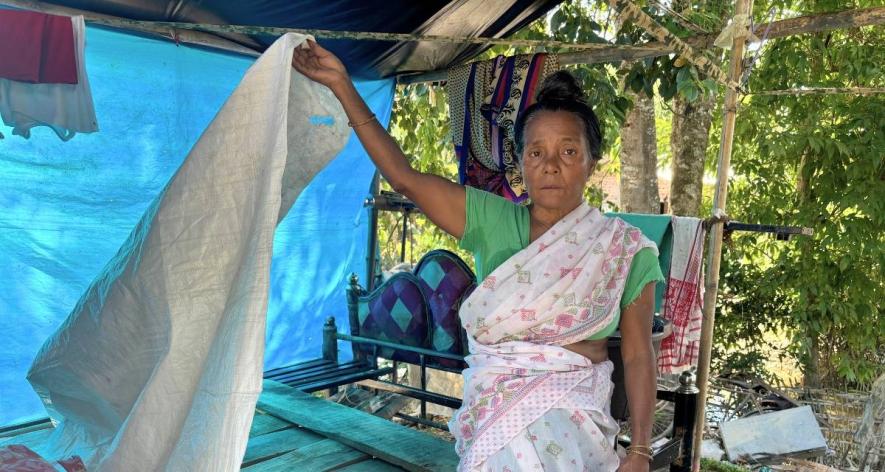
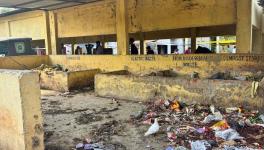
Swarna Das shows the wooden bed where she has been living and sleeping for the past month, without even a mattress (Photo: Sayantani Deb, 101Reporters).
Sivasagar/Charaideo/Jorhat, Assam:“Amar to ekui nai.”
“We have nothing left.”
Swarna Das, 60, sat under a makeshift shelter along the Sepon-Sunpura Road in Assam’s Charaideo district, recalling the flood that swept through her home on July 19. For several months, she had been preparing for her granddaughter’s tuloni biya — a ceremony marking a girl’s transition into womanhood after she begins menstruating. The family had bought gold ornaments, a mekhela sador made of muga silk, a traditional Assamese attire, and mulberry silk to gift her granddaughter during the ceremony. But within half an hour, much of what her family had built and saved over nearly 15 years was gone.
Swarna Das is among the lakhs of people affected by the floods that have killed more than 100 people in the state. On August 17, Chief Minister Himanta Biswa Sarma said that flood losses in four Upper Assam districts had touched Rs 450 crore.
Residents and experts say what made the disaster particularly devastating was not just its scale. The flooding was unusually sudden, leaving communities with little time to respond and exposing how poorly prepared many areas were for a flood of this nature.
‘Unfamiliar’ Annual Floods
For people living in Assam, floods are a familiar part of the monsoon. But this year, the speed and intensity of the flooding caught many communities off guard.
Environmentalists and researchers say the scale and nature of the recent flooding cannot be viewed in isolation from changing weather patterns and human interventions in the region.
Tirtha Prasad Saikia, director of the North-East Affected Area Development Society, said floods in Assam have traditionally been slow-onset disasters, giving communities some time to anticipate and respond. This time, however, the water rose with little warning.
“Very quickly, everything was submerged,” he said, pointing to changes in rainfall patterns, including more frequent episodes of intense rain interspersed with prolonged dry spells. Parts of Golaghat and Jorhat, he noted, had experienced drought-like conditions only days before the flooding.
Noted climatologist and former director of the Indian Institute of Tropical Meteorology (IITM), Dr Bhupendranath Goswami, attributed the changing nature of floods to both climatic and human-induced factors.
“The recent flooding in Upper Assam is a perfect example of how human activities such as deforestation and mining are changing climatic conditions and affecting the topography,” he said.
Goswami described the recent flood as unusual, saying that the frequency of extreme rainfall events has increased with changing climatic conditions.
“Due to sudden changes in climate, frequent extreme rainfall events have increased over the years. If we compare it with around four decades ago, the frequency has risen considerably,” he said.
Bhaswati Das, a geography teacher at DCB College, Jorhat, mentioned Assam’s geographical location and the presence of numerous tributaries of the Brahmaputra and Barak make the state flood-prone.
However, she added that the impact of this year’s flooding was intensified by high rainfall in the region, particularly upstream, along with deforestation, mining and the accumulation of silt in riverbeds.
“The sediments generated by haphazard anthropogenic activities in the upper watersheds have increased the sediment load in rivers such as the Dikhow, Disang and Dhansiri. Over the years, the accumulation of these sediments has raised and silted the riverbeds, contributing to devastating floods like the recent one,” Bhaswati Das said.
Rapid Rise in Waters
Swarna Das also recalls how suddenly the flood unfolded in their village.
At around 3 am, her phone rang. It was a neighbour calling to inform her that the embankment along the Disang river had breached and floodwater was rapidly entering the area. She immediately alerted her son and daughter-in-law. The family of five escaped.
Her neighbour, Jyoti Das, 35, a young widow raising her five-year-old son said: “When the flood came, my only thought was to save my son. It was only the next morning that I realised how much we had lost.”
According to a flood report issued by the Assam State Disaster Management Authority (ASDMA) on July 20, flooding affected more than three lakh people across 189 villages in Sivasagar, 162 in Jorhat, 108 in Charaideo and 101 in Golaghat. Till August 17, the total death toll had reached 105, with Sivasagar reporting the highest number at 53, followed by Charaideo with 22, Jorhat with nine and Golaghat with eight. But the impact of the flooding is also visible in the everyday difficulties faced by those who survived.
In Hulang Katoni Chetia Chowk, one of the worst-hit villages in Sivasagar, octogenarian visually impaired woman Kusum Phukan Borgohain has been avoiding the toilet since the floods damaged it, as navigating the altered surroundings has made it difficult for her to reach it.
“Being visually impaired, I could only feel what was happening but could not understand it at first. When the water started rising, my grandson lifted me into his lap, carried me out of the house and left me at a safer place. Since then, I have been taking as little food and water as possible to avoid using the toilet,” she said.
Borgohain, who spent many years in Majuli before moving to Sivasagar, said communities on the river island prepare for floods well before the monsoon.
“People on the island prepare for floods well before the monsoon by storing food grains and arranging temporary shelters. They even avoid organising community festivals during that period. What happened here is completely different and therefore quite shocking,” she added.
Gaps in Local Preparedness
Saikia, who works closely with communities at the grassroots, said people in these areas had limited experience of dealing with floods of such magnitude.
“Whether at the traditional or community level, people did not have adequate disaster preparedness. There was also no micro-level governance system in place,” he said.
He contrasted this with flood-prone districts such as Dhemaji, Lakhimpur and Majuli, where communities have historically developed ways of adapting to recurring floods.
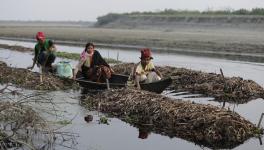
“In these areas, people often live in chang ghars built above maximum-flood levels, while communities in char areas have developed floating shelters to withstand severe flooding,” Saikia explained.
Himangshu Bailung, a state officer with ADRA India, another organisation working on the ground, said communities that had not previously experienced severe flooding had fewer established coping mechanisms.
“As most of these families had never experienced floods of this scale, their coping mechanisms, physical, mental and emotional, have taken a massive setback. Compared to areas that face annual floods, people here have fewer coping mechanisms because they have not lived with floods for generations,” he added.
“In flood-prone areas, granaries are often built at higher levels. In places such as Sivasagar and Jorhat, these structures are comparatively lower,” Bailung added.
Samir Ali, executive convergence officer for Upper Assam with SeSTA, stressed the need for greater awareness and preparedness among communities that had not traditionally been exposed to severe flooding.
However, Rupam Bora, former District Disaster Management Authority (DDMA) official of Sivasagar, disputed these claims and said, “There was sufficient preparedness. The flood came suddenly without an India Meteorological Department warning, leaving very little time to react. That made the situation more hazardous.”
A researcher on the Brahmaputra river basin, Dr Mirza Zulfiqur Rahman, attributes the changing nature of floods to climate change in conjunction with a range of human-induced factors.
“Over the years, floods have taken different forms. Climate change is certainly one of the reasons, but there are other contributing factors too. Human interventions are increasing rapidly, amplifying the effects of climate change, and these cumulative impacts have magnified the scale and intensity of the recent disaster,” Rahman said.
He cautioned that flooding is likely to recur in these areas and that proper preparedness and long-term planning are essential.
Rahman noted that after the Great Assam Earthquake of 1950, districts such as Jorhat, Dibrugarh and Sivasagar, which were important resource-rich centres, had received greater protection in terms of embankment construction.
“In an attempt to protect the south bank of the Brahmaputra, the districts on the north bank, such as Dhemaji and Lakhimpur, which were considered less economically important, received comparatively less attention. The flooding pattern was significantly altered and as a result, people of these areas have historically experienced instances of flooding and also know the coping mechanism,” he said.
Rahman called for scientific research on floodplains and urged the governments of all Northeastern states to come up with a bioregional/ecoregional plan taking account of the cultural and traditional knowledge of indigenous communities.
“This will help in flood preparedness, mitigation while adopting a larger landscape approach to governance.”
Sayantani Deb is a freelance journalist and a member of 101Reporters, a pan-India network of grassroots reporters.
Get the latest reports & analysis with people's perspective on Protests, movements & deep analytical videos, discussions of the current affairs in your Telegram app. Subscribe to NewsClick's Telegram channel & get Real-Time updates on stories, as they get published on our website.