





After Setbacks in West Africa, France Courts Anglophone Africa
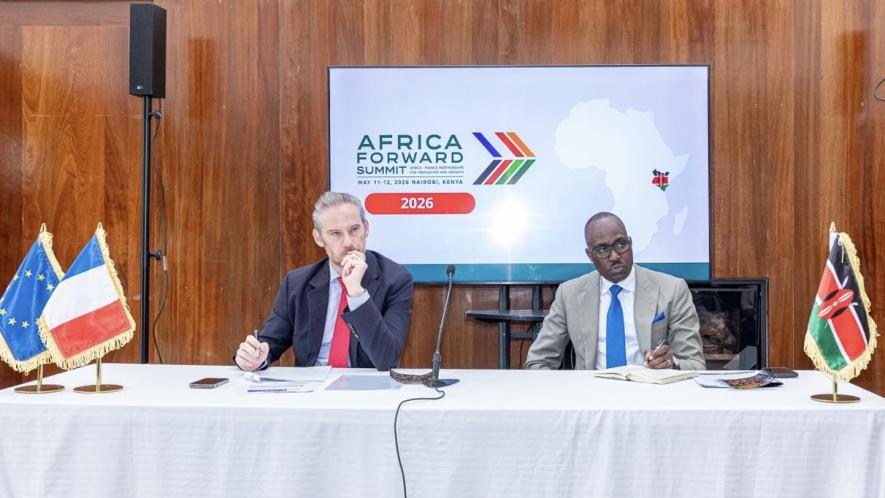
Dr. Korir Sing’Oei, of Kenya's Department for Foreign Affairs, with French Ambassador to Kenya and Somalia Arnaud Suquet. Photo: Kenyan Foreign Ministry
From May 11–12, Nairobi will host a two-day France–Africa Summit, jointly convened by the governments of France and Kenya. French President Emmanuel Macron is expected in the country alongside 30 African heads of state and government, hosted by President William Ruto. Framed around themes of innovation, economic growth, business cooperation, partnership, and security, the summit officially aims to “affirm a shared commitment to developing common, mutually beneficial solutions based on effective multilateralism and a spirit of transformative partnership.”
A shifting French strategy in Africa
The summit, officially called “Africa Forward Summit: Africa-France Partnerships for Innovation and Growth”, has already raised major questions: Why is the Summit being held in Anglophone East Africa? And, why is France increasingly pursuing high-level engagement in that region?
The Nairobi summit appears to be not just a platform for development cooperation or business networking, but as part of a broader French strategic recalibration at a moment when its historic sphere of influence in Africa is undergoing profound strain. France’s expanding engagement with Anglophone Africa must be situated within the context of its declining influence in the Sahel.
The shift of strategy has already triggered resistance from Pan-African and progressive movements in Kenya. Progressive groups in Kenya and the continent have come together to organize the Pan-Africanism Summit Against Imperialism (PASAI), a parallel counter-summit in Nairobi. PASAI’s critique reframes many of the summit’s official themes through a more Pan-African and anti-imperialist lens. On questions of finance, the coalition rejects discussions around merely “reforming” the international financial system, instead calling for the dismantling of neo-colonial monetary structures and the cancellation of African debt. The critique draws historical connections to systems such as the CFA Franc, long viewed by critics as mechanisms of continued French economic control in parts of Francophone Africa.
The coalition also challenges the summit’s emphasis on green industrialization and energy transition. PASAI argues instead we should be confronting the root causes of climate change not the false solutions of green capitalism.
The Sahel rupture
Over the last several years, anti-French sentiment has intensified across the Sahel. Military governments in Mali, Burkina Faso, and Niger, installed through patriotic coups, expelled French troops and downgraded diplomatic relations with Paris in response to popular pressure. Public demonstrations against French military presence have grown in frequency across French West Africa, not just limited to the AES countries, as many young Africans have questioned whether decades of French intervention has delivered either security or meaningful development.
This emerging political mood in the Sahel has been increasingly shaped by demands for sovereignty, anti-imperialism, and rejection of foreign military control. France’s presence, once justified through counterterrorism operations and “security partnerships,” is now widely perceived by critics, activists, and sections of leadership in the continent as a continuation of neo-colonial influence under a security guise.
The persistence of insecurity in the region has further complicated France’s position. In Mali, the coordinated attacks which unfolded on the weekend of May 2, including the attack which killed Mali’s Defense Minister Sadio Camara, cast a light on the continuing instability that has defined the Sahel for decades despite (or because of) prolonged foreign military involvement.
At the same time, the Francophone bloc remains among the poorest regions globally despite decades of close ties with Paris. The Francophone countries in West Africa rank in the 40 least developed countries in the world, while neighboring Anglophone countries do not. This reality has strengthened arguments advanced by African intellectuals and activists who describe Françafrique as a neo-colonial system that preserved French economic and strategic interests while constraining sovereignty and limiting structural transformation in African states.
It is within this historical context that France’s turn toward East Africa must be understood. Progressive movements in Kenya increasingly view the Nairobi summit not simply as a diplomatic or economic forum, but as part of a broader French “reset” strategy following setbacks in the Sahel and the emergence of a more multipolar global order. As powers such as China, Russia, and Turkey deepen their engagement across Africa, France is seeking to re-establish influence through new alliances and regional footholds.
Why East Africa and why Kenya?
East Africa presents itself as a strategic frontier for this repositioning. Unlike the politically volatile Sahel, Kenya is viewed by Western powers as relatively stable, economically influential, and strategically positioned within regional and global networks. It has also historically served as a gateway for Western economic, diplomatic, and security interests in the region.
Kenya’s capital Nairobi already functions as a diplomatic, financial, and logistical hub for international organizations and foreign capital operating in East Africa. The Kenyan capital is home to the regional office of the IMF, the World Bank, the International Finance Corporation, the African Development Bank, and others.
Hosting the summit in Nairobi is therefore highly symbolic. From multinational corporations and international financial institutions to security cooperation frameworks, Nairobi occupies a central role within broader geopolitical strategies on the continent.
President William Ruto’s foreign policy orientation has continuously positioned Kenya within close alignment to Western strategic and economic interests. In 2025, Kenya signed a five-year defense cooperation agreement with France. In 2024, Kenya was designated as an official non-NATO ally. Without the regard and the extent to which such alignment reflects domestic development priorities versus external geopolitical expectations. Kenya’s growing role as a platform for Western diplomatic initiatives, including the France–Africa Summit, suggests a deeper integration into evolving global power structures.
France’s renewed interest in Anglophone Africa therefore reflects an attempt to diversify influence beyond the weakening foundations of Françafrique, while adapting to an Africa that is increasingly asserting political agency within a multipolar world. While it presents this shift with the rhetoric of “equal partnership” and “effective multilateralism,” activists maintain that its underlying objectives remain largely consistent; the preservation of strategic influence, access to economic opportunities, and the maintenance of geopolitical relevance on the continent. It appears that Anglophone countries may be France’s new frontier.
Courtesy: Peoples Dispatch
Get the latest reports & analysis with people's perspective on Protests, movements & deep analytical videos, discussions of the current affairs in your Telegram app. Subscribe to NewsClick's Telegram channel & get Real-Time updates on stories, as they get published on our website.