





Waist-Deep in Sahara: Bengal Farmers Watch Their Fields Drown, Again
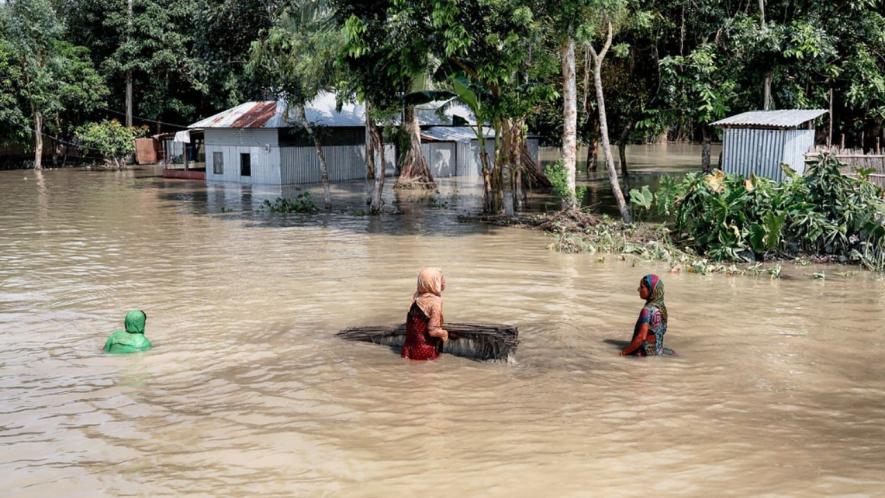
Representational Image. Image Courtesy: Flickr
Egra, Purba Medinipur — The water arrived the way it always does in this corner of Bengal: not as a wall, but slow and patient. First, it took the seedbeds. Then the fish ponds. Then the betel-leaf gardens that all the families in Sahara, Chakmurari, Nehelia and Alipur had nursed for a full year on borrowed money and borrowed hope. By Thursday, it had taken the roads, too, and in some lanes of Sahara, it was pressing against people's chests as they waded for miles toward the only relief camp — a single shelter set up inside Sahara High School.
This is what a flood looks like when it is manufactured hundreds of kilometres upstream and delivered, by opened gates, to people who have no say in the decision at all.
A River That Makes a Dam in Another State
The Subarnarekha does not rise in West Bengal, and increasingly it seems the decisions that determine whether it drowns West Bengal's villages aren't made here either. Locals in Egra-I block say the flooding that has swallowed Sahara's paddy fields this week began building the moment Jharkhand's Galudih reservoir started releasing water in stages — a familiar, almost ritual act of upstream engineering that this stretch of the Bengal-Odisha borderland has learned to dread every monsoon since at least 2017, when the same river, fed by the same dam, killed dozens and buried tens of thousands of hectares of paddy under silt.
There was no cloudburst over Sahara this week. The gates opened elsewhere, and the water simply came, the way it has come before, and the way — farmers here say bitterly — it will come again next year, because nothing structural has changed since the last time.
By Thursday, the seedbeds for both the Aush and Aman paddy crops lay under water, deep enough to reach an adult’s waist. For a farming household in Purba Medinipur, that is not just an inconvenience; it is the annual income gone, the collateral on next year's loan gone, the food on the table for the coming winter gone.
Vegetable cultivation across the affected villages has been wiped out. The ponds where families raised fish to sell at the local haat have vanished, taking a full season's aquaculture along. Betel-leaf gardens — a slow, labour-intensive crop that takes years to establish and can be destroyed in a single submersion — are gone. So is the region's mat-weaving cultivation, another quiet, unglamorous livelihood that rarely makes a headline until the year it is annihilated.
"If we don't get compensation, survival will be impossible" is how families describe what they now face. They have no cushion left to fall back on.
Relief Camp That Couldn't be Reached
What makes this flood particularly cruel is not only its scale but its geography. Roads into and out of the worst-hit hamlets are under chest-deep water. Innumerable houses are flooded. And the administration's response — a single relief camp set up inside Sahara High School — sits, for many families, on the far side of that same chest-deep water. Reaching the camp safely means wading through the very flood they are trying to escape, carrying children, and whatever belongings can still be carried. There are no boats. For women with infants and small children, and for the elderly, this has turned into a genuine hazard.
Electricity has gone for three or four days running in large parts of the affected zone. In many homes, there is no kerosene left to light a lantern, let alone the small hurricane lamps that have traditionally been Bengal's answer to a power cut. Villagers have appealed to the administration for something as basic as candles — a small request that speaks of how thin the state's presence has been on the ground, even as officials elsewhere talk of aerial surveys and compensation packages.
Parallel Disaster in West Midnapore
Sahara's suffering is not an isolated pocket. Across the district line in Paschim Medinipur, the Sabang block has effectively gone under — all 13 of its gram panchayats are affected by the rising Keleghai and Subarnarekha rivers, alongside worsening conditions reported from Narayangarh, Mohanpur, Dantan and Keshiary. Two people have died in the district, including a three-year-old boy who drowned in Sabang — a preventable death. Roughly 3,200 houses in Sabang block alone have been damaged.
Further east, the breach of an embankment along the Kangsabati river has sent fresh floodwater into villages that were only beginning to assess the earlier damage, forcing families to move out with whatever belongings they could carry on their heads and shoulders, wading past submerged fields that used to be their livelihood.
Chief Minister Suvendu Adhikari conducted an aerial survey of the Sabang flood zone on Thursday and announced a compensation of ₹9 lakh each for the families of the two deceased, along with ₹30,000 for each of the 3,200 damaged households in the block. He said water levels on the Keleghai had dropped below the danger mark and that relief operations were under way. For the families still wading to Sahara High School through waist-deep water, that reassurance will take time to feel real.
The Left's Charge
For the Communist party of India (Marxist), this flood is not a natural disaster so much as a governance failure with a long and repetitive history. Addressing a press conference on Thursday, CPI(M) state secretary Mohammed Salim demanded urgent relief and rehabilitation for flood-hit families, framing the crisis as part of a pattern in which the state's poorest agricultural belts are left to absorb the cost of decisions made in dam control rooms outside Bengal's borders — and, critics argue -- without adequate warning systems or embankment maintenance inside them.
In Purba Medinipur's Kanthi-3 block, a CPI(M) delegation submitted a memorandum to Block Development Officer Arghya Sen, demanding immediate drainage of standing water, relief material and food supplies for the marooned. The party's demands went further than emergency aid alone: a waiver on agricultural loans for farmers whose paddy, vegetable and fish crops have been destroyed; crop insurance payouts to be processed without the usual bureaucratic delay; compensation and repair support for damaged homes, with all mud-built houses brought under the Pradhan Mantri Awaas Yojana; a crackdown on illegal bheri (shrimp/fish enclosure) cultivation that critics say worsens drainage and embankment stress in the coastal belt; and faster repair of the Odisha coast canal system, whose disrepair, the delegation argued, compounds flooding on the Bengal side of the border virtually every monsoon.
This is a familiar list, assembled after a familiar disaster — which is precisely the point critics like Salim are making. Illegal bheri construction, poor canal maintenance, chronic underinvestment in embankments along a river whose flow is controlled from another state entirely: these are not “act of God” problems, and the fact that they resurface with almost calendar-like regularity, delegation after delegation, memorandum after memorandum, is itself the indictment.
What Numbers Don't Show
None of this — the compensation cheques, the aerial surveys, the memoranda submitted to block offices — captures what it actually feels like to stand in Sahara this week: to watch your betel garden, three years in the making, disappear in the space of two days; to carry a child through floodwater that reaches your chest because the only shelter available sits on the far side of the current; to sit through a fourth straight night without electricity, without kerosene, with nothing to light against the dark except the hope that the water recedes before the rice runs out.
West Bengal's coastal and riverine districts have been here before — in 2017, in 2022, in 2024 — each time with the previous chief minister announcing a different compensation figure, each time with the same rivers, the same upstream dams, the same underfunded embankments, and the same families left to calculate, in the days after the water finally goes down, exactly how much of the coming year they have just lost. The flood always recedes eventually. The question Sahara's farmers are left asking, this week, as in every week before, is what — if anything — will actually change before the water comes again.
The writer is a senior journalist, who has headed the Eastern regional bureau of various national publications. The views are personal.
Get the latest reports & analysis with people's perspective on Protests, movements & deep analytical videos, discussions of the current affairs in your Telegram app. Subscribe to NewsClick's Telegram channel & get Real-Time updates on stories, as they get published on our website.