





Venezuela Siege: US Imperialism, Capitalist Crisis & Global Resistance
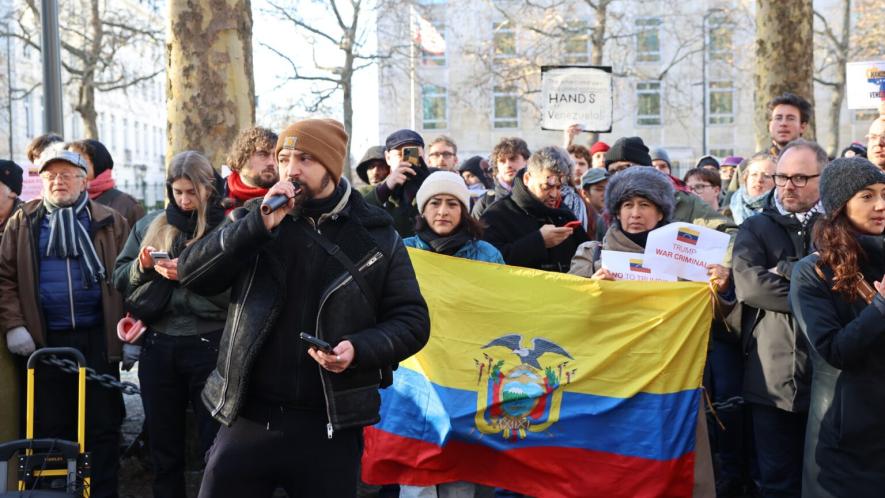
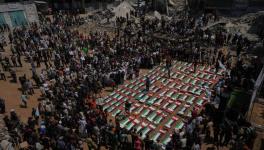
Solidarity demonstration with Venezuela, Brussels, January 4, 2026. Source: Workers' Party of Belgium/Facebook
The sustained campaign of coercion directed against Venezuela by the United States must be situated within the historical consolidation of unipolar imperialism that followed the dissolution of the Soviet Union in 1991. The post–Cold War order, frequently described by Western elites as a “rules-based international system,” has in practice been characterised by the unchecked expansion of monopoly and finance capital.
Freed from the constraints imposed by a socialist counterweight, US-led imperial power has increasingly relied on military intervention, economic warfare, and the institutionalisation of coercive neoliberal governance to reproduce global hierarchies of accumulation.
Within this context, US aggression against Venezuela cannot be understood as an episodic deviation from liberal international norms, nor as a response to alleged democratic or humanitarian deficiencies. Rather, it represents a structurally determined response to the deepening contradictions of late capitalism itself.
As historical materialism makes clear, global order is not governed by abstract principles or moral claims, but by concrete relations of production, class power, and imperial domination. Where consent to neoliberal globalisation erodes, coercion emerges as the primary mechanism through which imperial authority is maintained.
The Venezuelan case exemplifies this dynamic with particular clarity. Possessing the world’s largest proven oil reserves and pursuing a development strategy centered on State control over strategic resources, Venezuela posed a direct challenge to the prerogatives of US-led capital. Its partial rupture with neoliberal orthodoxy and assertion of economic sovereignty rendered it a paradigmatic target of imperial discipline. From a Marxist perspective, such defiance threatens the conditions of imperial accumulation and, therefore, necessitates intervention, not as a matter of policy preference, but as a systemic imperative.
Consequently, Venezuela has been subjected to a multi-dimensional campaign of aggression encompassing financial sanctions, restrictions on oil exports, diplomatic isolation, and persistent regime-change operations. These measures have been accompanied by an intensive ideological offensive that seeks to delegitimise Venezuelan sovereignty through narratives of humanitarian crisis and democratic failure. Far from serving neutral or benevolent ends, such discourses function to obscure the material foundations of imperial power and to normalise coercive intervention against the Global South.
Drawing on the theoretical contributions of Marx, Lenin, Rosa Luxemburg, and Samir Amin, this analysis conceptualises sanctions, economic warfare, and political destabilisation not as anomalies within the international system, but as essential mechanisms through which late capitalism manages its structural crises. By externalising internal contradictions onto peripheral societies, imperialism preserves accumulation at the centre while deepening social and economic devastation at the margins.
Examined through this lens, Venezuela does not appear as a “failed state,” but as a critical terrain of intensified global class struggle. Its experience illuminates the deeper logic of unipolar imperialism: the preservation of capitalist dominance through systematic coercion in an era of escalating crisis. The Venezuelan struggle thus transcends national boundaries, revealing the limits of liberal internationalism and the violence inherent in imperial capitalism.
The essay, therefore, arrives at a decisive conclusion. Under conditions of deepening global instability, resistance to imperialism is no longer a normative aspiration or ideological preference; it is a historical necessity. The fate of Venezuela is inseparable from the broader struggle against unipolar domination and for an emancipatory, multipolar world order capable of transcending the crisis of imperial capitalism itself.
The Myth of ‘Post-Imperial’ World
The collapse of the Soviet Union in 1991 was celebrated by Western political and intellectual elites as the definitive triumph of liberal capitalism. The proclamation of a “post-imperial” or “post-ideological” world order—popularised through notions such as the “end of history”—was less an analytical conclusion than a strategic ideological intervention. As historical materialism demonstrates, social formations do not transcend contradictions; they reorganise and displace them.
As Karl Marx emphasised, history advances not through moral proclamations or abstract ideals, but through material conditions and class struggle. The disappearance of a socialist counter-pole did not abolish imperialism; it removed its principal structural constraint. What followed was the consolidation of a unipolar world dominated by the US, in which military force, financial power, and ideological coercion converged into a unified apparatus of global domination.
Venezuela’s confrontation with US power must be situated within this broader historical configuration. The country did not become a target because of “authoritarianism” or “democratic deficits,” but because it challenged imperial control over resources, finance, and political sovereignty. In this sense, Venezuela does not represent an exception, but a paradigmatic instance of 21st Century imperial aggression.
Imperialism as Structural Necessity of Capitalism
In Imperialism: The Highest Stage of Capitalism, Vladimir Lenin identified imperialism as a distinct phase of capitalist development characterised by monopoly capital, the fusion of industrial and banking capital into finance capital, the export of capital, and the political division of the world among competing powers.
Crucially, Lenin rejected the notion that imperialism was merely a contingent policy choice; it was, rather, a structural necessity arising from capitalism’s internal contradictions.
Late capitalism is marked by chronic crises of overaccumulation, declining profit rates, and market saturation. Under such conditions, capital must expand outward—geographically, politically, and militarily—or confront stagnation. War, sanctions, and regime-change operations thus function as mechanisms through which capital temporarily resolves these contradictions.
The US-led wars in Iraq, Afghanistan, Libya, and Syria exemplify this logic. They were not defensive responses to security threats, but offensive strategies aimed at securing strategic resources, enforcing dollar hegemony, and disciplining non-compliant states in the Global South. Venezuela’s vast oil reserves and its assertion of sovereign control over them placed it squarely within the crosshairs of this imperial strategy.
Venezuela and Crime of Sovereignty
Venezuela’s fundamental transgression lies in its assertion of sovereignty over natural resources and its refusal to submit unconditionally to neoliberal restructuring. The Bolivarian process—initiated under Hugo Chávez and continued under Nicolás Maduro—sought to redirect oil revenues toward social development, reduce dependency on US capital, and promote regional integration independent of Washington.
From a Marxist perspective, such a project constitutes a direct challenge to imperial accumulation. Control over energy resources is not merely an economic question; it is a geopolitical one. By nationalising strategic sectors and resisting privatisation, Venezuela disrupted the circuits of monopoly and finance capital.
US hostility intensified precisely as Venezuela attempted to pursue this alternative developmental trajectory. Diplomatic pressure was followed by covert destabilisation, culminating in comprehensive economic warfare. This sequence reflects a recurring imperial pattern: non-compliance is met first with ideological delegitimisation, then with economic coercion, and ultimately with the threat or use of force.
Economic Sanctions as Imperial Warfare
Contemporary imperialism increasingly relies on economic sanctions as a substitute for direct military intervention. As Amin argued, neo-colonial domination operates through unequal exchange, debt dependency, and financial control. Sanctions constitute a central instrument within this architecture.
US sanctions against Venezuela have systematically targeted oil exports, access to international finance, and the importation of essential goods. Frequently portrayed as “targeted” or “non-violent,” these measures have produced devastating social consequences. Shortages of food, medicine, and industrial inputs are not unintended side effects; they are integral to a strategy designed to induce internal collapse.
From a Marxist standpoint, sanctions amount to collective punishment—an attempt to discipline an entire population for the political choices of its government. These function as a form of siege warfare conducted through financial institutions rather than armies. In this respect, economic warfare is no less violent than conventional war; it merely renders its victims less visible.
Ideology, Media, and Manufacture of Consent
Imperialist aggression cannot be sustained by coercion alone; it requires ideological legitimation. Corporate media and liberal political discourse play a decisive role in constructing Venezuela as a “failed state” or “dictatorship,” thereby normalizing external intervention. Such narratives obscure the material causes of crisis—sanctions, capital flight, and economic sabotage—while transferring responsibility onto the victim.
Marxist theory understands ideology as a material force embedded within institutions and social practices. The demonisation of Venezuela serves to naturalise imperial violence, recasting coercion as humanitarian concern. This ideological operation is indispensable for maintaining consent within imperial core societies.
Permanent War and Luxemburg’s ‘Barbarism’
Luxemburg’s warning that capitalism confronted a historical choice between socialism and barbarism resonates with renewed urgency in the Venezuelan case. Barbarism today manifests not only through bombs and invasions, but through slow, structural violence.
Luxemburg recognised that capitalism’s drive for endless accumulation would inevitably generate war and social disintegration. The prolonged economic strangulation of Venezuela confirms this prognosis. Contemporary imperialism no longer seeks to construct stable client states; it produces fragmented, crisis-ridden societies incapable of autonomous development.
This condition of permanent crisis is not accidental. It reflects a system that can no longer reproduce itself without destruction. Venezuela’s suffering is, therefore, not an anomaly, but a symptom of a deeper systemic decay.
Israel, US Power & Architecture of Imperial Enforcement
Although Venezuela lies outside West Asia, the global architecture of imperial enforcement must be understood holistically. Israel functions as a militarised outpost of US imperial power, illustrating how settler-colonial violence is normalised within the global order.
The same legal and moral exemptions granted to Israel are extended, in different forms, to US actions in Latin America. International law is applied selectively, reinforcing a hierarchy in which imperial powers operate above accountability. This double standard is not hypocrisy; it is structural.
UN and Illusion of Liberal Internationalism
The United Nations is frequently invoked as a guarantor of peace and legality, yet its institutional architecture reflects imperial power relations. The veto system ensures that dominant powers—particularly the US—can obstruct any substantive challenge to their actions.
From a Marxist perspective, this does not represent a failure of the UN, but its function. As Lenin observed with regard to bourgeois States, institutions operating under capitalism cannot transcend the class relations that generate them. The UN manages imperial conflict; it does not abolish it.
Reclaiming Internationalism
Imperialist aggression against Venezuela exposes the fundamental logic of unipolar capitalism: when consent fails, coercion prevails. Economic warfare, ideological manipulation, and diplomatic isolation are not deviations from the system, but its normal operations under conditions of crisis.
History demonstrates that imperialism cannot be humanised or reformed. The dismantling of colonial empires and apartheid regimes was not achieved through moral appeals, but through organised resistance and international solidarity. Venezuela’s struggle must, therefore, be understood as part of a broader global confrontation between capital and human emancipation.
The present historical moment demands a renewed Marxist internationalism—anchored in anti-imperialism, class struggle, and transnational solidarity. As Luxemburg warned, the alternative remains stark: socialism or barbarism. The fate of Venezuela—and indeed of humanity—will be determined by how this choice is confronted.
The writer, an economics professor and author, is currently engaged in research on Sustainable Economic Development, Political Economy of the Global South, and India’s Socioeconomic Crisis. The views are personal. acpuum@gmail.com.
Get the latest reports & analysis with people's perspective on Protests, movements & deep analytical videos, discussions of the current affairs in your Telegram app. Subscribe to NewsClick's Telegram channel & get Real-Time updates on stories, as they get published on our website.