





VB–G RAM G Bill: Agri, Farm Worker Groups to Hold Nationwide Protests on Dec 19
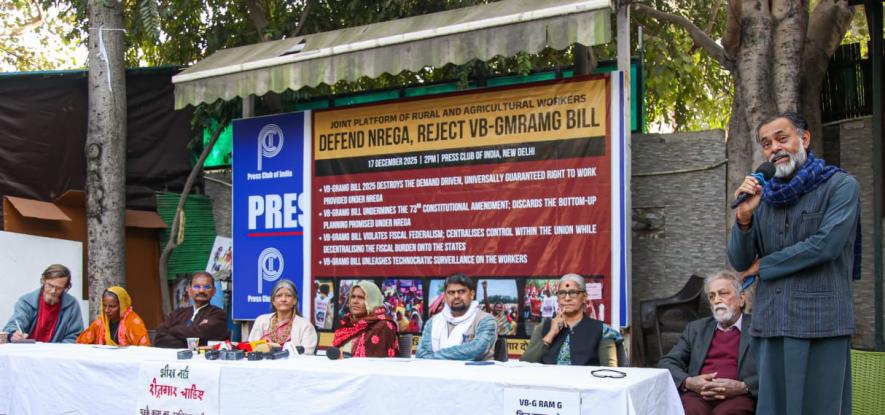
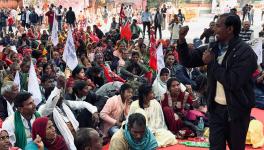
The NREGA Sangharsh Morcha held a press conference in New Delhi on December 17, 2025, condemning the proposed Viksit Bharat - Guarantee for Rozgar and Ajeevika Mission (Gramin) (VB-G RAM G) Bill, 2025.
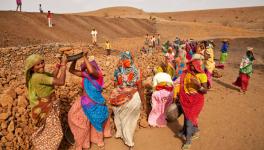
New Delhi: The NREGA Sangharsh Morcha (NSM) and hundreds of allied grassroots organisations announced a nation-wide day of action on Friday, December 19, where rural and agricultural workers will stage protests demanding withdrawal of the Narendra Modi government’s VB–G RAM G Bill which seeks to replace the MGNREGA.
“Any attempt to repeal or fundamentally alter MGNREGA without the consent and participation of workers and their organisations will not be accepted,” the NSM said at a press conference held in New Delhi on December 17.
The press conference included testimonies by several NREGA workers, along with speakers, such as Jean Dreze, economist and social activist, Annie Raja of the NFIW, Prabhat Patnaik, Professor Emeritus JNU, Mukesh Nirvasit of MKSS, social activist Yogendra Yadav among others.
Dreze said: “If there is any law in India because of which India can be called a Vishwaguru, it is NREGA”, according to an NSM statement, He highlighted the dangerous discretionary powers granted to the Centre under the new Bill, and spoke of the current regime’s track record with NREGA: the stoppage of work in Bengal since 2021, exclusionary technology measures, and fund cuts.
Read the full NSM statement below:
Reject VB-G RAM G Bill, Save MGNREGA: National Action Day on 19th December
The NREGA Sangharsh Morcha (NSM) held a press conference in Delhi on December 17, 2025 condemning the proposed Viksit Bharat - Guarantee For Rozgar And Ajeevika Mission (Gramin) (VB-G RAM G) Bill, 2025. Brought in without any consultation with workers and workers-groups, the bill repeals the MGNREGA, 2005, and reduces the employment guarantee into a centralised, discretionary, budget-capped scheme run at the mercy of the Union Government. According to the proposed bill, the Union Government shall determine a state-wise "normative allocation" every year, and any excess expenditure will be borne by State Governments. This pre-determined allocation will effectively act as a cap on the number of days of employment that may be provided in each state. With the existing budget, the Union Government is not even able to provide 50 days of work per household per year. And now, by capping budgets and putting the burden on states to raise funds - when many states are already starved of cash - the BJP government’s headline narrative of 125 days of employment is a scam.
● From demand-based right to supply-constrained scheme → by repealing NREGA, employment guarantee is no more a right, but a mere scheme that runs on the discretion of the government.
● Right to work restricted to select rural areas notified by the Central Government → No guarantee of employment for rural workers in non-notified areas.
● Capping of workdays through State-wise normative allocations determined by the Centre → Any demand beyond this budgetary cap to be borne by State Governments; such selective allocations would benefit BJP-governed states at the cost of others.
● Wage burden shifted onto states → The new 60:40 cost-sharing ratio ends the Centre’s responsibility for full payment of wages and puts states under severe financial strain. Poorer, cash constrained states would be disproportionately affected, leading to lower employment generation and distress migration.
● 60-day blackout period in peak agricultural seasons → Denial of work for 2 months in a year will impact the bargaining power of women, landless and other marginalised communities.
● Undermines Gram Sabhas, centralises planning → Rural works to be planned through “Viksit Gram Panchayat Plans” aligned with the PM Gati Shakti Plan, subordinating the 73rd Constitutional Amendment of decentralised planning.
● Technocratic control → Increased technocratic control through biometric authentication of workers and functionaries, despite documented evidence of large-scale exclusions arising from technocratic initiatives like digital attendance (NMMS) and Aadhaar-based payments (ABPS). Corruption can only be curtailed through decentralised monitoring, and actually acting upon the findings of the Gram Sabha-led social audits conducted under NREGA every year.
The press conference, moderated by Yogendra Yadav, included economists, political leaders, NREGA workers, activists, and agriculture union leaders. Prabhat Patnaik, Professor Emeritus JNU and Ex-Vice Chairman of the Kerala Planning Board, emphasised the critical role of the right to guaranteed employment in times of rural distress.
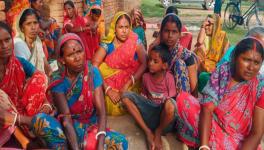
Kamla Devi, a widow from Beawar, Rajasthan who has worked in NREGA for 18 years, echoed the sentiment, highlighting how the NREGA was her only source of income when her husband died and she had no land or children, “How will I survive without NREGA?”
Annie Raja, Vice President, NFIW and worker rights activist, spoke about the historic struggle that had led to the NREGA, fought for by all sections of society such as women, marginalised groups and the youth. She highlighted how NREGA improved women’s lives by giving them equal pay and economic freedom.
The economist, Prof. Jayati Ghosh, emphasised the grave dangers the bill poses to federalism in India, particularly given the Centre’s tendency to weaponise funds against opposition states. NREGA was designed to be inclusive and participatory. However, the new bill gives Centre full powers to decide the areas where it will apply, the shelf of works, and most dangerously, the Centre will impose a cap on the budget, beyond which states will have to fund 100% of the programme. This will likely affect poorer states disproportionately, where NREGA is needed the most.
Mukesh Nirvasit, from MKSS and Rajasthan Asangathit Mazdoor Union, spelled out the details of the new bill, specifically how it destroys employment as a right and gives a meaningless guarantee, which the government has no obligation to uphold.
Shravani Devi, NREGA worker from Beawar, Rajasthan, declared that NREGA was accomplished by the people, and the people will not let it be repealed. “We will come to the streets, and the government should not underestimate the power of workers”, she said.
B Venkat, representing All India Agricultural Workers Union, emphasised that the government was trying to create a false divide between NREGA workers and farmers. In fact, NREGA does not negatively impact agricultural work in the country, and small farmers and artisans support the workers in their struggle. The new bill, he added, will create a new bonded, feudal system in India, and undermine the positive effects NREGA has had on rural wages.
Jean Dreze, economist and social activist, said “If there is any law in India because of which India can be called a Vishwaguru, it is NREGA”. He highlighted the dangerous discretionary powers granted to the Centre under the new bill, and spoke of the current regime’s track record with NREGA: the stoppage of work in Bengal since 2021, exclusionary technology measures, and fund cuts.
Dreze echoed Shravani Devi, declaring that we will not stop protesting until GRAMG is taken back and NREGA strengthened. Worker representatives have been reaching out to Members of Parliament to resist efforts by the BJP to bypass parliamentary procedure and steamroll this bill.
Individual briefings were held with MPs from various opposition parties such as Sasikanth Senthil (INC), Manoj Kumar Jha (RJD) and Kanimozhi Karunanidhi (DMK) as well as key NDA allies like the TDP’s Lavu Sri Krishna Devarayalu. Worker representatives also met with members of the National Secretariat of the Communist Party of India (CPI).
VB-G RAM G Bill is not a reform but a rollback of constitutional guarantees won by workers through decades of sustained struggle.
The NREGA Sangharsh Morcha unequivocally rejects the VB-G RAM G Bill, 2025, and demands its immediate withdrawal.
NSM has declared a nationwide day of action on 19 December 2025 where rural and agricultural workers will stage protests against this regressive bill at the national, state, district and local level to push the NDA Government to withdraw the VB–G RAM G Bill. Any attempt to repeal or fundamentally alter MGNREGA without the consent and participation of workers and their organisations will not be accepted.
Allied Organisations of NREGA Sangharsh Morcha: All India Agricultural Workers Union, Anna Suraksha Adhikar Abhiyan, Chhattisgarh Kisan Mazdoor Sangathan, Dalit Bahujan Front, Grameena Koolikarmikare Sangathane, Gram Vikas Manch, Jagrit Adivasi Dalit Sangathan, Jan Jagran Shakti Sangathan, Jagruta Mahila Okkutta, MGNREGA Majdoor Union - Banaras, MGNREGA Majdoor Union - Haryana, Mazdoor Kisan Shakti Sangathan, Majdoor Navnirman Sangathan, National Alliance for People's Movements, National Federation for Indian Women, National Platform for the Rights of the Disabled, Jharkhand NREGA Watch, Paschim Banga Khet Majoor Samity, Paschim Banga Cha Majoor Samity, Pravasi Majdoor Sanagthan, Rajasthan Asangathit Majdoor Union, Rashtriya Seemant Kisan Majdoor Union, Samalochana, Jan Vikas Shakti Sangathan, Sangatin Kisan Majdoor Sangathan, Soochna Evum Rozgar Adhikar Abhiyan, Swabhimani Mazdoor Sangathan, Right to Food and Work Network - West Bengal, Right to Food Campaign, Ambedkarism Punadi Association, Samaj Parivartan Shakti Sangathan, Bhakhar Bhitrod VikasManch,Odisha Khadya Adhikar Abhijan.
Get the latest reports & analysis with people's perspective on Protests, movements & deep analytical videos, discussions of the current affairs in your Telegram app. Subscribe to NewsClick's Telegram channel & get Real-Time updates on stories, as they get published on our website.