





Trump-Bibi’s Gift to West Asia: Third Gulf War?
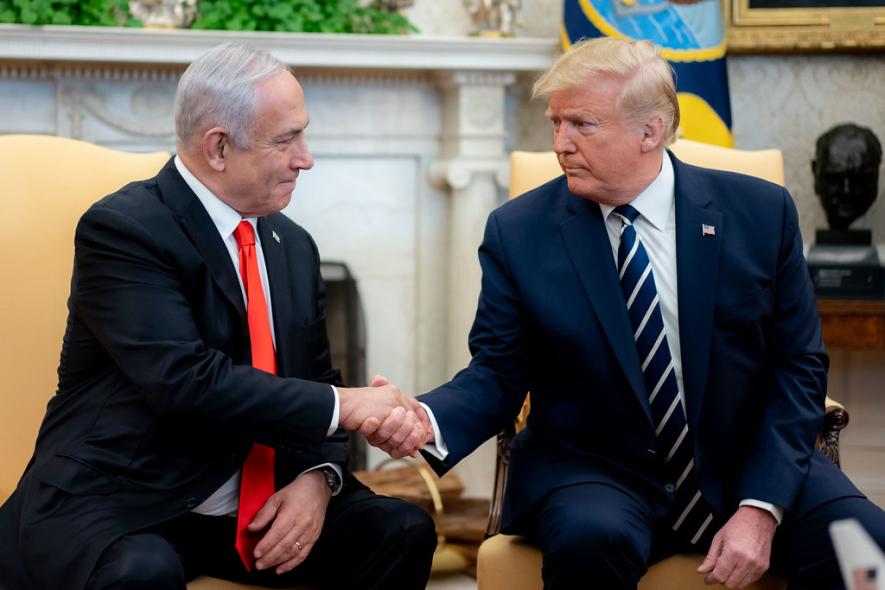
Image Courtesy: Flickr
The third Israel-US War on Iran enters its 34th day; instead of a swift victory and regime change that the Donald Trump administration had imagined, it has turned into a brutal battle of attrition. Iran has not only stood up to the US and Israeli attacks but inflicted heavy damage on the US bases in the region, destroying its THAAD radars and bases in Saudi Arabia, Qatar, Kuwait, and the UAE. It has also struck the Haifa refinery, Dimona (where Israel’s nuclear plant is housed), and Tel Aviv. In Lebanon, a land war continues. Israel has caused enormous damage to Beirut and occupied Lebanon up to the Litani River, but it has also suffered heavy losses, including dozens of Merkava tanks.
Trump is now threatening a land war against Iran. He is considering capturing Kharg Island, which houses Iran’s oil and LNG loading infrastructure. He is also eyeing the islands in the Strait of Hormuz as a means of breaking Iran’s blockade.
Meanwhile, the Houthis have entered the war and closed the Red Sea, which connects the Mediterranean and the Indian Ocean. As the war settles into a slugfest, the key question is this: which side has greater staying power? Iran and its allies, or US-Israel with their Gulf crony regimes?
Three wars have taken place in the region in the past five decades. The first was the Iraq-Iran war, from 1980 to 1988, in which the US and the UK backed Iraq, even providing Saddam Hussein with chemical weapons.
The other two—referred to as the Gulf Wars—involved the US, first against Iraq, when Saddam invaded Kuwait in 1991, leading to the US intervention. George Bush initiated the 2nd Gulf War with the express purpose of not only defeating Iraq, but also conducting a “regime change” operation. The objectives were to control Iraq’s oil and to remove Saddam Hussein, perceived as a long-term strategic threat to Israel. Ironically, Saddam was captured in this war, tried and hanged by the US for the “war crime of using chemical weapons against Iran”, the same ones that the US and UK had supplied to Saddam during the Iraq-Iran War!
Iran’s ability to fight a longer than expected war of attrition has surprised the US. It has also unleashed a barrage of missiles and taken out 10 US radar sites, a core component of the US missile shield in the region. These are the eyes of the Terminal High Altitude Area Defence system (THAAD).
Iran targeted four AN/TP-2 radars, each costing more than $500 million, and an AN/FPS Phased Array Radar system in Qatar costing more than a billion dollars. These systems detect incoming missiles and drones and work with THAAD batteries to shoot them down. Without these “eyes,” a THAAD battery cannot acquire targets or direct interceptors. Lacking long-distance radars, the THAAD system is partially blinded. The batteries can still function, but the lead time is reduced to a few minutes, instead of the usual 10-15 minutes to acquire, track, and shoot down a target.
This has meant that Israel and US allies in the region have taken many more hits than they would have if the long-distance radars were still functional. An airborne AWACS system that combines a long-range radar with battle management—command and control functions—was also destroyed on March 27 in an attack on Saudi Arabia’s Prince Sultan Airbase. The AWACS is another key part of the US air offence and defence.
The problem the US faces is that all such systems—whether ground- or airborne—are expensive, take a long time to manufacture, and are in short supply. Two are in Israel, a few are in East Asia, and again, a small number are in the US. The US has begun removing the one in South Korea, much against the wishes of the South Korean government. South Korea may have paid for the system, but it still does not own it.
Iran has long anticipated the war and has prepared accordingly. A significant part of their military strength is underground, whether for military production or for storing their weapons. They can emerge from these underground facilities, load the missiles into trucks, deploy and fire them within 10-15 minutes, then return. This has meant using largely solid-fuel missiles, which have a much shorter time from deployment to launch than liquid-fuel missiles, reducing the possibility that the US-Israel will detect such launches and take out the missiles.
The second strategy is to focus more on drones for attack purposes rather than the expensive missiles. Iran’s drones are another story that the world is relatively unaware of. The US drones were developed earlier than those of other countries, but were expensive products that combined monitoring and attack functions. These were widely used in Afghanistan and in West Asia, for example, the Reaper drones. Most US drones were used as substitutes for aircraft and were not considered single-use.
Unlike the US, Iran developed the Shahed drones, which are easy to manufacture, much cheaper, highly accurate, and can zigzag to their targets, making defence against them much more difficult. The US Lucas drone, the Ukrainian and Russian drones have all copied the Shahed drone, as none of them had a similar drone in their kitty.
In today’s drone warfare, whether in the Russia-Ukraine war or in the US-Israel war, the Iranian drones or their copies have become dominant. The key to their success is their rapid trajectory changes, which make target acquisition for defence systems difficult, and their pinpoint accuracy, causing significant damage. As these are relatively simple devices to manufacture, not only is Iran continuing to produce them at scale during the current war, but it has also shifted the entire manufacturing underground. This makes them virtually invulnerable to missile or drone strikes from the Israel-US alliance.
With Iran taking out the radar systems in almost all the Gulf states, these states are now vulnerable to Iran’s attacks. The US is focusing only on Israel’s defence, not even pretending that they are protecting the Gulf countries. Their allies in the region are pretty much at the mercy of Iran, except perhaps Saudi Arabia, which may still have some missile defence.
Observers note that while the number of missile or drone strikes on Israel has dropped since the early days of the war, the number of hits has stayed the same or even increased. The initial heavy strikes were meant to uncover the location and type of Israel’s missile defences. Once these patterns are known, fewer missiles and drones can cause as much damage as higher salvoes of drones and missiles.
It is not Iran’s ability to fire a high number of missiles that is the problem for Israel. It is Iran’s ability to evade missile and drone defences that is the key factor in the US-Israel’s missile defence problems. Even Israeli news outlets concede that 40% of Iran’s drone and missile salvoes are currently getting through, a much higher number than the 5-10% claimed initially.
In addition, Israel is also running out of missiles it uses for its defensive shield. The Iron Dome addresses the cheaper missiles fired from Gaza. For Iranian missiles and drones, Israel relies on the next tiers: David's Sling and the Arrow systems. Israel has also used aircraft to shoot down missiles and drones.
The bigger issue here is the cost of Iranian drones compared with Israeli missiles and how quickly Israel can resupply its stock. Israel still has a stock of cheaper missiles, but is rapidly using up its long-range missiles. According to the Royal United Services Institute (RUSI), Israel used up 80% of its Arrow missiles, its strongest defensive shield, in the first 16 days of war.
Tom Karako, a missile defence expert, recently said that the US and Israel could run out of interceptors before eliminating Iran’s missiles and mobile launchers. Iran has also struck Tel Aviv, Haifa, and Dimona—where Israel’s nuclear facilities, including its reactor, are located. Iran’s attack on Dimona mirrored the US-Israel strike on Iran’s Natanz nuclear facility. This made it clear that Iran would match whatever the US-Israel axis does, and that Israel’s air defence cannot stop such attacks.
I am not dealing with the nuclear weapon issue here. I will only point out that Iran has enough weapons-grade uranium for 11 bombs. Building a nuclear weapon at the Hiroshima bomb level from this stock is a relatively simple task. We have seen the devastation that such weapons cause.
Fortunately, Ayatollah Khamenei’s fatwa against nuclear weapons remains in place. This is true in spite of Trump’s stupid belief that removing him and Iran’s other leaders will lead to a rapid regime change and Iran’s surrender to the US-Israel axis.
While the West Asia’s missile and drone battles continue, it is still not clear whether the US will physically land ground troops. With Trump changing his position every day, sometimes even twice a day, it is unclear whether he wants to declare victory and stop the war, even if it leaves Iran in charge of the Strait of Hormuz and, de facto, the dominant power in West Asia. Or is this a tactic to lull Iran into lowering its guard, before it actually launches ground attacks? Or will he wait till the US mid-term elections are over before venturing into another West Asian war, the nemesis of George Bush Jr.?
There is no question that this war, which has cost Iran dearly, has nevertheless shown that Iran, not Israel, is the pre-eminent power in the Gulf region. This may be Trump’s unique gift to his allies in the region.
Get the latest reports & analysis with people's perspective on Protests, movements & deep analytical videos, discussions of the current affairs in your Telegram app. Subscribe to NewsClick's Telegram channel & get Real-Time updates on stories, as they get published on our website.