





TN Elections: The Political-Tactical Contours in 2026
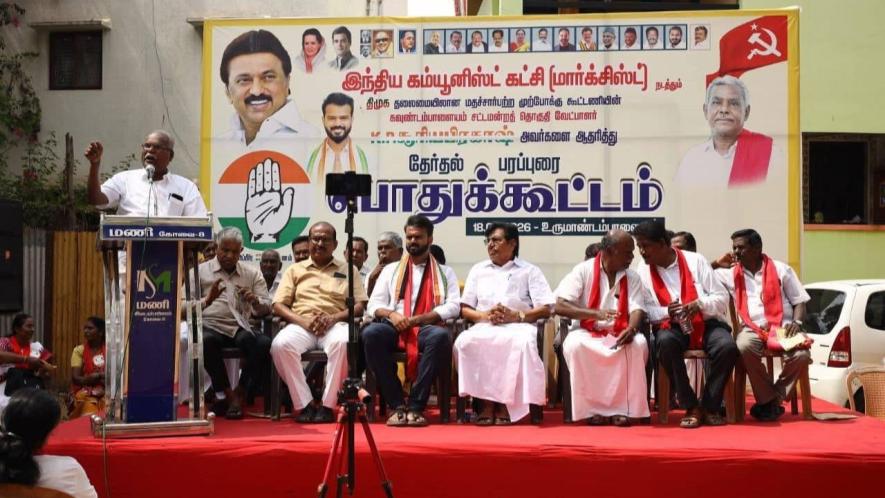
Image Courtesy: CPM Tamil Nadu/facebook
The political-tactical contours of the Tamil Nadu Assembly elections scheduled for April 23, 2026 will be dialectically determined by the conjunction of the political economy context of the state and the specificities of the three- (plus) way electoral contest.
In this election, an electorally significant third political formation has emerged, though the extent of this significance continues to be debated. However, it would be incomplete to comprehend this election exclusively through a tactical prism. Instead, it would be more rigorous to locate the political-tactical contours of this election within the concrete context of political economy.
As previously argued, this political economy context involves the resistance by a broad front of democratic forces to the neo-fascist dispensation's quest to comprehensively re-centre domestic monopoly capital in the process of accumulation of capital in the state. This broad front's political organisation centres around the Secular Progressive Alliance led by the Dravida Munnetra Kazhagam (DMK).
This resistance faces a multipronged challenge due to the ongoing political re-engineering exercise of the neo-fascist dispensation.
For instance, the special intensive revision (SIR) of electoral rolls by an Election Commission, which is evidently in thrall to the neo-fascist dispensation, has had a relatively limited adverse impact as far as exclusion of the socially marginalised sections in Tamil Nadu, as compared to other states, due to organised resistance by the broad front.
Moreover, unlike in most other states, the broad front has adequate conceptual, organisational, and media resources to more than match the heft of the neo-fascist dispensation in these domains.
In this light, the neo-fascist dispensation's first best strategy of cobbling together all parties that can be subject to political re-engineering, in particular, the All India Anna Dravida Munnetra Kazhagam (AIADMK) and the Tamilaga Vettri Kazhagam (TVK)) within the National Democratic Alliance (NDA) failed to fructify since there were irreconcilable differences over sharing of seats and other resources.
Therefore, the neo-fascist dispensation has shifted to its second-best strategy to try and ensure that the TVK ends up drawing more votes from the broad front rather than from the NDA. But this is unlikely to be the case due to both the AIADMK's organisational decay and anti-intellectualism that it shares with TVK as well as the TVK's organisational nascence.
The AIADMK's organisational decay, induced by the neo-fascist dispensation's long-term goal of replacing it as the second pole in Tamil Nadu's politics, is unavoidably conflicting with its short-term goal of dislodging the broad front from its pole position in the politics of the state.
This organisational decay of the AIADMK is also regionally uneven and compounded by the fact that many AIADMK leaders have shifted to DMK or TVK or set up parties with the explicit objective of defeating AIADMK candidates in this election. Likewise, a split in the Pattali Makkal Katchi (PMK), a constituent of the NDA, is likely to at least partly dent the NDA's electoral prospects in the northern strongholds of the PMK in the state.
The anti-intellectualism of the AIADMK, manifested by its obsession with the quotidian, enables a migration of that section of its (relatively younger) supporters who do not have a psychological affinity with the party (relatively older supporters due to long-run association) to other parties such as the TVK or DMK besides opening a window for the diffusion of Hindutva into the state.
In these circumstances, given that both the 2021 Assembly election figures and the adjusted 2024 Lok Sabha election figures show a clear 6% plus lead for the broad front, an increase in the vote share of the TVK can improve the electoral prospects of the NDA in the state only if the TVK draws relatively more votes from the broad front than from NDA to such an extent that it also compensates for the lead that the broad front had over the NDA in 2021 and 2024 (as per adjusted figures).
Besides, the consistent resistance of the broad front to the neo-fascist dispensation's designs regarding the state, has undermined the political credibility of AIADMK by making its politically re-engineered status fully transparent.
Therefore, it is likely that the TVK, which is expected to perform better in urban locations, may dent the vote share of the AIADMK more than that of the broad front. As long as the vote share of the TVK is not high enough to secure outright victory, a drawing of votes from other parties that is skewed toward AIADMK will tend to favour the broad front's electoral prospects.
The TVK, like many other elite parties, has sought to carry forward the obsession with the quotidian of AIADMK but within the framework of the Bonapartist cult of its leader (assiduously crafted through carefully scripted and marketed films that eventually coalesced into an organisation).
The programmatic vision of TVK is deliberately kept vague to try and maximise its vote share at the tactical level. For instance, the TVK pitches itself as the party of change in but leaves the contours of this proposed change deliberately undefined.
At best, this deliberate vagueness is compatible with politically vacuous technocratic claims, such as the following: the right leadership which is already rich enough to not want to accumulate wealth through corruption will miraculously ensure "good governance". This formulation is innocent of even basic political economy and macroeconomic considerations.
Corruption or the state-enabled primitive accumulation of capital is both "demand driven" (of both upstarts (not yet rich) and incumbents (rich)) with a skew toward bigger capital and "supply led" (disempowerment of the working people). Further, it will matter to the level of output and employment in the state how the proceeds of this process of corruption are utilised. If the resulting deployment of proceeds creates more demand for the output of the state than otherwise, then the resulting outcome would still be adverse but less adverse than otherwise.
The empowerment of the working people and the consequent adoption of policies outside the toolkit of capital are the means to further the resistance to the primitive accumulation of capital including corruption.
Strategically, this deliberate vagueness of the TVK's programmatic vision along with the proclivity of its top leadership to keep its organisation in a state of persistent nascence (either by design or default) makes its comprehensive political re-engineering by the neo-fascist dispensation in the future all the more likely.
The deliberate vagueness of TVK's programmatic vision allows for the possibility of a post-poll tie-up between the NDA and TVK if the broad front fails to achieve an outright majority. The unwillingness of TVK to criticise the neo-fascist dispensation is in keeping with this possibility. Moreover, this bait and switch manoeuvre will eventually culminate in the neo-fascist dispensation ruling the roost as has transpired in most other states of India.
The other flank of the political re-engineering process in the state is the Naam Tamilar Katchi (NTK). The NTK's central programmatic plank is the false claim that people who are South Indian non-Tamil linguistic minorities in Tamil Nadu are effectively dominating the state politically and economically. This false claim is objectively a Trojan horse for the infusion of Hindutva in Tamil Nadu. A part of the vote share of the NTK is likely to shift to the TVK in this election, especially a significant fraction of those who gravitated to the NTK previously since it was then the alternative to both the DMK and the AIADMK-led fronts.
In spite of these multi-flank processes of political re-engineering unleashed by the neo-fascist dispensation, most opinion polls undertaken by agencies that are not beholden to the neo-fascist dispensation, are forecasting that the Secular Progressive Alliance will attain a majority of seats in the elections though there are differences among these pollsters about the magnitude of the forecasted majority.
The Secular Progressive Alliance and the other components of the broad front are mounting an effective challenge to the political re-engineering of the state by the neo-fascist dispensation of which the election process is a principal but not exclusive plank. Underlying this challenge, there is a near consensus among non-Hindutva intellectuals (the overwhelming majority) in the state that the defeat of the neo-fascist dispensation's designs in the state is a necessary condition for progressively developing the attainments of Tamil Nadu's distinctive political economy trajectory. The democratic movement in the country will definitively be strengthened if this challenge is successful.
The writer is Professor, Department of Economics, Satyawati College, University of Delhi. The views are personal.
Get the latest reports & analysis with people's perspective on Protests, movements & deep analytical videos, discussions of the current affairs in your Telegram app. Subscribe to NewsClick's Telegram channel & get Real-Time updates on stories, as they get published on our website.