





Strait of Hormuz: Imperial Struggle to Control Energy Lifeline
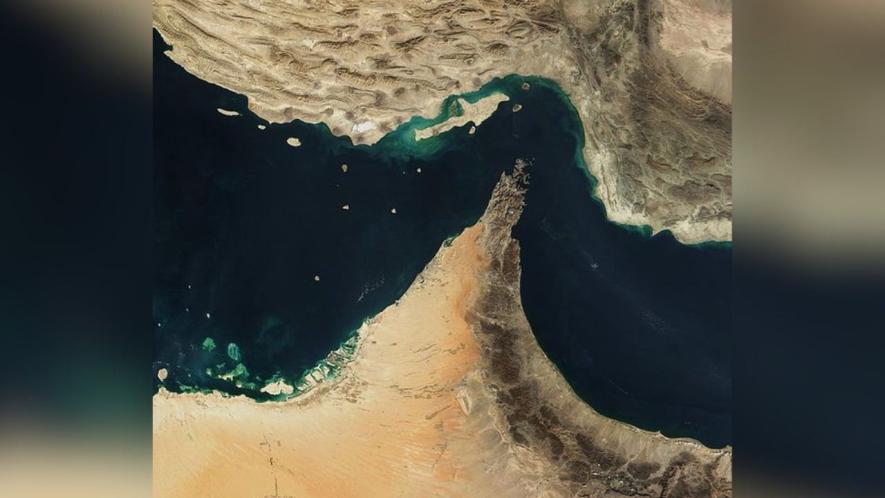
Satellite image of the Strait of Hormuz. Image Courtesy: Jacques Descloitres | NASA
The contemporary global order is characterised by profound structural inequalities in wealth, power, and access to strategic resources. A small transnational elite exercises extraordinary economic influence, while the overwhelming majority of humanity remains exposed to the uncertainties of volatile markets, precarious employment, and escalating living costs.
In many respects, the modern world resembles a system in which a handful of billionaires preside over a vast global estate, while the rest of society functions as the labour force responsible for sustaining its operations. Such asymmetries are not accidental; rather, these are deeply embedded within the institutional architecture of global capitalism.
Within this unequal international structure, geopolitical conflicts rarely arise as isolated diplomatic disagreements. Instead, these are manifestations of the relentless struggle among powerful states, multinational corporations, and financial interests seeking control over strategic resources, trade corridors, and monetary systems. Among these resources, energy—particularly petroleum and natural gas—continues to occupy a central position in the functioning of the global economy. Consequently, competition over energy reserves and transportation routes has become one of the defining features of contemporary geopolitics.
One of the most critical arenas of this contest is the Strait of Hormuz, a narrow maritime corridor linking the Persian Gulf with the Arabian Sea. Despite its relatively modest geographical dimensions, this waterway constitutes one of the most strategically significant energy chokepoints in the world.
Nearly one-third of global seaborne oil shipments and a substantial proportion of liquefied natural gas (LNG) exports transit through this passage each day (US Energy Information Administration, 2024). Any disruption to navigation through this corridor would immediately reverberate across global energy markets, affecting industrial production, transportation costs, and inflationary dynamics in economies across the globe.
Read Also: Energy Geopolitics and US-BRICS War: Who’s Next After Iran, Venezuela, Syria?
The geopolitical importance of the Strait of Hormuz derives from its unique geographical location between Iran and the Arabian Peninsula. Major hydrocarbon exporters—including Saudi Arabia, Kuwait, Iraq, and the United Arab Emirates—depend heavily upon this maritime passage to transport petroleum to international markets. As a result, the corridor functions not merely as a logistical route but as a critical strategic fulcrum capable of influencing the stability of the global economy.
The tensions surrounding this waterway must also be interpreted within the broader context of the international financial system, particularly the emergence of the “petrodollar regime”. Since the 1970s, global oil transactions have predominantly been denominated in US dollars, thereby reinforcing the global dominance of the American currency (Spiro, 1999). This arrangement has enabled the US to maintain a privileged position within the international monetary system while encouraging oil-exporting states—especially those in the Gulf region—to recycle their revenues into Western financial markets.
States that have attempted to challenge or circumvent this monetary arrangement have frequently encountered economic sanctions, diplomatic isolation, or political pressure. Iran, for instance, has faced multiple rounds of sanctions since the mid-1980s, measures that have significantly constrained its economic development and international financial integration (International Monetary Fund, 2023). Similarly, Venezuela, another major oil-producing nation, has been subjected to extensive economic restrictions in recent years. These developments demonstrate the intricate interconnections among energy politics, financial power, and geopolitical rivalry.
The US maintains one of the most extensive global military infrastructures in modern history. With hundreds of overseas bases across numerous countries, its military presence spans multiple continents (Vine, 2015). Although such deployments are frequently justified in terms of maintaining international security or safeguarding maritime navigation, many scholars argue that they also serve to protect strategic energy routes and ensure continued access to vital natural resources. In this regard, West Asia—home to some of the largest proven oil reserves in the world—has remained a focal point of geopolitical intervention and strategic competition for decades.
Within this volatile geopolitical environment, Iran occupies a uniquely strategic position. By controlling the northern coastline of the Strait of Hormuz, Tehran possesses considerable leverage over maritime traffic passing through this corridor. While international law guarantees the principle of freedom of navigation, the proximity of Iranian territory to the narrowest section of the waterway grants the country a significant capacity to influence shipping movements during periods of geopolitical tension.
The strategic relevance of this region has intensified further with the rapid economic rise of China, which has emerged as the world’s largest importer of crude oil. China’s vast industrial system—responsible for sustaining global manufacturing supply chains—requires enormous quantities of energy to maintain economic expansion. Current estimates indicate that Beijing imports approximately 11.5 million barrels of oil per day, a substantial share of which travels through the Persian Gulf and the Strait of Hormuz (International Energy Agency, 2023). Consequently, the stability of this maritime corridor has become a matter of global concern extending far beyond West Asia.
The escalating tensions in West Asia must, therefore, be interpreted within this broader framework of energy dependency and strategic competition. Iranian authorities have repeatedly emphasised the importance of safeguarding national sovereignty and resisting external military pressure. At the same time, Tehran has insisted that long-term regional stability must involve binding guarantees against foreign aggression and recognition of its right to pursue peaceful technological development, including civilian nuclear research.
These positions reflect a broader contest between regional powers seeking strategic autonomy and global alliances determined to preserve their geopolitical influence. Within this larger struggle, the Strait of Hormuz emerges as both a symbolic and practical battleground where competing visions of international order intersect.
Simultaneously, the global energy system is undergoing profound transformation. The conflict in Eastern Europe and the consequent reduction of Russian energy supplies to parts of Europe have already exposed the vulnerability of industrial economies that depend heavily on imported fuels (World Bank, 2023). Rising energy prices have contributed to inflationary pressures across numerous countries, increasing production costs for industries while eroding household purchasing power.
Historical experience demonstrates that such energy disruptions rarely remain confined to the economic sphere. The oil shocks of the 1970s triggered a severe global recession, widespread political instability, and fundamental transformations in international economic policy (Yergin, 2011). Under contemporary conditions, a similar disruption could generate far-reaching consequences across both advanced economies and developing nations.
For countries in the Global South, these dynamics present particularly complex challenges. Many developing economies rely heavily on imported energy while simultaneously attempting to pursue independent foreign policies. Balancing economic imperatives, diplomatic commitments, and domestic development objectives, therefore, requires careful strategic judgment.
India provides a revealing example of this dilemma. As one of the fastest-growing major economies in the world, India’s energy demand continues to expand rapidly. At the same time, New Delhi maintains extensive economic ties with both Western powers and emerging global actors. Bilateral trade between India and the US alone exceeds $100 billion annually, reflecting a high degree of economic interdependence (International Monetary Fund, 2024).
Such complex relationships inevitably constrain the scope for independent geopolitical manoeuvre. Governments must constantly evaluate the potential economic consequences of diplomatic decisions, particularly when powerful corporate interests and global financial institutions are involved. As a result, foreign policy often reflects a delicate balancing act between domestic political pressures and international strategic considerations.
China faces a comparable structural reality. Despite growing geopolitical rivalry with the US, China remains deeply embedded within global trade networks, financial markets, and production chains. The contemporary world economy is thus characterised not simply by competition among states but by intricate patterns of cooperation, investment, and interdependence that bind national economies together.
In response to these evolving geopolitical realities, emerging multilateral platforms such as BRICS and the Shanghai Cooperation Organisation have gained increasing prominence. These institutions are often portrayed as potential counterweights to Western dominance in global governance. Their stated objectives include promoting economic cooperation, enhancing regional stability, and encouraging alternative development pathways.
However, the capacity of these organisations to fundamentally transform the existing international order remains constrained by the entrenched structures of global capitalism. Member states remain deeply integrated into the prevailing systems of trade, finance, and investment that shape the modern world economy.
The struggle over the Strait of Hormuz, therefore, encapsulates one of the central contradictions of contemporary globalisation. On the one hand, control over strategic energy corridors provides immense geopolitical leverage. On the other hand, the highly interconnected nature of the global economy restricts the freedom of states to act independently without risking severe economic repercussions.
As the world advances deeper into the 21st century, the significance of energy security, maritime stability, and international cooperation will only intensify. Safeguarding vital trade routes such as the Strait of Hormuz is essential not merely for the prosperity of individual nations but also for the stability of the global economic system as a whole.
Ultimately, the future of this strategic corridor will depend upon the capacity of regional and global actors to manage their competing interests through diplomacy rather than confrontation. Without sustained efforts toward cooperative security arrangements and equitable resource governance, the Strait of Hormuz may continue to serve as a geopolitical flashpoint where imperial ambitions, economic rivalries, and strategic anxieties converge.
The writer, an economics professor and author, is currently engaged in research on Sustainable Economic Development, Political Economy of the Global South, and India’s Socioeconomic Crisis. The views are personal. acpuum@gmail.com.
Get the latest reports & analysis with people's perspective on Protests, movements & deep analytical videos, discussions of the current affairs in your Telegram app. Subscribe to NewsClick's Telegram channel & get Real-Time updates on stories, as they get published on our website.