





Awami League Can’t Return to Power With Same Faces: Sheikh Hasina
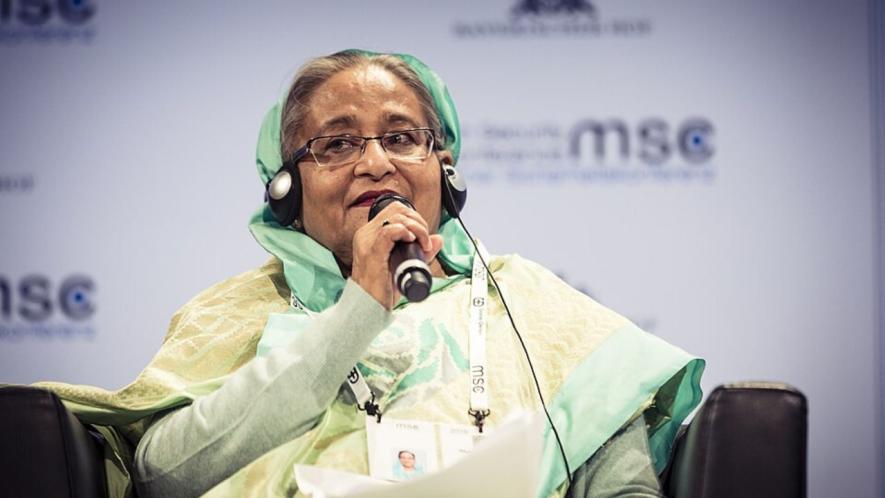
Image Courtesy: Wikimedia Commons
The ousted Prime Minister of Bangladesh, Sheikh Hasina, reacting to the recent incidents of arson and looting of newspaper offices and places connected with the memories of Sheikh Mujibur Rahaman, cultural institutions associated (Bangladesh Udichi Shilpigoshthi & Chhayanaut) with secular ideals, not allowing the main force of liberation war, Awami League, to participate in the election, has blamed the Muhammad Yunus regime of emboldening a handful of extremist groups that were hell-bent on creating anarchy in the country. She doesn’t see the hands of common Bangladeshi people in such disturbances, rather feels that they abhor the civil war-like situation and want their right to vote restored.
In an exclusive interview with senior journalist Amal Sarkar, Executive Editor of The Wall, Kolkata, she exudes confidence that the people of Bangladesh remember the role of Awami League in securing the independence of the nation and also is deeply concerned and anguished to see the once stable Awami League-led nation progressing toward economic growth and development, suddenly descending into utter lawlessness. She says she is eager to return home to help restore order and stability.
Taking a look into the shape her own party, the Awami League, is currently in, she intends to bring in a few fundamental changes in the leadership, bowing to the suggestions of her grassroot workers and supporters. She feels the necessity of drawing in new generations into the leadership across Bangladesh. The demand for new leadership is logical. Even if her son, Sajib Wajed Joy, or the daughter, Saima Wajed Putul, want to come to the forefront of leadership, she firmly believes that they should first prove their merits and capabilities. She says one of the yard sticks of leadership would be loyalty to the ideals of the party and the ability to adapt with the present ground realities.
The declaration of President Sahabuddin that he would resign from his post soon after the ensuing election has been seen by Hasina as an indication of rupture in the system of governance. She also acclaims the role of the Indian Prime Minister Narendra Modi in the way the government here quickly decided to give her shelter on August 5, 2024. She felt that the decision was not only to provide help to a neighbour steeped in distress, but also was a statement of belief to the identical ideals of democracy and secularism that bind “our two neighbouring countries.” The decision of Modi government gave an unequivocal message that India wouldn't allow any extremist outfit to establish its new political narrative in South Asian region.
Hasina was of the opinion that keeping Awami League out of electoral politics in Bangladesh was tantamount to depriving the electorate of the opportunity to choose their really legal government. She claimed that if allowed to compete, Awami League would bag the majority of the polled votes. Edited excerpts:
Amal Sarkar: President Shahabuddin, who was nominated by you, has announced that he will step down. How do you assess his intention to resign and his role as President over the past 16 months under the interim government?
Sheikh Hasina: President Shahabuddin's decision to step down speaks volumes about the impossible position he found himself in. For 16 months, he has watched helplessly as (Muhammad) Yunus dismantled everything we built – the rule of law, judicial independence, protections for minorities. A true leader governs for the good of the entire country – including those who do not necessarily share his views. But Yunus preferred to pander to a handful of extremists rather than steward our country.
What troubles me most is that President Shahabuddin is the last constitutionally appointed leader left in Bangladesh. Yunus has systematically removed every official with the ability under our constitution to act as a check on his authority. The Chief Justice was forced out through mob intimidation, senior judges resigned under threats, and now the President himself feels compelled to leave.
These are all symptoms of Bangladesh’s collapsing state under an unelected regime that has discarded our constitution. The best way forward now is to allow the Bangladeshi people to choose their own leaders through free, fair, and participatory elections that include all political parties.
AS: Many people believe that a planned political anarchy has been orchestrated in Bangladesh to eliminate the Awami League. On the other hand, the interim government is putting you in the dock, accusing you of trying to create unrest. Do you think a civil war could break out?
SH: The Bangladeshi people do not want civil war —they want their right to vote restored. Yet it is difficult to ignore the handful of extremists, emboldened by the Yunus regime, that are hell-bent on creating anarchy. These are the same actors currently burning down newspaper offices and threatening citizens who simply wish to see democracy return.
Yunus accuses the Awami League of destabilisation while his own government has banned Opposition parties, detained hundreds on fabricated charges, and presided over daily violence against minorities and journalists.
The scapegoating will not succeed. Ordinary Bangladeshis remember 15 years of stability, economic growth, and progress under Awami League’s leadership. They remember our role in securing independence for this nation. I am deeply concerned for my country and wish to return home to help restore order after this painful period in which I have watched, with great anguish, a once-stable nation descending into lawlessness.
AS: I am in regular touch with your grassroot workers and supporters. There is a strong opinion for reforms, especially the removal of unpopular leaders. Have you thought of any reforms or any reshuffle in your party echelons?
SH: The message from our grassroots is clear and as a party, we are listening. This crisis has exposed where we need fundamental changes. Some leaders lost touch with the people they were meant to serve. Others failed to recognise the shifting dynamics in Bangladesh, especially among young people who felt their voices weren't being heard despite the opportunities we created.
Reform isn't just necessary, it is overdue. We need leaders who understand both traditional organising and modern communication, who can connect with workers in the fields and students on social media. The party that led our independence struggle and built modern Bangladesh must prove it can adapt without abandoning its principles. This means establishing stronger accountability mechanisms and ensuring our local networks are not just vote-gathering machines but genuine channels for people's concerns to reach leadership.
AS: Many people say that while you should continue leading from the top, your son and daughter should be brought into the party’s frontline leadership. Grassroots workers are also demanding new leaders in other key positions. Your view?
SH: The Awami League has never been about my family alone. It belongs to the millions of ordinary Bangladeshis who support us and whose interests we represent. If Sajeeb (son) or Saima (daughter)were to take enhanced roles it would be based on merit and the party's democratic processes.
More importantly, we need a new generation of leaders from across Bangladesh. Not just Dhaka elites but voices from every district who understand local realities. The demand for a new leadership is justified. We cannot return to power with the same faces and expect different results. The party needs leaders who can bridge generational divides, who understand that governance today requires both street-level organisation and digital engagement. This transition must happen through internal democracy, with our supporters having a real say in who leads them.
AS: The Indian government’s decision regarding your stay has been approved by all parties in Parliament. What is your view on your acceptance cutting across the political spectrum?
SH: The unanimous support across India's political spectrum demonstrates the deep understanding of what is at stake, not just for me personally, but for regional stability. This isn't about party politics but about standing with democracy against extremism. I am profoundly grateful for this remarkable display of solidarity.
Prime Minister Modi's immediate response showed both compassion and wisdom. He understood that this wasn't just about offering refuge to a neighbour in need but also about supporting the democratic and secular foundations that both our nations share. His decision sent a clear message that India won't allow extremist forces to reshape South Asia's political landscape. This gesture will be remembered in Bangladesh's history as a moment when India stood firmly on the right side, despite the complications it might bring.
AS: The silence of India’s political parties regarding the oppression and repression being carried out against Awami League and the banning of your party’s activities is surprising—especially those parties that have had long-standing relations with Awami League. Do you think there has been any shortcoming on the part of your party in this matter?
SH: India has never been anything but supportive of Bangladesh and our right to self-determination. They have, as a part of the international community, condemned the human rights abuses and political repression that have become all too common under the Yunus regime. They are watching in dismay right now as Bangladesh descends into lawlessness, and as the Awami League is repressed under draconian laws. But Indian political parties are not Bangladeshi ones, and I appreciate India’s respect for its own role as a neighbour and an ally, rather than an internal political player.
AS: You have established contacts with people in your country through virtual means. This is a new experience in the sub-continent’s politics. Many believe that even though you are not physically in the country, you are still very much there. If Awami League is ultimately allowed to participate in the election and if voting is free and fair, what do you think would be the outcome?
SH: Technology has transformed how we connect with our people. Every day, I speak with ordinary people facing persecution, families struggling under economic hardship, and young people desperate for change. Physical distance hasn’t diminished these bonds. If anything, it has strengthened them.
This virtual presence is unprecedented in our region's politics, but it reflects a broader truth – that legitimacy comes from people's values, not from controlling government buildings. Yunus may occupy offices in Dhaka, but he cannot occupy the space we hold in millions of Bangladeshis' consciousness. Every call, every message, every virtual meeting reinforces that we remain connected, coordinated, and committed to peaceful resistance.
The conversations I have daily leave no doubt: if Bangladeshi voters are given a genuine choice, Awami League would win a large share of the vote. As to which party would win the election, it’s premature to make such a prediction. What I would emphasise, though, is that Awami League is woven into the fabric of our nation. Whether in government or Opposition, we should be part of the national conversation. Excluding us from participating in an election denies Bangladesh the chance to have a government that is truly legitimate.
This exclusive interview of Sheikh Hasina was first published on Bengali news portal, The Wall, by Amal Sarkar, Executive Editor of the portal, and former Senior Editor, The Times of India Group.
Get the latest reports & analysis with people's perspective on Protests, movements & deep analytical videos, discussions of the current affairs in your Telegram app. Subscribe to NewsClick's Telegram channel & get Real-Time updates on stories, as they get published on our website.