





Petrol-Dollar Trap: Imperialist Decay & Rupture of Global Energy
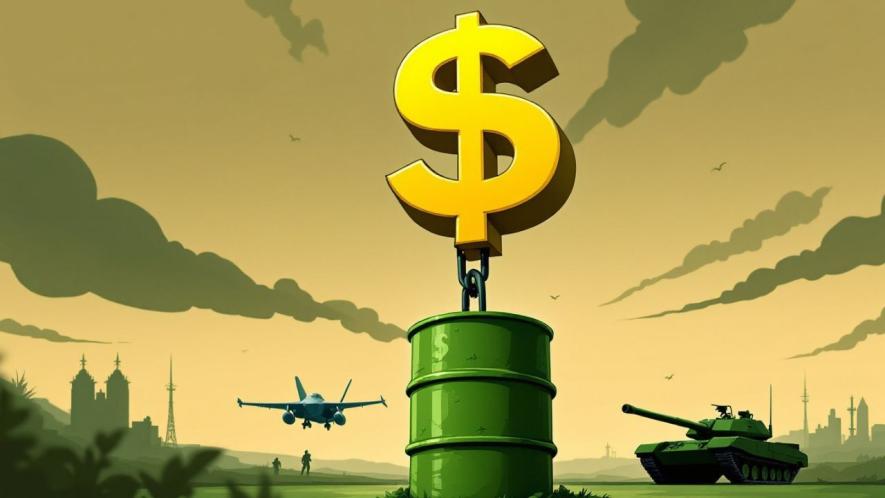
Image Courtesy: creativecommons.org
The world stands on the brink of a third world war. The terrifying threat of nuclear war looms large. No one knows what tomorrow will bring. Eight decades after the cataclysm of the Second World War—a systemic upheaval that claimed tens of millions of lives—the contemporary world once again stands on the edge of a fresh imperialist conflagration.
The "international law" of the post-WWII era has been exposed as a hollow bourgeois fiction. The imperialist "quad" (the US, the UK, France, and the Zionist entity, Israel) operates as a global gendarme, disregarding the UN framework to impose a unipolar dictatorship. Behind this shell lies the true engine of destruction: monopoly capital and the military-industrial complex. The dictatorship of the dollar, backed by oil and steel, demands perpetual war to sustain its terminal accumulation.
Within this current historical event, “four major contradictions” have emerged and intensified across the globe. So, this is not an accidental drift into disorder, but the sharpening of structural contradictions inherent in the imperialist phase of capitalism. These contradictions among major imperialist powers can be seen as —
- Inter-Imperialist Rivalry: The escalating friction between the US and its European counterparts—most notably the United Kingdom, Germany, France, Italy, and Turkey—reflects a fracturing of the Western alignment as these powers navigate competing interests for market dominance.
- The Metropole-Periphery Divide: The yawning chasm between the developed capitalist core and the Global South periphery continues to widen, driven by the mechanisms of neo-colonial extraction and the systematic subordination of developing economies.
- Ideological and Existential Conflict: The profound antagonism between US-led imperialist structures and the remaining socialist bastions—including China, Cuba, the DPRK aka North Korea, and Venezuela—remains a primary axis of global tension.
- The Fundamental Class Contradiction: Most pivotally, the internal struggle between capital and labour has reached a fever pitch within the nation-state framework, as the ruling class seeks to resolve systemic stagnation through the heightened exploitation of the proletariat.
In geopolitical terms, the growing militarisation of international relations—driven by US expansionist strategies and sustained through both direct and proxy interventions—has transformed West Asia into a theatre of prolonged devastation. The populations of Iran, Palestine, Lebanon, Yemen, and Syria continue to endure immense human suffering as warfare reorganises entire societies through destruction, displacement, and dispossession. This is not merely a regional crisis, it signals a broader instability within the global capitalist system.
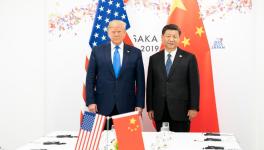
The aggressive unilateralism associated with Donald Trump accelerated these dynamics, pushing global war toward a destructive stage. According to the Stockholm International Peace Research Institute (SIPRI), the US accounts for about 42% of global arms exports to 99 countries. The Trump administration, by pushing the world toward a third world war, has effectively opened a new avenue for profit-making for American arms industries.
Israel-West Asia Conflict
Israel, which has occupied nearly 90% of Palestinian territory, has been equipped with nuclear weapons by the US in order to maintain its dominance over the abundant oil and gas resources, gold, and other natural mineral wealth of the Gulf region. On the other hand, around 28 countries, including Iran and North Korea, have not recognised Israel as a sovereign state.
In the past, several wars have taken place between Israel and the Gulf countries, in which Israel emerged victorious. In the entire Gulf region, Iran remains the only country capable of challenging Israel. The US and Israel do not want Iran to emerge as a nuclear-armed state with the support of China and Russia. Meanwhile, Iran, China, and Russia are committed to the establishment of an independent and sovereign Palestinian state.
US Attack on Kharg Island
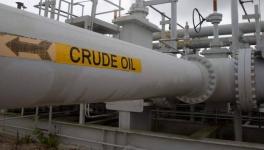
The US has made a grave mistake by attacking Iran-controlled Kharg Island. From this island, Iran exports around 90–95% of its daily oil. Nearly 80–90 % of Iran’s oil reserves are associated with Kharg Island, which also holds vast deposits of gold and other mineral resources.
Kharg Island is Iran’s largest oil export terminal, with a loading capacity of about 7 million barrels per day, although current exports are around 1.5 million barrels daily. At the same time, the movement of approximately 3.5 million barrels of oil through the Strait of Hormuz has already been disrupted. Global consumption (including China, India, Japan, South Korea) exceeding 105 million barrels per day on one hand, and oil prices exhibiting 50% around the $160/barrel on the other. (Source: International Markets. Ithaca: Cornell University Press).
Today, that struggle has moved from the oil field to the maritime chokepoint.
The Strait of Hormuz is a bottleneck for more than just fuel. It carries:
- 40% of the global fertiliser trade (essential for industrial agriculture).
- 85% of West Asian polyethylene.
- 25% of global helium supplies (critical for high-tech and semiconductor production).
- 30% of Oil and gas supplies to the million people
(Source: U.S. Energy Information Administration (EIA). 2026. World Oil Transit Chokepoints Report. Washington, D.C.: EIA).
Israel’s Attacks on Energy Infrastructure
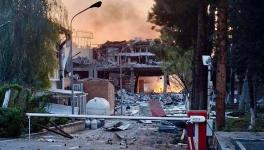
Israel struck Iran’s South Pars gas field (the field is indeed the largest gas reserve globally). Iran targeted Israel’s Haifa refinery. Qatar’s LNG infrastructure (including Ras Laffan) that supplies roughly 40% of global LNG, were also hit. Multiple Gulf refineries operated by US multinational corporations in Saudi Arab, Bahrain, Kuwait, Oman, and Jordan were attacked.
Reports that the US Navy has “withdrawn” from the Gulf and maintains no presence within 700 km is inaccurate. It maintains a significant presence through the Fifth Fleet based in Bahrain. Gulf countries. Saudi Arabia, Qatar, the UAE, Bahrain, Kuwait, Oman, and Jorden spend heavily on US security arrangements.
Global Impact of War
Since the outbreak of war against Iran on February 28, the global stock markets have suffered losses of approximately $6 trillion. Of this, nearly $2 trillion has been lost in the US stock market alone (Source: Sky News; TRT News; The Wall Street Journal; International Monetary etc)
Impact on India and China
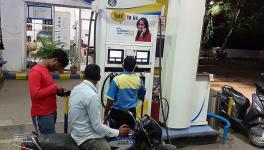
India imports about 85–88% of its crude oil, and around 40-45 % comes from the Gulf region. Around 60% hotels and restaurants have been closed in India due to shortages of gas supply. China is also a major energy importer but has diversified supply routes. China is constructing pipeline links to Russia (e.g., Power of Siberia). While India has no direct pipeline link with Russia, Iran or any other oil countries, and heavily relies on tanker imports.
Thorium Discovery in China: Fact and Context
China has indeed invested heavily in thorium-based nuclear research, particularly molten salt reactors. Thorium is widely considered:
- More abundant than uranium
- Capable of producing less long-lived radioactive waste
- Potentially safer due to lower meltdown risks
However, reports that China has “confirmed over one million tonne of thorium discovery” should be treated cautiously. Thorium resources are globally abundant (not unique to China), and estimates depend on geological classification rather than confirmed economically extractable reserves. According to the International Atomic Energy Agency, thorium technology remains experimental, with no large-scale commercial deployment yet.
The Energy Shock: Attacking the Working Class
Energy (particularly petroleum oil and gas) for newly industrialising countries, such as India, Indonesia, Bangladesh, Vietnam, Pakistan, and Eastern Africa and Eastern European countries, is a universal input. When the price of oil spikes, the cost of existence for the global proletariat follows. The projected jump to $200 per barrel threatens a global "stagflationary" spiral—where prices rise while the full-flagged economy falls.
This vulnerability is starkest in the periphery nations, like Vietnam and Pakistan, holding less than 20 days of reserves, which are being pushed toward total economic collapse. The IEA emergency release of 400 million barrels is a mere statistical band-aid, representing only four days of global appetite. This is a disruption of expanded reproduction.
Rising energy prices exert immediate pressure on everyday life. Increases in oil costs translate directly into higher prices for transport, food, and essential goods, disproportionately affecting working populations. The prospect of sustained price escalation raises the likelihood of a stagflationary environment, where inflation coexists with economic stagnation.
The impact is especially severe in the Global South, where limited reserves and fragile fiscal conditions heighten vulnerability. Countries with constrained energy buffers face mounting balance-of-payments pressures, currency instability, and potential social unrest. Emergency interventions by international agencies provide only temporary relief, failing to address underlying structural weaknesses.
Capitalists attempt to offset rising energy costs by squeezing labour—lowering real wages and intensifying exploitation. As Marxist theorist Rosa Luxemburg argued, the capitalist machine’s thirst for external resources makes it inherently violent; when those resources are constricted, the system turns its teeth inward on the working class.
Historically, such situations lead to intensified exploitation. In order to preserve profitability, capital responds by suppressing wages, reducing labour protections, and shifting the burden of crisis onto the working class. This pattern underscores the continued relevance of Luxemburg, who emphasised the expansionist and crisis-prone nature of capitalist accumulation.
Petrodollar System Under Strain
At the core of the present turmoil lies the question of monetary power. Since the 1970s, the global dominance of the US dollar has been closely linked to its central role in oil transactions. This arrangement—commonly described as the “petrodollar system”—has enabled the US to sustain large fiscal deficits while maintaining its global influence.
However, this system is increasingly under pressure from ‘BRICS’ - China and Russia. Efforts by emerging economies to conduct energy trade in alternative currencies, including the Chinese yuan and various local units, signal a gradual shift away from dollar dependence. Such developments challenge the foundations of US financial hegemony and suggest the emergence of a more fragmented monetary order.
As Egyptian economist Samir Amin observed, global capitalism is structured through unequal exchange, whereby value flows disproportionately from the periphery to the core. Any weakening of the petrodollar arrangement has the potential to disrupt this pattern, though it does not automatically guarantee a more equitable outcome.
Multipolar Realignments and Emerging Contradictions
The rise of alternative economic groupings, particularly BRICS, reflects an ongoing transition toward multipolarity. Initiatives aimed at creating independent financial mechanisms and reducing reliance on Western-dominated institutions point to a reconfiguration of global power relations.
Yet this transition is neither linear nor inherently progressive. Multipolarity may simply redistribute influence among competing centres rather than transform underlying structures. As American sociologist Immanuel Wallerstein argued, periods of hegemonic decline are often characterised by turbulence, uncertainty, and conflict rather than orderly change.
Crisis, Transition, and Historical Choice
The brink of a third world war surrounding West Asian and Caribbean countries: Venezuela and Cuba, Ukraine, and Taiwan has exposed sharply the emerging contradictions among the inter-imperialist gangs: ‘the US vs. NATO’, and between ‘the US-led NATO and BRICS (particularly China and Russia)’ for changing the new multipolar global order or maintaining the current unipolar American order.
At this critical juncture, humanity confronts a fundamental choice. The erosion of dollar hegemony, the intensification of resource competition, and the growing instability of global systems are opening new historical possibilities. These developments may lead either to heightened inter-imperialist rivalry or to the emergence of alternative forms of cooperation and organisation.
The writer is an economist, academic, and author with over 25 years of experience across Asia, Africa, and the Pacific. The views are personal.
Get the latest reports & analysis with people's perspective on Protests, movements & deep analytical videos, discussions of the current affairs in your Telegram app. Subscribe to NewsClick's Telegram channel & get Real-Time updates on stories, as they get published on our website.