





Peru Breaks Record: 35 Candidates in Fray For President
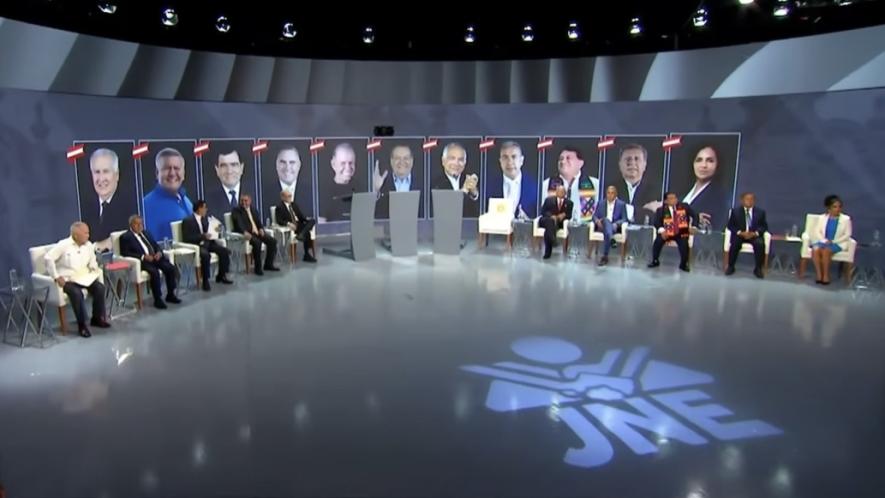
Presidential candidates in debate organized by the electoral authority in Peru. Photo: JNE
In two weeks Peruvians will head to the polls to elect their next president and members of Congress. A total of 35 candidates are vying for the presidency, though few are polling above 5%. It is difficult to predict what will happen, especially as the public’s sense of disillusionment and apathy could always boost the vote for an outsider who manages to capture the attention of a public fed up with a political class incapable of reaching agreements.
The Andean country is in the midst of a chronic political crisis following a rapid succession of leaders: eight presidents in ten years. The last elected president was the leftist Pedro Castillo, who was removed from office and imprisoned after attempting to convene a Constituent Assembly to replace the Peruvian constitution – a neoliberal document that profoundly benefits certain national and international economic elites, and at the core of which lies an institutional framework designed to sabotage any transformative and redistributive political process.
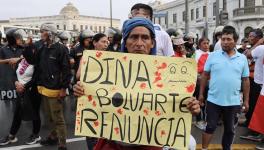
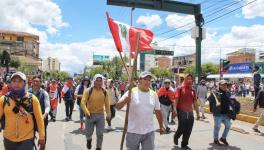
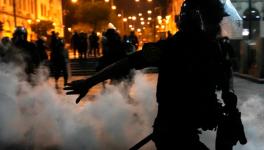
Following his removal, Castillo’s vice president, Dina Boluarte, took office. She promptly distanced herself from her former ally and governed in favor of local elites and US geopolitical interests. Boluarte was responsible for leading the brutal repression against the demonstrations that erupted across Peru, demanding Castillo’s release and reinstatement as president. The result of the demonstrations, which lasted several months, was more than 50 deaths and hundreds of injuries, for which Boluarte is currently under investigation.
But it was not her alleged involvement in human rights abuses that led to Boluarte’s removal from office, but rather an alleged corruption scandal that the parties controlling Congress exploited to oust Boluarte once she was no longer useful to their interests. Following that, José Jerí served as interim president for just four months, and he was succeeded by José María Balcazar, who stated that his administration would focus particularly on the transition of power to the new leader.
The “countless” presidential candidates
The ballot will be quite unusual this year. The list of presidential candidates includes 35 names, a record number for the country. What might be seen as a sign of the strength of democratic pluralism is, in reality, yet another indication of the weakness of the Peruvian political system.
According to polls, none of the candidates appears to exceed 12% of the vote. Political fragmentation does not, however, imply great ideological diversity. Most candidates resort to a discourse bordering on populism, promising voters “miracles” that are impossible to achieve, just to win a few votes. This attitude, which might be seen as reprehensible from a moral standpoint, has a pragmatic rationale behind it: with the vote so divided, a candidate could slip into the runoff without significant popular support.
This was demonstrated by a technical audit of the candidates’ government plans. According to the Institute for Sustainable Industrial Development (IDIS), nearly 85% of the candidates’ proposals are based on “wishful thinking” with no basis for implementation, whether due to a lack of funding or institutional capacity to carry them out.
Despite IDIS’s calls to reformulate the plans based on the country’s reality, most candidates in Peru’s representative democracy seem to care little whether the proposals are absurd or realistic, as long as they allow them to accumulate votes.
Who is leading in the polls?
Despite significant political fragmentation, some front-runners are emerging. According to the polling firm Ipsos, the current front-runner, with 11% of the vote, is right-wing candidate Keiko Fujimori, daughter of former Peruvian dictator Alberto Fujimori, who was convicted of several serious crimes. Keiko has undoubtedly built her political profile by appealing to those who once supported her father, although that very symbolic loyalty has led a large part of Peruvian society to reject her as a viable presidential candidate. Keiko appears to be particularly strong in the capital, Lima, and in the eastern part of the country.
In second place is the former mayor of the capital, the far-right Rafael López Aliaga of the Popular Renewal Party, who, according to the polls, has 9% of the vote. López Aliaga, a businessman by profession, is a full member of Opus Dei and holds staunch anti-abortion views, which has allowed him to garner support from the most reactionary segments of Peruvian society.
Following the line of a hard-line discourse against crime (something Fujimori and López repeat whenever they can) is comedian Carlos Álvarez. The Patria Para Todos candidate performed a comedic impersonation of one of the candidates during a presidential debate, and in another appeared alongside a memorable character from a local comedy show, which has caught the attention of a segment of the electorate clearly disenchanted with the Peruvian political system. Álvarez ranks third with 7% support.
The first candidate to maintain a moderate stance is Jorge Nieto of the Good Government Party, who polls at 5%. He is followed by center-left candidate Alfonso López Chau of Ahora Nación, with 4% of the vote. López Chau appears to have greater support in the south of the country. Tied with him is Roberto Sánchez, the only left-wing candidate with a chance of advancing to a runoff.
Trailing behind them in the polls are a large number of candidates with less than 2% support, such as Ricardo Belmont, César Acuña, Fernando Olivera, Marisol Pérez Tello, Yonhy Lescano, and Ronald Atencio.
Who could win the election?
It would be a mistake to rule out any candidate. With two weeks to go before the election, one of the candidates currently leading in the polls could lose ground, while one of those trailing could gain support, thereby securing a spot in the runoff. And then, depending on who makes it to the runoff, the assessment would have to change. The variables are vast.
This volatility means that candidates are taking great care to maintain the image they have crafted for this election, although it is not unreasonable to think that one of the 35 candidates might dare to make a move that draws significant attention in order to gain a few points in the race. This is particularly important to consider given that nearly a third of Peruvians have not yet decided who to vote for.
In short, nothing is set in stone. Peru will once again be a scene of uncertainty, largely generated by its own political system: weariness, indifference, anger, and even resentment. And it’s not that the economic and political elites are unaware of these symptoms, but rather that they have learned how to use them to maintain control and ensure that nothing changes.
Courtesy: Peoples Dispatch
Get the latest reports & analysis with people's perspective on Protests, movements & deep analytical videos, discussions of the current affairs in your Telegram app. Subscribe to NewsClick's Telegram channel & get Real-Time updates on stories, as they get published on our website.