





Odisha: How the Death of a Forest Led to Drying Streams in the State
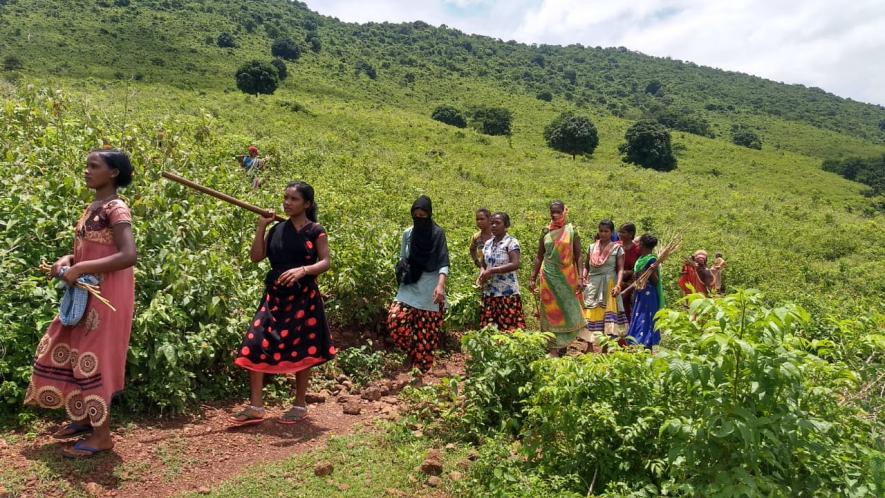
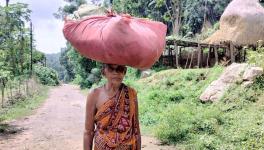
forest sorrounding area
Koraput, Odisha: “We have never seen God, but if we are alive today, it is because of this water and this forest,” said Yeshudan Disari (34) from Barakutuni village in Semiliguda block in Odisha’s Koraput district.
Barakutuni is home to 91 households, most belonging to Scheduled Tribe communities. For generations, life here revolved around monsoon-dependent farming and the forests that sustained it. Then, slowly, that relationship began to break.
Despite receiving 1,500mm -1,800 mm of annual rainfall, according to India Meteorological Department, most of it fell in a compressed monsoon window — and that window was becoming increasingly unpredictable. Across Koraput, nearly 1.8 lakh -1.9 lakh hectares of upland agriculture remains entirely rain-fed, leaving farming vulnerable to even brief dry spells.
Decades in making
Around 2009-’10, forest degradation intensified as more families turned to podu (shifting cultivation), clearing hill-slope forest patches for agriculture. The reasons were structural: declining soil fertility, erratic rainfall, and almost no access to irrigation.
“Earlier, we used to grow enough in our lands below. But the soil became weak and rains were not regular,” said Dabuli Santa, 75. “We had no option but to go uphill and clear forest patches for podu.”
The expansion of podu was both a response to ecological decline and a driver of it. Repeated clearing and burning reduced vegetation cover, exposing soil to erosion and cutting its capacity to retain moisture. Springs that once sustained the village began to dry up. Data from Global Forest Watch shows Koraput district lost an estimated 20,000-30,000 hectares of tree cover between 2001 and 2023.
“Earlier, we collected a variety of forest foods, kokodi saag, puliyari saag, girli flowers,” recalled Sambara Jani, 70. “As forests were cleared and land was burned for podu, these disappeared. They were not just forest produce, they were part of our daily meals.”
The village once depended entirely on a single perennial stream, Pahala Jhola, nearly 1.4 kilometres away, for drinking water and daily use. As farming failed, distress migration increased, men leaving for Andhra Pradesh and Chhattisgarh in search of work. The village was slowly emptying out.
The crisis peaked around 2010-’11 when Gorada Mala, the key spring used for drinking water, dried up completely during summer. In the Semiliguda block, where only about 0.33% of agricultural land is irrigated, this was an existential moment.
“We had nothing then. There was no water in the village. We depended on Pahala Jhola, a stream nearly one and a half kilometres away, for all our daily needs.” said Disari.
The crisis in Barakutuni was not unique — it reflected a broader pattern across Koraput. The problem was never a shortage of rain, but its increasing unreliability. Earlier studies show the region received relatively stable rainfall of about 1,274 mm annually with nearly 70 rainy days. Today, farmers report a different reality: delayed monsoon onset, prolonged dry spells, and sudden intense downpours that damage standing crops rather than recharging the soil.
According to the Odisha State Disaster Management Authority, districts like Koraput are experiencing both extreme rainfall events and prolonged dry periods — a double blow to rain-fed farming. Rising temperatures have compounded the problem by accelerating soil moisture loss, worsening water stress during critical crop stages.
The economic toll is severe. Across Koraput, erratic rainfall has led to estimated losses of over Rs 30 crore in cashew cultivation alone, according to GB Nayak of ICAR-Central Rainfed Upland Rice Research Station. Unseasonal rainfall events have repeatedly damaged standing crops in several blocks including Semiliguda. In such a fragile landscape, communities depend heavily on hill streams — making their protection not just an ecological choice, but a matter of survival.
Rebuilding water
Faced with collapse, the people of Barakutuni came together. In January 2012, at a panchayat-level meeting with elected members and facilitated by the Foundation for Ecological Security (FES), the community collectively recognised — for the first time — the link between forest loss, water scarcity, and collapsing livelihoods. Their response began with water.
With their own labour and support from FES, the village built a diversion-based irrigation (DBI) system: channelling water from hill streams to farms using gravity. A 1,400-metre pipeline was laid from Pahala Jhola to farmlands; a small cement storage structure with a control valve was constructed to regulate use. Water is released only when needed, and the community agreed that half the flow would be reserved to sustain the forest ecosystem.
“We made rules so that everyone gets water,” said Barsha Sirika, a farmer from Barakutuni. “No one can irrigate more than two acres. Water is shared from upstream to downstream, and once one field is done, we help the next.”
All work was done through voluntary labour. The system, pipes, channels, storage structures, continues to be maintained collectively.
“We worked together to bring the water to our fields,” said Nilasa Santa, 63. “Now we don’t waste it…only when needed do we open the valve. We have rules so that both farming and the forest can survive.”
Water management
As the irrigation system stabilised, villagers understood that it alone would not sustain them unless the surrounding ecosystem was restored. Through repeated Gram Sabha meetings facilitated by FES, they arrived at a critical decision: to completely stop podu cultivation on upper hill slopes.
The land was left undisturbed to regenerate. To support families who had depended on podu, those with cultivable land in the plains voluntarily shared portions of their fields, an arrangement based on mutual agreement rather than formal contracts, held in place until alternative livelihoods and irrigation were established.
“We could not stop podu unless everyone had something to depend on,” says Manuku Sisa, 80. “So those who had land gave a part of it for others to cultivate. It was our way of supporting each other.”
Youth groups began restoring degraded hillsides through annual seed broadcasting drives during the monsoon, dispersing native species across barren slopes. Within a few years, the impact became visible: streams that had dried up began to flow again, and new springs emerged closer to the settlement.
Two additional streams — Jamir Jhola and Gorada Maha — were revived through community-led conservation. Villagers mobilised their own resources and labour to construct additional DBI structures on each. Recognising the scale of what the community had achieved, Koraput district Collector Abdaal M. Akhtar, during a recent visit, sanctioned Rs 10 lakh for a further DBI system on the revived Gorada Maha stream.
Rising incomes
Today, revived streams, Gorada Maha, Dayori Kalu, and Jamir Jhola, support irrigation across nearly 70 acres. Where once a single paddy crop in the kharif season was possible, farmers now cultivate beans, ginger, tomato, chilli, and sweet potato across three seasons: kharif, rabi, and summer.
“I cultivate around three acres now. With water available beyond the monsoon, we can grow crops in two to three seasons. Earlier, we depended only on rain and had to migrate for work — but now we can manage from our own fields,” said Tika Gunkha, a farmer.
“Earlier, we could grow only one crop,” said Basanti Jani. “Now we cultivate two to three crops — even if rainfall is irregular.” In Semiliguda, where irrigation coverage is just 0.33%, that qualifier carries real weight.
The income data from the village’s producer group, Annapurna Producers Group, tells a clear story. In 2022-’23, most households earned between Rs 32,000 and Rs 40,000 annually. By 2023-’24, incomes rose to Rs 1.18- Rs 1.42 lakh. By 2024-’25, they reached Rs 1.59- Rs 1.91 lakh, with some farmers earning over Rs 2 lakh. Average annual incomes have increased four to six times within three years.
Distress migration has declined sharply. Families that once relied on seasonal work in neighbouring states are now able to sustain themselves within the village.
“Earlier we depended on one crop and rain. Now we grow crops throughout the year,” said Jambo Dishari, a farmer from the village.
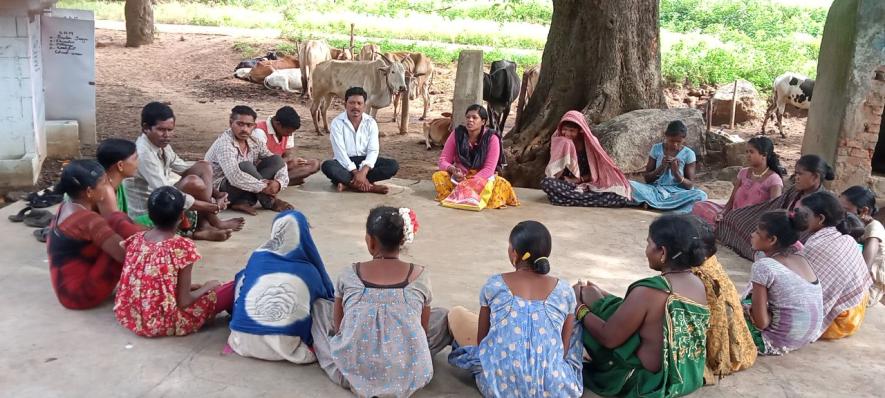
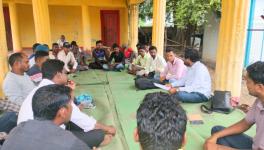
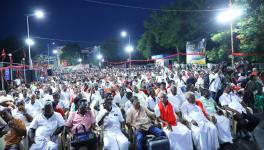
villagers do their meeting on different issues before gram sabha
Diversification of livelihoods
Ecological recovery has created new livelihood opportunities. Women in the village now collect hill broom from regenerated forests, process it, and sell it in nearby markets including Kunduli. Supported by government livelihood programmes, this has become a steady secondary income source.
“The forest has come back, and so has our income,” said Jamuna Jani, a member of a women’s self-help group.
Dependence on forests has also become more sustainable, reduced pressure on natural resources is allowing regeneration to continue, creating a self-reinforcing cycle.
The roots of this transformation go back to 2008, when villagers first organised to protect their forests amid rising degradation, forest fires, and human-wildlife conflict. They introduced rules on grazing, fire prevention, and forest use, and adopted a ‘thengapalli’ system, rotating household-by-household forest guard duty.
In 2016, the village secured Community Forest Rights (CFR) under the Forest Rights Act, bringing nearly 1,000 acres under collective protection. The Gram Sabha gained legal authority to manage forests, regulate use, and enforce conservation rules. Today, decisions on forest use, water management, and livelihoods are taken collectively.
Alongside conservation, the village has adopted a Village Ecological Register (VER) to track environmental changes. Villagers document rainfall patterns, water sources, biodiversity, and seasonal cycles, building a local record of climate variability that now informs decisions under community forest rights.
“We are now tracking changes in rainfall and forests ourselves,” says Jayanti Sirika, a young para-ecologist trained through the programme. “Last year we recorded delayed monsoon rains, so farmers postponed sowing to avoid crop loss. It helps us understand what is happening and plan better.”
A model worth watching
Barakutuni’s experience demonstrates that resilience in rainfed regions does not always require large infrastructure. By restoring forests, managing water collectively, and strengthening local governance, the village has built a system capable of withstanding climate variability — and of sustaining the people who depend on it.
In Koraput, where nearly 1.89 lakh hectares of farmland remains rain-fed and irrigation covers a fraction of a percent of agricultural land in blocks like Semiliguda, this model carries implications well beyond one village.
“What Barakutuni shows is that restoring forests and water systems together can significantly improve climate resilience in rainfed regions,” said a practitioner associated with FES. “The intervention shows diversion-based irrigation can increase farm incomes by 20-50% and enable multiple cropping cycles. Equally important, reducing dependence on podu has allowed forests to regenerate — creating a cycle of ecological recovery that reinforces itself.”
“We understood that if the forest lives, we live.” said Jayanti Disair.
Prativa Ghosh is a freelance journalist and a member of 101Reporters, a pan-India network of grassroots reporters.
Get the latest reports & analysis with people's perspective on Protests, movements & deep analytical videos, discussions of the current affairs in your Telegram app. Subscribe to NewsClick's Telegram channel & get Real-Time updates on stories, as they get published on our website.