





Mohan Bhagwat and Different Shades of Hindus
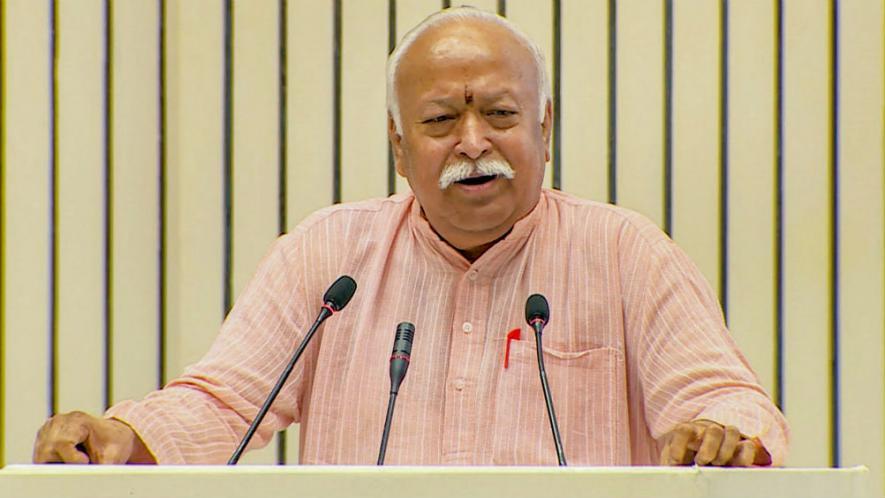
File Image
Mohan Bhagwat, the Rashtriya Swayamsevak Sangh (RSS) chief, does all kinds of acrobatics to defend the idea of Hindu Rashtra. Many times, he even says that all people living in India are Hindus, and we share common ancestry etc. Earlier RSS ideologues have given out signals that Islam and Christianity are “foreign” religions.
The progenitor of Hindu nationalism, V. D Savarkar, gave a definition of Hindu as one who regards the land from Sindhu to the Sea as a Holy land and Fatherland. The second RSS sarsanghchalak, M. S Golwalkar, says that for making a Hindu Rashtra, the RSS will follow the German model where so many Jews were put to torture and in gas chambers to build a German nation. Lately, a more polished version of this statement is being dished out by Bhagwat.
The RSS has also been saying that Hinduism is not a religion but a way of life, defying the sociological understanding of religion wherein the Holy deity, rituals, Holy books, clergy etc. are key components. Recently, Bhagwat came up with a unique classification of Hindus, in a bid to assuage the deep feeling of marginalisation among Muslims and Christians.
Citing a lofty meaning of Hinduism, the RSS chief stated that “If you are Indian, this nature (Hindu, added) is inherent in you". He was underlining that Muslims and Christians are an inseparable part of the Hindu nation. He went on to outline four broad categories of Hindus in the country. The first group, he said, consists of those who openly declare their Hindu identity with pride. The second includes people who acknowledge being Hindu but see nothing exceptional in it. The third category, according to Bhagwat, comprises those who prefer to speak about their identity only in private. The fourth, he said, includes people who have either forgotten their Hindu identity or have been made to forget it.”
So, according to him, who is a proud Hindu? Those who demolished the Babri Mosque? Those who dance and raise abusive slogans in front of mosques? Those who, like a huge section of Kanwarias, create ruckus on the streets? Bhagwat did not clarify, but one will have to make a guess.
Babasaheb Ambedkar was born in a Hindu family and went on to burn the Manu Smriti and also declare that he was born in a Hindu family, but will not die a Hindu. Where will the RSS supremo fit him? Where will he put the Indian Constitution? His organisation had opposed the Constitution saying that it was based on Western values and that there was nothing Indian about it.
The current dilemma of RSS is to win over Muslims, Christians, Dalits and Adivasis and draw them into the RSS fold. Hence, the new acrobatics of talking in decent terms about Christians and Muslims. As such, defining Hinduism is a difficult task for sure. The reasons for this are multiple.
One, Hinduism is not a prophet-based religion, it has no single founder. Two, religious streams developing in this part of the world have been lumped together as Hinduism, and three, there are so many diversities in the practice of Hinduism that all streams cannot be painted with a single brush.
Practices and beliefs originating at different times continue to exist side by side. Lord Satyanarayana and Santoshi Maa exist along with the concept of Ishwar (God) and a Nirankar Nirguna Ishwar (God beyond the attributes of qualities and form) at the same time.
Read Also: Ambedkar Birth Anniversary: Whither Annihilation of Caste?
The major point of departure for Hinduism is the imprint of the caste system on the major aspects of Hinduism, the religious sanctity for social inequality, the caste system being the soul of its scriptures and practices.
The Aryans, who came in a series of migrations, were pastorals and polytheists. During the early period, we see the coming into being of the Vedas, which give a glimpse into the value system of that period and also the number of gods/goddesses with diverse portfolios, and the prevalence of polytheism. The ‘Laws of Manu’ were the guiding principles of society. This Vedic phase merged into the Brahminic phase. During this phase, the elite of the society remained insulated from all and sundry. At this point of time, the caste system provided a perfect mechanism for this insulation of the elite.
Buddhism’s challenge to the caste system forced Brahminism to come up with a phase, which can be called Hinduism. During this, the cultic practices were broadened and public ceremonies and rituals were devised to influence the broad masses to wean them away from Buddhism.
It is interesting to note that till the 8th century, the so-called Hindu texts did not have the word ‘Hindu’ itself. This word came into being with West Asian Muslims coming to this side. They called the people living on this side of Sindhu as Hindus. The word ‘Hindu’ began as a geographical category. It was later that religions developing in this part of the world started being called Hindu religions. The victims of the caste system made every effort to convert to other religions, Buddhism, Islam and partly Christianity and later to Sikhism.
Within Hindu religion, two streams ran parallel -- Brahminism and Shramanism. The Shramans defied Brahminical control and rejected the caste system. While Brahminism remained dominant, other streams of Hinduism also prevailed, Tantra, Bhakti, Shaiva, Siddhanta etc. Shramans did not conform to Vedic norms and values. Brahminism categorised religious practices by caste while Shramanism rejected caste distinctions.
Brahminical Hinduism was the most dominant tendency, as it was associated with rulers. Side-tracking the Hindu traditions of the lower castes, Brahminism came to be recognised as Hinduism in due course of time. This phenomenon began with the Magadh-Mauryan Empire after subjugating Buddhism and Jainism in particular.
Later, with the coming of the British, who were trying to understand Indian society, Hindu identity, based on Brahminical norms, was constructed for all non-Muslims and non-Christians. The Vedas and other Brahminical texts were projected as Hindu texts. Thus, the diversity of Hinduism was put under the carpet and Brahminism came to be recognised as Hinduism. So, Hinduism, as understood as a religion, is based on Brahminical rituals, texts and authority of Brahmins.
Bhagwat needs to spell out the validity of his classification with the caste system in mind. So, within this elaborate Hinduism how will these four categories be articulated, that is the question?
The writer is a human rights activist, who taught at IIT Bombay. The views are personal.
Get the latest reports & analysis with people's perspective on Protests, movements & deep analytical videos, discussions of the current affairs in your Telegram app. Subscribe to NewsClick's Telegram channel & get Real-Time updates on stories, as they get published on our website.