





Jadavpur Seige: How a Campus Became a Political Battlefield
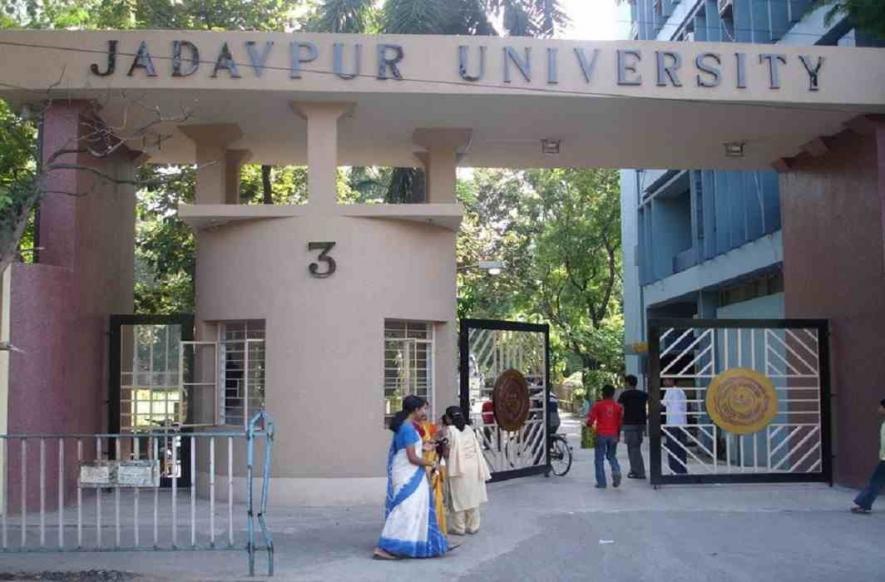
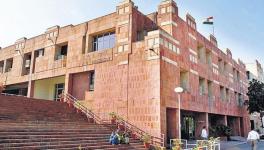
KOLKATA — There is a particular kind of silence that falls over a university when its own students no longer feel safe inside their hostel rooms. On the night of August 19, that silence descended on Jadavpur University — one of the sub-continent's oldest surviving monuments to the idea that education can be free, public and unowned by empire or ideology. By the time it lifted, two days later, the campus's iron gates had been shaken loose, its administrative headquarters had been barricaded from within by frightened staff, and a piece of its own emblem — sculpted after a design tied to the Santiniketan master Nandalal Bose — lay snapped off in the dust.
For students who have spent years defending this campus as a rare island of dissent in an increasingly monitored republic, the events of the past week have felt less like a student-union scuffle and more like a rehearsal for something much larger: the slow, systematic humbling of every institution in India that still dares to think out loud.
This is not hyperbole to the people who lived through it. It is, they say, simply what it looked like.
A Students' Union Meeting, and Then a Mob
The trouble began, as these things so often do, over something almost bureaucratic: the constitution of a students' union. On the evening of August 19, the Faculty of Engineering and Technology Students' Union (FETSU) convened a General Body Meeting inside Aurobindo Bhavan, the administrative nerve-centre of the university.
Left-affiliated students and activists of the Akhil Bharatiya Vidyarthi Parishad (ABVP) — the RSS's decades-old vehicle for capturing Indian campuses— disagreed over how the union should be formed. Words became shoves; shoves became blows. Two ABVP-linked students needed hospital treatment. It was, students insist, an ordinary and eminently containable dispute — the sort that campuses across the country absorb and move past.
What followed was not ordinary at all.
By midnight, Sarbari Mukherjee, the ruling Bharatiya Janata Party (BJP) sitting MLA from the Jadavpur constituency, arrived at the local police station to file a complaint on ABVP's behalf. Soon after, students allege, the university's gates began filling with people who had no student card, no class timetable, and no legitimate business inside a university at all.
Videos that circulated widely on social media show bike-borne men entering the campus carrying sticks and batons, tearing down posters belonging to Left-aligned student groups and setting them alight outside Aurobindo Bhavan. Whether every one of those men was a registered ABVP member or simply a BJP Yuva Morcha volunteer along for the ride hardly mattered to the students cowering behind hostel doors that night: to them, it was one indistinguishable saffron mob, and it had come armed.
The main hostel bore the worst brunt. Resident students — many of them far from home, some from small towns and villages who had fought hard for a berth at one of India's most competitive public universities — found themselves under a barrage of stones, mud and eggs hurled at their windows, accompanied by chants and abuse that students describe as vicious and, in several instances, communal.
Amid all this, security personnel posted at the gates, students and faculty allege, did essentially nothing. Calls to the officer-in-charge at Jadavpur police station reportedly went unanswered for a crucial stretch of the night; calls to the Vice-Chancellor and Pro-Vice-Chancellor's phones, students say, simply rang out. It took the direct intervention of professors — moving between the mob and the gates, trying physically to calm both sides — to prevent the night from ending in something far worse than broken glass.
The Students' Federation of India (SFI), the CPI(M)'s student wing, central executive committee declared that “Jadavpur's students would not stand alone in defending the university's democratic and peaceful character”, and insisted there is no place on any Indian campus for hatred, communal politics or organised violence dressed up as student activism. The organisation's state secretary went further in comments to the press, describing the "goons" affiliated with the BJP-RSS (Rashtriya Swayamsevak Sangh) as “having stormed the administrative block and attempted arson” at multiple points on campus — a claim the ruling party has firmly denied.
Day 2: The Gate That Would Not Hold
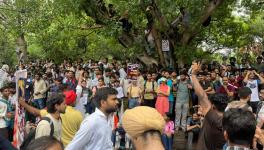
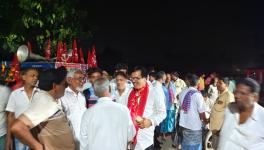
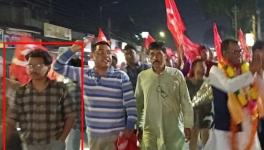
If the first night was chaos born of a spontaneous mob, the second day carried the unmistakable choreography of an organised political event. On Thursday, August 20, ABVP workers marched from Golpark to Jadavpur police station under the banner of a "Jadavpur University Abhiyan", ostensibly to protest what the organisation called an “unprovoked attack” on its office-bearers the night before. Police had lined the approach road with barricades. A section of the marching crowd broke through them anyway and pushed toward Gate No. 4, on the other side of which Left-aligned student organisations were holding their own protest march against the previous night's violence.
What happened at Gate 4 has become the defining image of the entire episode. According to some students and faculty present, the crowd outside began shaking the locked iron gate, attempting to force it open, and — failing that — climbing over it, using the university's own bronze emblem, mounted on the ironwork since the institution's earliest days, as a foothold. In the process, a section of that emblem broke away entirely. From the other side of the gate, students responded with slogans of defiance — "JU never surrender" among them — even as, they allege, water bottles, mud, stones and eggs rained down on them, along with a torrent of abuse.
It was in this same melee, students allege, that a group of their peers walking near the gate, uninvolved in either the union dispute or the protest march, were surrounded by a section of the crowd and beaten, accused as they were struck, of being "agents of Pakistan" and "agents of China."
This is a vocabulary sounds depressingly familiar to anyone who has followed the trajectory of campus politics in Narendra Modi's India over the past decade — the same rhetorical arsenal that has, in other university towns, preceded lynchings, that has painted questioning students as traitors before a single fact has been established.
Rajyeshwar Sinha, a professor in Jadavpur University's Bengali department, retrieved the broken piece of the emblem from the ground and held it aloft in protest, calling the university a heritage institution whose century-long project of offering serious, low-cost education to India's marginalised students was now under a broader assault — one he tied explicitly to a creeping push toward privatising Indian public higher education altogether.
A Pattern With a Long Memory
For Kolkata's academic and cultural community, watching this unfold felt like watching a rerun of a film they know by heart. Filmmaker Kamaleshwar Mukherjee told reporters that the trigger for the unrest was transparent: an attempt to provoke Jadavpur's elected student unions into a reaction that could then be used to discredit them. No organisation, student or otherwise, is ever truly apolitical, he argued — those claiming to be so, simply lack the political competence to admit what they are doing. He termed the burning of rival organisations' flags as an act of barbarism, unworthy of any democracy, and accused a communally charged, administration-backed faction of working to dismantle West Bengal's democratic balance after 15 years of operating, he said, behind a mask of "club culture" that has now been discarded.
Filmmaker Indranil Roychowdhury rejected the framing of the violence as a stray student clash, calling it a planned operation whose true authorship was visible in the presence of a sitting legislator at its head. He connected it directly to the Prime Minister's recent description of student dissent as "Dimagi Naxal," terming the phrase a dog-whistle aimed at a nationwide student movement that, in his telling, has reached a boiling point the government can no longer ignore through ordinary means.
Actor Ritabrata Mukherjee described the campus violence as symptomatic of a now-familiar governing reflex: attacking Jadavpur, he said, has become a rite of passage for every incoming administration that finds no foothold for its own politics inside the university's gates. He drew a direct line to the 2020 assault on Jawaharlal Nehru University, where SFI's Aishee Ghosh was beaten bloody by a masked mob while security stood by — an episode that remains, for the Indian left, the year zero of campus violence under Hindutva politics, and one now being cited by Jadavpur's defenders as proof that this is not an isolated Bengal story, but a national template.
The most searing condemnation came from linguist and educationist Pabitra Sarkar, who called those responsible for breaking Nandalal Bose's emblem “uncivilised and violent”, entirely ignorant of the very tradition they had just vandalised, and said no greater act of contempt for the university's heritage could be imagined.
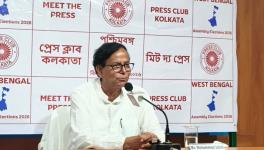
CPI(M) state secretary Mohammed Salim, addressing a press conference at Muzaffar Ahmed Bhavan on Thursday, situated the Jadavpur violence within what he called a 12-year pattern of coordinated assaults by the RSS-BJP on India's centres of higher learning — invoking JNU, Jamia Millia Islamia and Aligarh Muslim University in the same breath.
Wherever free thought and democratic space survive, Salim argued, fascist forces return again and again to attack it. He called upon every anti-fascist current in the country — regardless of party — to unite against it. Asked how BJP could disown a party legislator's presence at the scene at midnight, Salim said the question, in effect, answered itself.
Salim tied the Jadavpur episode, too, to a broader erosion of institutional trust — from unresolved custodial deaths to a citizenship-verification regime, he said, had already been used to push people across the border into Bangladesh — arguing that all of it belonged to a single, connected pattern of majoritarian overreach.
BJP state president Samik Bhattacharya, for his part, moved quickly to put institutional distance between his party and the violence, insisting that ABVP was an independent organisation that answered to no one but itself and that BJP does not endorse partisan politics inside university campuses.
Silence From the Top
Three days on, no arrests have been announced in connection with either the hostel-area stone-throwing or the vandalism at Gate No. 4, despite complaints lodged by multiple parties. Vice-Chancellor Chiranjib Bhattacharjee has called the episode "unfortunate," ordered an internal inquiry to establish who bears responsibility, and said the university may now be forced to accept a round-the-clock police presence on campus — a proposal it has long resisted as fundamentally at odds with its self-governing culture. Kolkata Police says its personnel entered the campus once alerted and "removed the outsiders," though it noted that, as of Thursday, it had received a formal complaint from only one side of the confrontation.
For students who spent Wednesday night bracing hostel doors against a crowd outside their windows, these statements are cold comfort. What they wanted was a phone picked up at 1 a.m. What they wanted was a security guard who did more than just watch. What they say they got, instead, was a night that has left them wondering exactly how much protection an Indian public university can still offer the young people inside it — and how many more Jadavpurs, JNUs and Jamias will it take before that question receives an answer that satisfies anyone.
The writer is a senior journalist, who has headed the Eastern regional bureau of various national publications. The views are personal.
Get the latest reports & analysis with people's perspective on Protests, movements & deep analytical videos, discussions of the current affairs in your Telegram app. Subscribe to NewsClick's Telegram channel & get Real-Time updates on stories, as they get published on our website.