





India’s Continental Maritime Dilemma
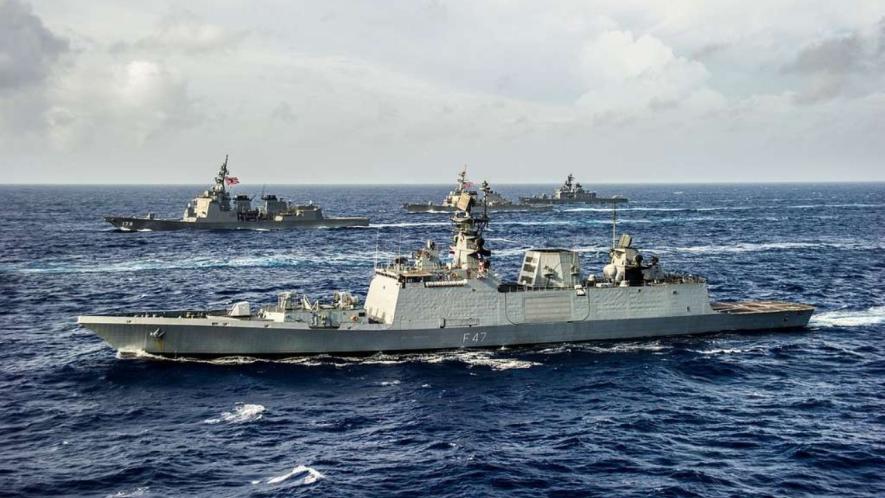
Representational image. Image Courtesy: PICRY
For much of its modern history, India’s strategic thinking was shaped by a peculiar geographical privilege. The towering Himalayan frontier in the North and the vast expanse of the Indian Ocean in the South created the impression that India’s primary security concerns would remain overwhelmingly continental. Even when maritime considerations entered the strategic discourse, they were rarely perceived as existential concerns. The dominant assumption was that India’s principal challenges would emerge from disputed land borders, insurgencies, and regional rivalries, while the surrounding ocean would provide strategic depth, economic opportunity, and a favourable balance of power. That assumption is becoming increasingly untenable.
A profound transformation is underway in India’s strategic environment. The country is no longer confronted merely by unresolved territorial disputes or episodic border crises. Rather, it faces the far more complex challenge of managing simultaneous continental and maritime competition. This shift represents one of the most consequential geopolitical developments in contemporary Asia. It compels India to rethink not only its military posture but also its understanding of power, security, and its place within the evolving regional order.
The central question confronting India is no longer whether the country can defend its territory. The more pressing question is whether India possesses the economic resources, institutional capacity, and strategic coherence necessary to sustain competition across multiple theatres at the same time.
The significance of this development lies in the fact that history has rarely been kind to states compelled to divide their strategic attention between land and sea. Great powers have often flourished when geography allowed them to concentrate resources in a single domain. They have struggled when confronted by simultaneous pressures across several domains.
India’s emerging predicament is, therefore, not merely a military challenge. It is a structural challenge, rooted in the changing distribution of power across Asia and the gradual erosion of the geographical advantages that once insulated India from external competition.
The deterioration of relations between India and China has fundamentally altered the strategic landscape. For nearly three decades following the end of the Cold War, there existed a cautious optimism that economic engagement and diplomatic management could prevent the boundary dispute from dominating bilateral relations. Despite periodic tensions, policymakers on both sides appeared committed to the proposition that cooperation and competition could coexist. The violent confrontation in Galwan Valley in 2020 shattered that assumption. The crisis revealed not merely the fragility of existing arrangements but also the emergence of a deeper strategic rivalry that transcends the boundary question itself.
The India-China relationship today reflects a broader contest over power, influence, and regional order. The disputed frontier is no longer simply a geographical line. It has become a manifestation of competing visions of Asia’s future. Consequently, India finds itself compelled to devote enormous military, financial, and political resources to maintaining deterrence along one of the world’s most inhospitable frontiers. Infrastructure projects, troop deployments, logistical networks, surveillance systems, and air assets increasingly define the security landscape of the Himalayas. What was once viewed as a manageable dispute has evolved into a long-term strategic commitment that demands sustained attention.
Yet the continental challenge represents only one dimension of India’s changing security environment. Equally significant is the transformation taking place across the Indian Ocean. For decades, Indian strategists derived confidence from geography. The Indian Ocean appeared to be a natural sphere of influence where India’s central location conferred enduring advantages.
The absence of major external naval competitors reinforced the belief that maritime security could be managed with relatively limited effort. While China emerged as a major economic actor, few anticipated the speed and scale with which Beijing would expand its maritime presence beyond East Asia.
The rise of China as a maritime power represents one of the defining geopolitical developments of the twenty-first century. As China’s economy became increasingly dependent on global trade, energy imports, and overseas markets, the protection of maritime interests emerged as a strategic imperative. This transformation reflects a historical pattern observed across centuries.
Great commercial powers eventually seek naval capabilities commensurate with their economic reach. Britain’s maritime dominance in the 19th century and the United States’ naval expansion in the 20th century were both products of this logic. China’s contemporary maritime strategy follows a similar trajectory.
For India, however, the implications are profound. Chinese naval deployments in the Indian Ocean are not isolated events. They form part of a broader effort to establish a sustained and institutionalised presence across a region that has traditionally remained outside Beijing’s immediate strategic orbit. Port developments, logistical arrangements, intelligence networks, commercial investments, and naval operations collectively suggest the emergence of a long-term maritime strategy rather than temporary tactical initiatives. Whether described as strategic access, influence projection, or maritime connectivity, the practical consequence remains the same: the Indian Ocean is becoming an increasingly contested geopolitical space.
Within this broader context, the growing strategic partnership between China and Pakistan assumes particular significance. Historically, the Sino-Pakistani relationship has been viewed primarily through a continental lens, shaped by shared concerns regarding India and reinforced through military cooperation, diplomatic coordination, and economic assistance.
Today, however, the partnership is acquiring a distinctly maritime dimension. The modernisation of Pakistan’s naval capabilities, supported extensively by Chinese technology and defence cooperation, signals a gradual expansion of Islamabad’s strategic reach beyond its traditional areas of operation.
The significance of this development does not lie in the prospect of Pakistan achieving maritime superiority over India. Such an outcome remains highly improbable. The disparity in resources, geography, and naval infrastructure continues to favour India. Rather, the importance of Sino-Pakistani naval cooperation lies in its capacity to complicate India’s strategic calculations. Advanced submarine platforms, enhanced surveillance capabilities, intelligence-sharing arrangements, and coordinated maritime activities create additional layers of uncertainty for Indian planners. Even limited capabilities can generate disproportionate strategic effects when integrated into a larger framework of cooperation.
The appearance of Pakistani submarines in areas such as the Bay of Bengal would be significant not because they fundamentally alter the balance of power but because they challenge assumptions about India’s uncontested maritime space. Strategic competition is often as much about perceptions as capabilities. The ability to demonstrate presence, gather intelligence, and impose planning burdens on an adversary can produce effects far exceeding the immediate military value of the assets involved. In this sense, maritime cooperation between China and Pakistan contributes to a broader process through which India’s strategic environment becomes increasingly multidimensional and complex.
The fundamental challenge arising from these developments is one of strategic allocation. Every state operates within constraints. Resources are finite, political attention is limited, and military capabilities require years of investment. Strategic choices, therefore, involve trade-offs. A country focused primarily on territorial defence can organise its military institutions around land warfare. A maritime power can concentrate resources on naval expansion and overseas influence. India’s predicament is that it must increasingly pursue both objectives simultaneously.
The implications of this reality extend far beyond defence planning. Maintaining military readiness along the Himalayan frontier requires substantial expenditure on infrastructure, personnel, logistics, and advanced weapon systems. Simultaneously, preserving influence across the Indian Ocean necessitates investments in naval modernisation, anti-submarine warfare capabilities, maritime surveillance networks, aircraft carriers, undersea sensors, and strategic partnerships. The cumulative burden is immense. It places growing pressure on fiscal resources and demands a level of strategic coordination that few states have historically managed with ease.
This reality exposes a deeper truth about contemporary geopolitics. The measure of national power cannot be reduced to military strength alone. Enduring influence depends upon the capacity of a state to mobilise economic resources, generate technological innovation, maintain institutional effectiveness, and sustain political legitimacy. Military capabilities are ultimately derivative of these broader foundations. States that neglect this principle often discover that strategic ambitions outpace national capacity.
For India, therefore, the central issue is not simply how to respond to China or Pakistan. The more consequential question concerns the nature of India’s own rise. Can India generate the economic dynamism necessary to support prolonged geopolitical competition? Can its institutions adapt to the demands of a more contested regional environment? Can it reconcile developmental priorities with expanding security commitments? These questions are ultimately more important than any individual military acquisition or diplomatic initiative.
India’s emerging continental-maritime dilemma must, therefore, be understood within this larger framework. The challenge is not merely to defend borders or monitor sea lanes. It is to navigate a transition from being a regional power preoccupied with territorial security to becoming a major state operating within an increasingly competitive Asian order. Such transitions are rarely smooth. They demand intellectual clarity, political discipline, and a willingness to think beyond immediate crises.
The deeper significance of the current moment lies in the gradual disappearance of strategic comfort. Geography no longer offers the insulation it once did. The Himalayas remain contested even as the oceans become crowded with competing powers. China’s rise has blurred the distinction between continental and maritime challenges, while Pakistan’s growing integration into Beijing’s strategic vision adds further complexity to India’s security environment. The result is a geopolitical condition in which India must simultaneously manage deterrence on land, competition at sea, and economic transformation at home.
This is not merely a defence challenge. It is a test of statecraft. The countries that shape the future international order are not necessarily those that possess the largest armies or the most advanced weapons. They are the states capable of aligning military power, economic strength, institutional resilience, and strategic purpose within a coherent national project. Whether India can achieve such alignment will determine not only its ability to manage contemporary threats but also its capacity to emerge as a consequential power in the Asian century.
The defining strategic question before India, therefore, is not whether it can prevail in a border standoff or respond to a naval deployment. It is whether it can successfully adapt to a world in which security is no longer measured solely by the defence of territory but by the ability to compete across multiple domains simultaneously. The answer to that question will shape not only India’s future but also the future balance of power in Asia.
The writer is a Kashmir-based independent researcher. The views are personal. Email: Zahidcuk36@gmail.com.
Get the latest reports & analysis with people's perspective on Protests, movements & deep analytical videos, discussions of the current affairs in your Telegram app. Subscribe to NewsClick's Telegram channel & get Real-Time updates on stories, as they get published on our website.