





Indian Innovators Put India on Global Map With Pathbreaking Climate Tower
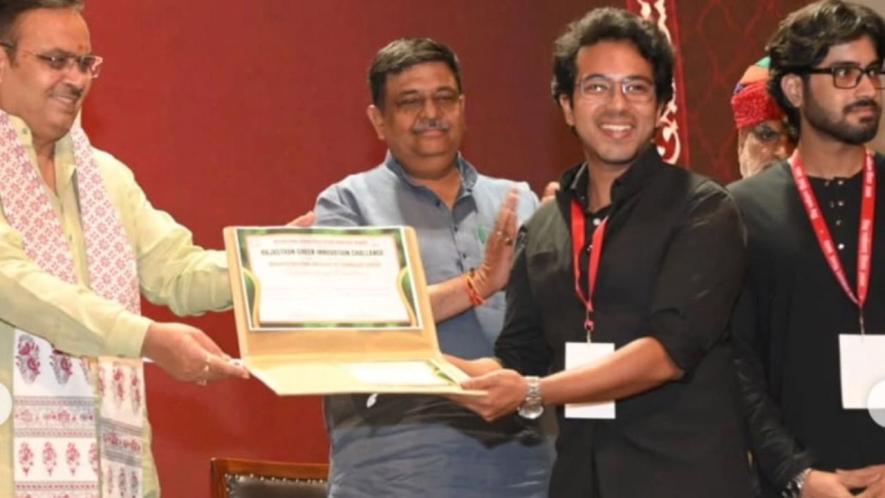
Two researchers from the TERI School of Advanced Studies, New Delhi — Souryadeep Basak and Saatvik Narayan Mishra — were honoured by Rajasthan Chief Minister Bhajan Lal Sharma and State Environment Minister Sanjay Sharma for a prototype that could change how Indian cities breathe.
Kolkata: On World Environment Day on June 5 this year, amid the familiar chorus of governmental pledges and symbolic gestures, something more concrete was on display in Jaipur. Two young researchers from the TERI School of Advanced Studies, New Delhi — Souryadeep Basak and Saatvik Narayan Mishra — were honoured by Rajasthan Chief Minister Bhajan Lal Sharma and State Environment Minister Sanjay Sharma for a prototype that its supporters believe could genuinely change how Indian cities breathe.
Their climate tower — a nature-based urban installation designed to simultaneously tackle air pollution, carbon emissions, wastewater, and degraded land — won them the National 2nd Runners-Up position at the Rajasthan Green Innovation Challenge, organised by the Rajasthan Pollution Control Board in collaboration with MNIT Jaipur. The recognition, however ceremonial in setting, carries real weight: according to the Pollution Control Board, the tower demonstrates "a spirit of creative problem solving through a unique approach to geo-political pressure and environmental issues."
The climate tower houses shallow pools of azolla on each floor. The design of the tower is optimised through passive solar geometry, so that year-round cultivation can be sustained without zero active electrical energy inputs. Weekly biomass harvests are carried out, to be used as bio-fertiliser, animal fodder, pellets, or bio-diesel. Dust entrapment leads to significant reductions in particulate matter concentration levels.
Water-based agriculture ensures thermal inertia and maintenance of optimal micro-climate in cities, combating the urban heat island effect. The climate towers are also biodiversity hotspots, acting as a safe haven for pollinators, insects, butterflies, birds and many other species.
In cities, the biomass can be used as organic fertiliser for urban horticultural activities, reducing costs as well as emissions associated with synthetic nitrogenous fertilisers such as urea. The high biomass growth rate also captures carbon at a phenomenal rate of 7.7kgCO2/m2-year, making it a veritable solution to greenhouse gas mitigation
A Different Kind of Solution
What sets the climate tower apart from the industrial air purifiers and energy-intensive smog machines that have proliferated across polluted Asian cities is its design philosophy. Rather than treating air quality as an isolated engineering problem, Basak and Mishra have engineered a multi-function ecological system — one that integrates carbon capture, wastewater remediation, biodiversity enhancement, and land reclamation into a single deployable unit. The prototype, they claim, can mitigate urban air pollution by up to 60%.
This matters in a country where the scale of the crisis has long outpaced incremental solutions. The World Health Organisation has consistently ranked India's cities among the most polluted on earth — 14 of the 20 worst-affected cities globally are Indian. Delhi, where Basak and Mishra conduct their research, regularly records PM2.5 concentrations running 10 to 15 times above safe thresholds. The Centre for Science and Environment (CSE) has for years argued that reactive measures — odd-even traffic schemes, firecracker bans, emergency shutdowns — are woefully inadequate substitutes for structural intervention.
The climate tower is positioned as exactly that kind of structural intervention: scalable, ecologically grounded, and designed for dense urban deployment rather than elite architectural showcase.
Support from Industry, Eyes on the World
The prototype has not remained confined to a university laboratory. Pilot projects have received backing from Haldia Energy Limited in West Bengal, Dhariwal Infrastructure Limited in Maharashtra, Berger Paints, the Emerson Centre of Excellence for Sustainability Studies in New Delhi, and the Swedish Research Foundation. Intellectual property applications have been filed across India, the United States, China, Saudi Arabia, Australia, South Africa, and the European Union — a signal that the inventors and their backers see potential well beyond domestic adoption.
The global IP (intellectual property) footprint is significant. It suggests the climate tower is not being positioned as a one-off academic exercise, but as a commercially viable and internationally scalable technology. The question of whether that ambition can be realised will depend as much on policy environments and institutional will as on engineering merit.
A Trajectory Built on Consistent Achievement
For Basak, this recognition is the latest in a line of achievements that stretches back several years. In 2020, his team became the first Indian winners of the Efficiency for Access Design Challenge, run by Engineers Without Borders, UK — a competition focused on affordable energy access for underserved communities. Their entry was a solar-powered hydroponic fodder unit designed to ease the burden on farmers, timed against the backdrop of nationwide agrarian protests.
That win brought Basak to the attention of international climate forums. He became the youngest Indian speaker at COP26 in Glasgow in 2021. In 2024, his work was validated again at the Climate Investment Challenge hosted by Imperial College London, and he secured a national runner-up position at the Indian Oil Sustain-a-thon, a competition that drew over 35,000 entries.
Mishra's contribution to the climate tower rounds out a partnership that combines research rigour with an established track record of translating ideas into recognised, deployable prototypes.
Voices from the Ground
Civil society organisations have cautiously welcomed the recognition. Sunita Narain, Director General of CSE, has previously noted that India's climate future hinges on youth-led innovation that connects science with social need. The climate tower, in this framing, is promising precisely because it does not chase a single metric — clean air — but seeks the ecological co-benefits that come with land reclamation and biodiversity restoration.
In West Bengal and Maharashtra, where pilot projects are already underway, grassroots response has been measured but hopeful. Farmer collectives familiar with Basak's earlier hydroponic work see continuity in the approach.
A representative of the Paschim Banga Khet Mazdoor Samiti told NewsClick that if the tower can simultaneously clean air and restore degraded agricultural land, its potential impact for rural and peri-urban communities could be significant.
The Larger Structural Challenge
Recognition on World Environment Day is one thing. Institutional adoption is another.
Scaling the climate tower to the level where it can meaningfully shift India's urban air quality will require municipal corporations to integrate it into urban planning frameworks — something Indian city governments have historically been reluctant to do with unproven technologies. It will require long-term ecological monitoring of nature-based systems, a form of sustained maintenance that Indian cities routinely neglect. And it will require navigating the bureaucratic and industrial interests that often obstruct innovations perceived as threatening to established sectors.
NewsClick has tracked numerous cases where grassroots innovations, celebrated on symbolic occasions, subsequently stalled for want of institutional support. The climate tower's future will be shaped by whether this recognition translates into procurement decisions, policy mandates, and public funding — or whether it remains a prototype celebrated on a ceremonial stage.
Youth as Solution-Providers, Not Just Protesters
The broader significance of Basak and Mishra's work lies in what it represents for India's climate movement. Youth activism in India has grown sharply in recent years — from student-led Fridays for Future mobilisations to legal challenges filed against polluting industries. But activism and innovation are not always the same conversation.
What Basak and Mishra demonstrate is that young Indians are not only demanding accountability from systems they inherited; they are building alternatives. This shift — from reactive protest to proactive design — is precisely the kind of energy that India's environmental future requires.
The climate tower, if it realises its promise, will not solve India's pollution crisis alone. But it signals something important: that the ingenuity is there, that the partnerships are forming, and that the next frontier is whether India's governance structures choose to meet that ingenuity with corresponding seriousness.
For now, the recognition stands as more than a certificate. It is a marker of what becomes possible when youth-led innovation is taken seriously — and a measure of how much further that seriousness needs to go.
Get the latest reports & analysis with people's perspective on Protests, movements & deep analytical videos, discussions of the current affairs in your Telegram app. Subscribe to NewsClick's Telegram channel & get Real-Time updates on stories, as they get published on our website.