





Imperialism’s Attack on Third World Sovereignty
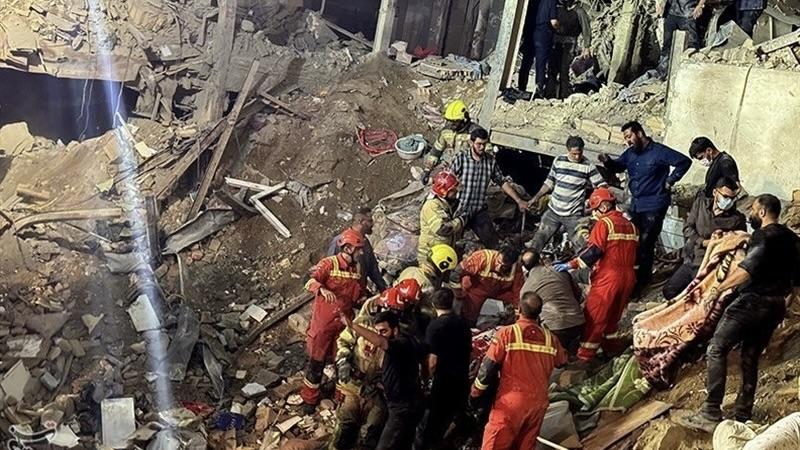
Impact of Israeli attacks on Iran. Photo: Tasnim News Agency
The very concept of sovereignty of Third World nations is now being sought to be abolished by imperialism in violation of all canons of international law, as is evident from the bombing of Iran by the US and Israel with the explicit objective of effecting a “regime change”. Until now, even when the obvious objective had been to change a regime that had become uncongenial for imperialism, the proffered official reason advanced for imperialist military intervention had been camouflaged under some other excuse, such as the regime possessing “weapons of mass destruction”, or the regime being engaged in narcotics trade, or something else.
Now, in the case of Iran, any such fig-leaf has been dropped; the bombing has been undertaken even as talks on Iran’s nuclear programme, the ostensible issue of contention, were going on, and reportedly even making progress. By its action, therefore, the US has now arrogated to itself, for the first time since the end of the colonial era, the right to effect a “regime change” wherever it likes within the Third World.
The point here is not whether the Islamic Republic enjoyed mass support among the Iranian people, or whether it was repressive, or whether it allowed free speech, or whether it tolerated an opposition; the point is that it is the people of Iran who alone have to right to decide on any “regime change” in their country and to work for it. It is not the job of US imperialism, which has no business to intervene militarily in the affairs of another country. That is what the sovereignty of a country implies, and that sovereignty is what anti-colonial struggles had achieved for their respective countries all over the Third World in the aftermath of the Second World War.
Imperialism, which until now had been engaged in undermining that sovereignty through diverse backdoor manoeuvres, has now resorted to open military intervention for doing so. This constitutes a direct attack upon national sovereignty, and therefore opens up an altogether new chapter in history, paving the way for an effective reversal of decolonisation.
Two questions immediately arise: how does imperialism feel emboldened to undertake such an attack? And why does it especially feel the need for doing so at the present juncture?
Read Also: US-India Trade Deal: A Colonial Era-Like Unequal Treaty
The answer to the first question is simple: the collapse of the Soviet Union and the end of the Cold War has left it in a position where it does not feel as constrained as it did earlier. In Cuba, for instance, where imperialism is also talking of “regime change” now, the contrast with the situation at the time of the Cuban missile crisis of 1962, is absolutely striking.
At that time the Soviet Union had asked its ships heading for Cuba to shoot their way through the American blockade of the island, thereby risking a possible nuclear war; and the US had been forced to compromise to avoid such an eventuality. One result of this had been the absence since then of any direct imperialist military intervention in Cuba; that kind of constraint on imperialism no longer exists. It, of course, has not existed for quite some time, but imperialism, as I argue below, is currently skating on the thinnest possible ice, which impels it to attempt to recolonise the Third World. And that is the answer to the second question raised above.
The nature of its current crisis can be understood properly if we keep in mind that it has two distinct components. The first is that over the past three or four decades, the share in the national income of workers in the advanced capitalist countries, and of the working people in the Third World countries, has undergone a drastic decline. And since consumption out of a unit of the economic surplus is lower than that out of a unit of workers’, or working people’s, income, this redistribution towards economic surplus, gives rise to a tendency toward over-production relative to aggregate demand, and hence to an increase in unemployment (which may, of course, be camouflaged, as in the case of the US, as a decline in work participation rate). This entails a sharp increase in the distress of the toiling people.
The second component contributing to the present crisis of imperialism is that, unlike in the heyday of colonialism prior to the First World War, the leading imperialist power of today lacks the ability to meet its balance of payments deficit through the imposition of a “drain of surplus” or of “deindustrialisation” on a colonial empire. The leading imperialist country at all times, it must be remembered, invariably runs a balance of payments deficit; in the present case an important reason for the deficit is the US running a string of over 750 military bases in 80-odd countries of the world to maintain its global dominance. This deficit in the period before the First World War was covered by the leading imperialist power of that time, Britain, at the expense of its colonies.
The absence of a colonial empire of its own has meant that the current leading power, the US, has been meeting its deficit by printing dollars. It is today the world’s most indebted country by far, and the world is awash with dollars or dollar-denominated assets that constitute American liabilities. This poses a massive threat to the stability of the capitalist world’s financial system.
It is often suggested that since there is no other currency as frequently used as the dollar, the latter faces no credible threat. But this is erroneous: even if there is no credible threat from any other currency, a sudden shift from the dollar to commodities is always on the cards, and, if this happens even for a while, it could well cause a massive inflation in the capitalist world.
This is exactly what had happened in the early 1970s and had formed the background to the rise of Thatcherism and Reaganomics that had created huge unemployment in their respective countries to combat inflation. But that imposition on the workers had come in a situation where they had experienced a significant post-war boom, while any repetition of such a situation in the present context, coming on top of acute workers’ distress, for reasons discussed above, would greatly upset the social stability of the system.
The response of imperialism in this conjuncture to pre-empt such a threat has two parts: one is the installation of a neo-fascist regime in the form of the Donald Trump administration in the US (and similar regimes or similar imminent regimes elsewhere).
The other is an attempt to reinstate colonial-style domination around the world by instituting obedient regimes. The criminal abduction of Nicolas Maduro of Venezuela, and the attack on Iran where a progeny of the Pahlavi dynasty is waiting in the wings to take power, courtesy the Americans, are examples of such re-colonialisation.
Both Venezuela and Iran are oil-rich countries, with the former possessing the largest oil reserves in the world; and the capturing of their reserves by American companies would open the way for another round of “drain of surplus”, this time towards the US, that would ease America’s payments problems.
Re-colonialisation, however, is not confined to extracting a “drain” from oil-rich countries; it also takes the form of seeking to impose “unequal treaties”, such as the Indo-US Trade Treaty, which create captive markets for American goods, as in colonial times. Of course, with this effort at re-colonialisation, whether imperialism would succeed in overcoming its present crisis is beside the point; it believes that re-colonialisation constitutes a way out of the crisis, and that is what matters.
Re-colonialisation as an imperial strategy was sold by the US Secretary of State Marco Rubio to a group of initially-sceptical European leaders recently. He, of course, put it in a different language but his suggestion was as direct as possible. His argument was that the glorious ‘Western Civilisation’ had in recent years suffered a setback because of the rise of communism and of the anti-colonial movements that communism supported; this setback had to be reversed. This obviously meant a reversal of the gains of the anti-colonial struggles, that is, a re-colonisation of the world.
A revival of the glory of ‘Western Civilisation’ in short depended, according to Rubio upon a re-colonialisation of the world. A more direct call for subjugating the Third World to imperialist control is difficult to imagine.
Rubio’s argument, according to news reports, proved persuasive for the initially-sceptical European leaders. Not surprisingly, there has been no major opposition from Europe, other than by Spain, to the latest US-Israeli atrocity inflicted on Iran. It would appear, therefore, that we are on the threshold of witnessing a concerted drive by all imperialist countries to reverse the gains of decolonisation.
Prabhat Patnaik is Professor Emeritus, Centre for Economic Studies and Planning, Jawaharlal Nehru University, New Delhi. The views are personal.
Get the latest reports & analysis with people's perspective on Protests, movements & deep analytical videos, discussions of the current affairs in your Telegram app. Subscribe to NewsClick's Telegram channel & get Real-Time updates on stories, as they get published on our website.