





Hopeful, Informed, Trapped: India’s Urban Middle Class
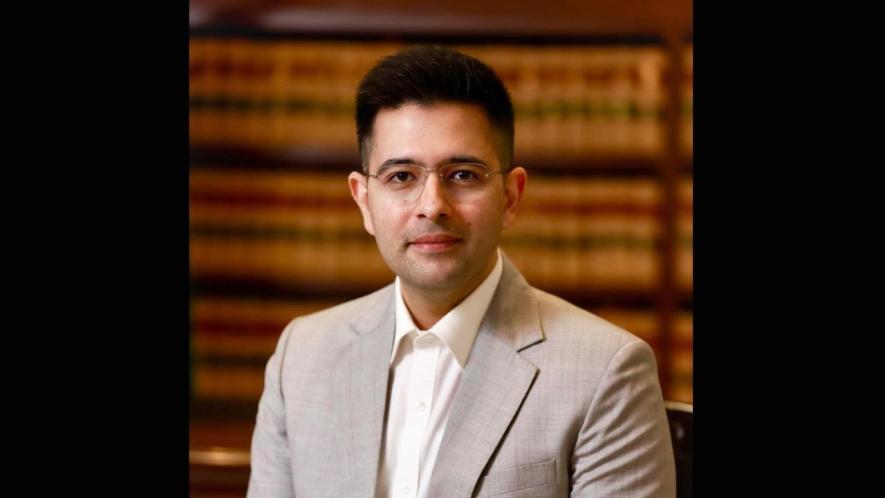
Image Courtesy: Wikimedia Commons
Indian Instagram has found a new messiah. Though his reels lack laser-eye edits, the comments are flooded with "future PM" and "Form a new party for Indian Youth". The baton has passed from foreign minister S Jaishankar to CA-turned-MP Raghav Chadha, who was recently stripped of his deputy leadership of the Rajya Sabha by his own party, the Aam Aadmi Party or AAP. On Instagram, a few reels of Chadha have crossed 140 million views, and lakhs of educated, urban Indians have found, in this chartered accountant from Delhi, something that feels like hope.
In Rajya Sabha, Chadha has raised issues such as samosa and extra-luggage price at airport, mobile data rollover, minimum average bank balance and food adulteration, among others. Without getting into how many people are affected by these issues, one could understand which voters were being targeted here.
It doesn’t hurt to notice what is not being talked about -- the recently hiked LPG prices, which has resulted into mass migration of daily-wagers from metro cities to their villages, the recent mass layoffs at whim by big corporates, rupee value at its lowest in history, unemployment at levels never seen in the past five decades, the systematic dismantling of free speech and constitutional right to protest.
The wise decision to not speak is an indication of two things, which at large sums up modern-day Indian politics. One is a cosy, intimate, well-documented affair between political parties and concentrated corporate capitalists that underlies all of these crises simultaneously.
The other would be the traction that these issues would not gain since these are at front and not a result of an immediate crisis. Indian voters, including urban educated middle class, are more interested in immediate visible crises rather than the structure that relentlessly generates it. This might explain that issues regarding mobile data and minimum bank balance are being raised but without naming the players behind them, who happen to feature among the top in the list of “most powerful Indians.”
This is not to say that the issues Chadha raises are unnecessary. The burden of minimum monthly average balance penalties, the cost of data, the tax squeeze on salaried income -- these are lived experiences of a real constituency that deserves to be heard, and in a healthier political culture, they would be heard alongside everything else.
However, there is a crucial difference between issues being real and issues being sufficient. What makes Chadha's parliamentary performance a politically useful asset to the status quo is precisely its legitimacy and traction that functions as a shock absorber. His viral reels shout that the middle class is not being ignored and their concerns have been documented on records as someone well-dressed MP raised it. Yet, none touches the architecture of the problem.
These token issues are most effective in the formation of partial truth. These are enough to contain discontent but wide enough to leave the foundations untouched. The argument here is that people do not revolt over samosa and mobile data prices. They revolt when the full picture is visible, which this kind of politics ensures never comes into focus.
So, where does that leave the urban middle class voter? This writer would argue -- hopeful, educated, and trapped.
Let us trace the trajectory that brings the middle class here. Without going into the political economy of discourse formation and social equation, the Che-Guevarafication of Chadha by Indian Instagram can be understood through the deradicalisation arc of Indian ‘non-cadre swing’ voters in recent years: Far Right (Hindutva & anti-Muslim) → apolitical (subtle Right) → Centre-Right (policy-based) → Centre.
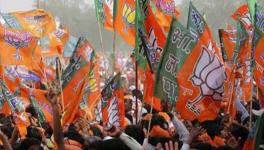
Chadha’s so-called supporters currently stand at Centre-Right. That means they are still hoping a great man will come and change India. They have moved away from Narendra Modi's hard Hindutva but not from the cult of leadership. Despite being betrayed by political parties and leaders, their trust remains with the latter. However, most of them will eventually realise that what Chadha is doing won't work at all. Their glimpses of possible glory will fall apart, and they would have no choice but to turn ‘Centre’, for the moment.
Chadha's rise highlights the tendency that urban middle class educated Indians show. They believe a great man will come and change things. This contrasts sharply with rural uneducated voters who believe things will remain as they are. The rural voter is hopeless and seeks relative mobility by any means possible. The educated urban voters assume that since they’re educated and know things, they must lead the march of India's progress. This assumption of leadership makes them more vulnerable to populist tactics of the corporate-media and PR-backed leaders. The appeal works brilliantly on upper middle class educated Instagram voters.
According to Centre for Developing Societies or CSDS data, the Bharatiya Janata Party’s rise to power in 2014 had more to do with upper urban class voters electing them than the rural ones. Realising Modi’s inability, this class is now in desperate search of another great man, without realising that the problem is the idea of a ‘great man’ itself and their unwillingness to commit to a structural diagnosis of why the establishment fails them.
What makes this distinctly an urban, educated-class phenomenon is the peculiar combination of knowledge and helplessness. These are voters who understand enough to know that problems are structural. They know the system is not accidentally broken. But they’re unable to imagine collective political action as a solution. They are unwilling to align with the un-cinematic and boring reality of mass movements and trade unions.
Consider CPI(M) Rajya Sabha MP, John Brittas, as a counterpoint here. In Parliament, Brittas has raised issues around surveillance, right to privacy, press freedom, the working conditions of unorganised labour, the implications of data protection law for ordinary citizens among many other. These issues directly affect crores of people, including the upper middle-class Instagram netizens who are moved by Chadha's reels. But Brittas has negligible Instagram presence, since he has no PR machinery, largely because this is not what he is concerned about.
There is an asymmetry of visibility. Chadha raises airport food prices and it becomes a trending reel. Brittas raises press freedom and no one reads raises an eyebrow. It is this operating logic of the post-truth media environment where the currency is determined by the capacity to make people feel that a politician understands their life. The one who provides information most hyperbolically wins the attention economy, and the one who wins this attention economy shapes what counts as a “political concern” at all.
The public relations or PR apparatus determines which politics should be amplified and which should be not. The post-truth problem is not simply that people believe false things. It is that people organise their sense of political reality around what is made readily available to them.
The political culture of a country, which is the premise for material empowerment of people, thrives when the people who’re supposed to be most informed also take politics seriously. But when the group oscillates between dreaming about a “great man” as saviour and chasing civilisational glory, a gap opens up. And that gap will always be filled by a new, well-dressed, rhetorical leader, who acts as if he/she cares, but won’t challenge the structure.
India's urban middle class has been through enough cycles of this to know better. History suggests that changes have been brought by collective political courageous actions of people and not by glorious persona. Can we prove this history wrong?
The writer is a student at Dept of Political Science, University of Delhi. The views are personal.
Get the latest reports & analysis with people's perspective on Protests, movements & deep analytical videos, discussions of the current affairs in your Telegram app. Subscribe to NewsClick's Telegram channel & get Real-Time updates on stories, as they get published on our website.