





Haughty US-Israel Pushing Iran to Acquire Nukes?
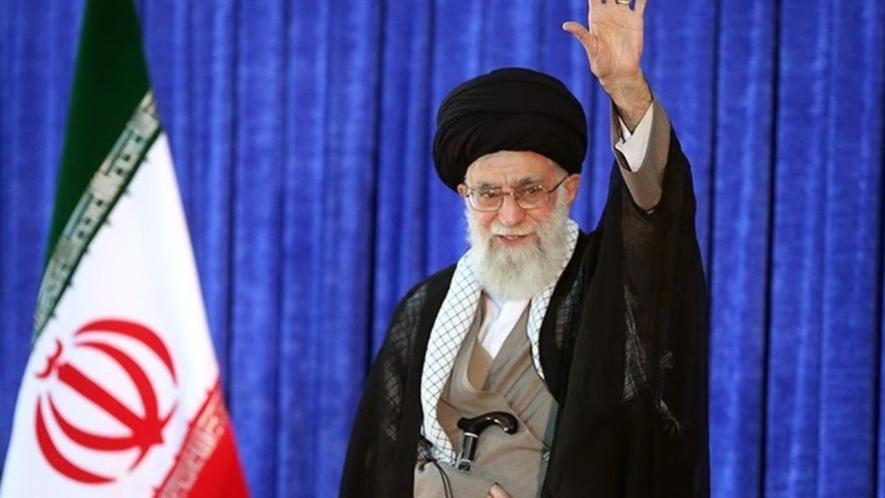
Ayatollah Ali Khamenei. Image Courtesy: Wikimedia Commons
The world remains struck by the fear of fragile peace in West Asia after US President Donald Trump's Press Secretary, Karoline Leavitt, declared that POTUS threw Iran's 10-point ceasefire terms “in the garbage.” Hours ago, Trump had said that Iran’s terms provided basis for a workable solution.
Israel’s Prime Minister Benjamin Netanyahu's brazen violation of the ceasefire—launching the most lethal strike to date on Beirut—has further fuelled tensions, as Iran's conditions included “no attack on Lebanon”. Iran warned of retaliatory action. Israel ostensibly doesn't want a ceasefire.
Many geostrategic experts rightly believe the war was becoming untenable for the US to sustain, which is why Trump announced a doomsday deadline on his social media platform, Truth Social: "A whole civilisation will die tonight" to earn brawny points before agreeing to the ceasefire. But they also agree that Trump's “fickle megalomania” could break the ceasefire any time. Trump's rejection of Iran's peace proposal even before the key meeting to be held between the representatives of the US and Iran, is dangerously pointing toward such a situation.
The deadline caused a frenzy, with many fearing that the US or Israel might unleash a nuclear strike. This fear had strong reasons:
First, Israel possesses a stockpile of at least 90 plutonium-based nuclear bombs, and its disregard for human lives is evident from the ongoing genocide in Gaza. Two, the US is the only country that has ever used nuclear bombs to exterminate humans, doing so in 1945 even when Japan was on the verge of total defeat. Three, both the US and Israel are ruled by Far-Right, ‘Epstein-class’ imperialists whose sole objective is to enjoy opulence-led power and entertainment.
These reasons—the scale of bombardment and the threat of a possible nuclear strike—may just push Iran’s resolve to revoke its self-imposed ban on developing a nuclear arsenal. It is the Fatwa (Religious Edict) issued by the assassinated Supreme Leader of Iran Ayatollah Ali Khamenei, is what is preventing a conventionally powered Iran from becoming a nuclear-armed country.
The US and Israeli think-tanks, such as Atlantic Council, termed the Fatwa a “smokescreen” to help Iran develop a nuclear weapon, opining that Iran was very close to acquiring one, despite the US and Israel bombarding its nuclear facilities in June 2025.
However, the logic of this argument is defeated by the fact that if that were the case, Iran should have gone nuclear by now. Iran's researcher density is 2,240 per million people, which is significantly higher than India's 210 per million people. Several State-run universities in Iran, such as Islamic Azad University (IAU), are headed by nuclear scientists and offer dedicated PhD programmes in nuclear physics and applied sciences. Dr. Mohammad Mehdi Tehranchi, an acclaimed theoretical physicist, heads the IAU.
Many strategic experts, such as Farhad Shahabi Sirjani, who have also studied the importance of the Fatwa issued by the Supreme Authority in Shi'ite Islam, claim it is even more robust than the signing of the Treaty on the Non-Proliferation of Nuclear Weapons (NPT) and the inspections conducted by the International Atomic Energy Agency (IAEA).
The IAEA remains steadfast that it has no evidence to claim Iran is building a nuclear weapon, with the caveat that some facilities were not opened for inspection. In August 2005, Iran’s Supreme Leader's Fatwa was officially relayed to the IAEA for the first time.
According to the Fatwa, [T]he production, stockpiling and use of nuclear weapons are forbidden under Islam and that the Islamic Republic of Iran shall never acquire these weapons. …The leadership of Iran has pledged at the highest level that Iran will remain a non-nuclear-weapon State party to the NPT and has placed the entire scope of its nuclear activities under IAEA safeguards and additional protocol, in addition to undertaking voluntary transparency measures with the Agency (IAEA, 2005: 121).
In a paper published in the Iranian Review of Foreign Affairs, Sirjani argued that a comparative study of the Fatwa and the NPT revealed serious weaknesses in the NPT's formulation. The Treaty is fundamentally discriminatory, dividing states into nuclear weapon possessors and non-possessors, with an unbalanced set of responsibilities and advantages for each group. For instance, no dates were set for a vitally serious matter like nuclear disarmament, which is the most important responsibility of nuclear weapon states.
Nuclear weapon states were also free from the safeguards. "The non-proliferation regime's discriminatory practices have also worsened the situation, as seen in the unjust sanctions against Iran's peaceful nuclear energy program," he said.
The reasons for aversion against possessing a nuclear bomb and answers to Western propaganda are also detailed on the Iranian government's special website KHAMENEI.IR dedicated to Ayatollah Khamenei. It contains excerpts from 16 of his speeches spanning 15 years, in which he elaborated on why Iran opposes nuclear weapons despite having the acumen to develop them.
The most telling of these speeches was his address to the members of the Assembly of Experts on February 22, 2021.
"Some people - including that international Zionist clown – constantly say that they will not let us build a nuclear weapon. But who are you to prevent Iran from building a nuclear weapon? If we decided to build a nuclear weapon, you and powers greater than you would not be able to stop us. But we have not decided to do so based on our Islamic thinking. Our Islamic thinking says that a weapon which is used for killing civilians, non-military people and ordinary people is forbidden. It is forbidden whether they are nuclear or chemical weapons. Such weapons are forbidden. It is due to the Islamic viewpoint that we do not want to build a nuclear weapon. However, if we wanted to do so, who are you to prevent us? You yourselves do not observe these principles. In one day, the US killed 220,000 people [referring to the bombardment of Japanese cities]."
A plausible view is that continuous sanctions imposed by the US, coupled with the 12-day bombardment of key nuclear sites—Natanz, Isfahan, and Bushehr—by the US and Israel in June 2025 followed by the recent assassinations of Ayatollah Ali Khamenei and scores of top government and military brass, and later continuous bombardment on civic infrastructure like hospitals, universities and energy sites, have pushed Iran to the brink of developing nuclear weapons. Netanyahu's inability to save Israel from continuous attacks by Iranian missiles and drones despite promising his supporters a quick end to the Islamic regime may force him to use a tactical nuclear strike.
Theodore Postol, Professor emeritus of Science, Technology, and International Security at the Massachusetts Institute of Technology (MIT), who previously worked at Argonne National Laboratory, the Pentagon, and Stanford University and was also on the editorial board of the journal Science & Global Security until 2019, has warned that an Israeli misadventure could prove very costly for the region and the world. He also thinks Iran would most likely have abandoned the Fatwa by now, considering the scale of US and Israeli attacks and the heightened Israeli threat to use a nuclear bomb.
Postol, a nuclear weapons expert, says there is a strong possibility that Iran has stashed 60% enriched uranium hexafluoride in several deeply buried long tunnels safe from the threat of B2 bombers.
"Only 30 kgs of uranium hexafluoride is enough to create a nuclear weapon once converted to uranium metal. They have 408 kg of 60% enriched uranium hexafluoride. So really, if you do more careful arithmetic, Iran can make 11 atomic bombs with this material,” says Postol.
Explaining further, he says, all that's all doable in a tunnel. “A few hundred square meters of floor space is all you need. You of course need baffles (critical structural components, typically steel plates or forgings, that enclose the fuel assemblies) but this is the kind of equipment the Iranians already have,” he adds.
According to him, this nuclear weapon never needs to be tested and can be delivered with total confidence that it will work.
“I can test this device with depleted uranium to make sure that the assembly process works. The United States did this for Hiroshima. It never tested a Hiroshima bomb,” explains Postol.
Postol also believes that Israel is far more reckless than Iranians have been. Similarly, he agrees with claims from various top think-tanks, such as the Arms Control Association, that Israel has evaded the NPT and possesses a stockpile of 90 plutonium-based nuclear warheads.
Nuclear scientist Dr. Ira Helfand, President of the International Physicians for the Prevention of Nuclear War and a founding member of the International Campaign to Abolish Nuclear Weapons (ICAN), cautions that the current war in West Asia has a real possibility of escalating to nuclear conflict and has absolutely solidified Iran's notion of the need to have nuclear weapons.
Dan Plesch, Director of the Strategic Concept for Removal of Arms and Proliferation (SCRAP) and Director of the Centre for International Studies and Diplomacy at the School of Oriental and African Studies (SOAS), University of London, considers that the US came close to use nuclear bomb against Iraq in 1990, which means that such plans do exist in Pentagon and that’s a real threat.
Sultan Barakat at Qatar Foundation’s Hamad Bin Khalifa University, and Honorary Professor at the University of York, whose research focuses on studying war-torn societies and their recovery, is wary of Israel using a tactical nuclear warhead against Iran.
Many US veterans of the Gulf War, such as Colonel Douglas Macgregor (who served as senior advisor to the acting Secretary of Defence during Trump's first presidency), Colonel Larry Wilkerson and academics such as Anton Fedyashin of American University, think that the looming threat of nuclear use against Iran by Israel and the US may have already pushed Iran to acquire a nuclear weapon.
Following President Trump's ultimatum that "A whole civilisation will die tonight," Iranians took a significant step to save the world, especially West Asia, from falling into a death trap by deciding to come out into the open where the US and Israel have threatened to strike and obliterate them. Their world famous musician, Ali Ghamsari, has once again decided to stage a sit-in and perform traditional tar and setar music outside critical infrastructure sites slated to be targeted by US and Israeli threats. Hope, his music and the bravery of millions of Iranians manage to halt this madness.
The writer is a senior independent journalist based in Delhi. The views are personal.
Get the latest reports & analysis with people's perspective on Protests, movements & deep analytical videos, discussions of the current affairs in your Telegram app. Subscribe to NewsClick's Telegram channel & get Real-Time updates on stories, as they get published on our website.