





GenZ Protest: A Beautiful India is Possible
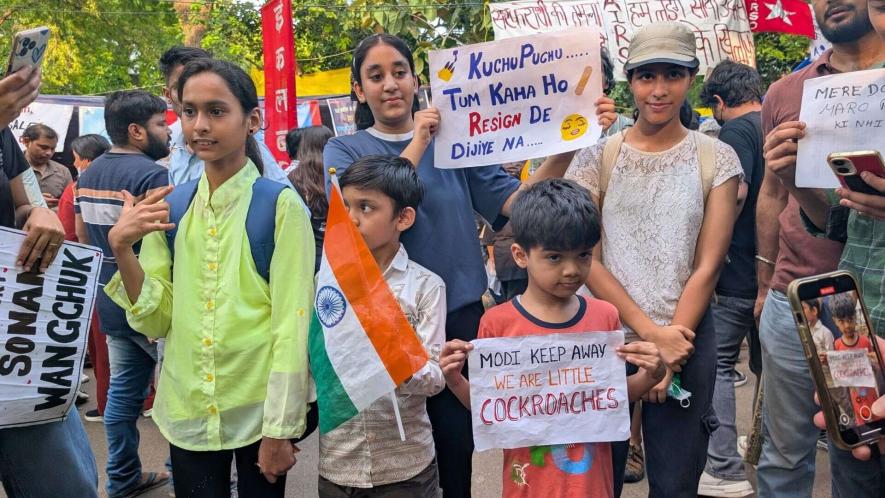
Image Courtesy: Manan Kumar
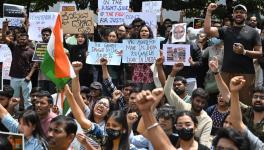
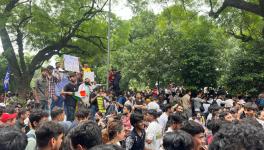
During my 13-day pilgrimage to Jantar Mantar beginning June 6, including seven consecutive days starting July 19, I increasingly felt that besides being a singular entity, I also belonged to a larger ‘Being’. This ‘Being’ was slowly growing organically into a remarkably beautiful creature of myriad and vibrant colours by attracting the best available souls from all parts of India. The organic process of evolution did not allow any vicious or self-centric soul to be a part of it.
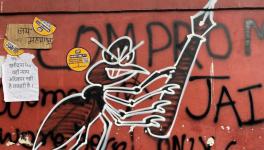
Initially, it seemed that the protest might derail the blitz campaign launched by the Indian Youth Congress, at Rahul Gandhi's call, against the NEET paper leak. Perhaps, that was the original idea of the Narendra Modi regime, which is why it allowed the Cockroach Janata Party or CJP to stage a sit-in at Jantar Mantar. But the organic evolution of the ‘Being’ didn't allow this.
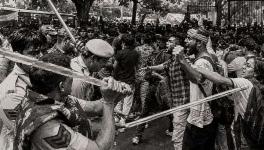
The protest grew, slowly gaining momentum after it was joined by famous climate change activist Sonam Wangchuk. It grew bigger when the man from Ladakh went on an indefinite fast along with many other student activists. It grew even bigger when the regime, afraid of its beautiful evolution, kidnapped Wangchuk and unleashed brutal repression on hapless students, not sparing even the minors, women and girls.
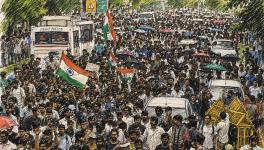
Volunteers and strangers formed a human chain in Jantar Mantar to successfully thwart a kidnapping attempt of the rest of the student activists on hunger strike. Similar replicas of the ‘Being’ evolved in major cities across India with a similar sense of urgency and purpose. The pictures and videos of the raw violence unleashed against the unarmed protesting youth travelled the world via social media and foreign press, leading to sporadic protest rallies by Indians in various cities across Europe, Canada, the US, Sri Lanka and Australia.
What shocked the State and its security apparatus was that the badly beaten and bruised students with broken limbs returned and looked straight into the eyes of their attackers.
"Police uncle, this time tell us 10 minutes in advance before the lathi-charge," one protester said in humour with a typical GenZ smile emoji, lowering her tormentor's eyes.
"Uncle, ye maarne se pehle ye helmet de dena," (Please lend us your helmet before you start baton-charging us) came another gem sporting a GenZ heart emoji.
The fear had ended. As more people poured into Jantar Mantar after the news of repression, police presence also swelled. But a tired security apparatus finally gave up when GenZ broke loose into dances on their own creative songs like Police Wale Babu Mujhe Danda Laga Do and Mujhe Apne Bank Ki Kitaab Dijiye, Desh Ki Tabahi Ka Hisaab Dijiye. The scene left many young policemen with heavy gear and batons, squirming. Their hearts and feet seemed to want to break free and join in, but the compulsion of a job kept them in check.
Meanwhile, the ‘Being’ kept evolving, growing bigger and more beautiful.
As a reporter of 30 years' vintage and now unemployed, I was awestruck by the tenacity of the ‘Being’. During my long hours of visits, the thought of capturing it on video and starting my own YouTube channel crossed my mind but the cost was very high. I would have failed to live the moment and absorb the nectar flowing abundantly from the pure souls of hundreds of people like, Neha, Aameen, Manish and Amitoj, who were staking their lives through an indefinite hunger strike; selfless individuals like Junaid, Anuj, Suraj and hundreds of nameless individuals arranging and distributing food, water and snacks; volunteers and sewadars from Gurudwara Bangla Sahib and nearby mosques; dozens of young beautiful volunteer students cleaning littered trash; volunteers fanning the sweat-drenched crowd and trying to bring order; young doctors with first-aid kits and important medicines; and young lawyers painstakingly jotting down the accounts of victims of State-sponsored brutality. Like my younger daughter and her friend, I also became a part of the ‘Being’, doing whatever small tasks we could find to keep the protest healthy, happy and vibrant.
An important factor that sustained the protest was the slogans and songs of struggle, revolution, courage and hope sung by the young comrades of the Left parties. Under a banner reading, "Yuva Rakt Ki Garmi Se, Barf Ki Ghati Pighlegi (The heat of young blood will melt the valley of ice)," activists from the All India Students Association (AISA), the student wing of the Communist Party of India Marxist-Leninist (Liberation); the Students Federation of India (SFI) of the Communist Party of India-Marxist; and the All India Students Federation of India (AISF) of the Communist Party of India, kept providing ample dosage of glue and adrenaline to keep the ‘Being’ in high spirits.
Groups of young and old could be seen having animated discussions on the key issues troubling India and the world: education, environment, E20, crony capitalism, climate change, rights of Dalits and Adivasis, constitutional rights, and the Brahminical order.
On July 24, my daughter decided to stay at the protest site with her friend for the night. I was scared, as I couldn’t have stayed. After braving several days of heat, dust and rain, my body had given up. I had fever. That night between 12:30 a.m and 6 o'clock, I called my daughter four times. Each time she seemed perfectly fine, doing some work or talking and listening to the struggles of newly made friends -- young boys and girls from villages, small towns and ghettos. Letting her spend a night at Jantar Mantar was a decision that I will always feel proud of. One night at the protest site made her wiser, more informed, and more humane.
Protest sites are great teachers indeed. These cramped places, teeming with people, teach you at no cost and much more quickly what you cannot learn in the best universities that teach behavioural science, psychology, human relations, politics and civic sense. It teaches you things even beyond any curriculum: love, camaraderie, empathy, care, brotherhood, bravery, unity, resoluteness and fraternity.
When my daughter returned home on the morning of July 25, she angrily prophesied us not to worry as the protest would not end even after Wangchuk’s “climbdown” from the main demand during midnight. She was unhappy that the main face of the protest had agreed for unsigned “paltry demands” and accepted juice from the State that had beaten students black and blue.
I decided to go back to Jantar Mantar to mark our family’s attendance. I was expecting another showdown as the police presence had increased to unprecedented levels.
My daughter proved correct. Ending the fast by the Ladakh man on lesser terms had met with a royal ignore by the ever-expanding ‘Being’.
Aghast at the raw courage, the haughty and adamant regime ultimately bowed down. Union Education Minister Dharmendra Pradhan resigned.
The ‘Being’ erupted in joy when Abhijeet Dipke of CJP announced the news of Pradhan's resignation. Soon these souls started leaving Jantar Mantar, feeling mixed emotions: joy from the shared struggle and victory and grief over the separation. I too became a part of it.
As I left my pilgrimage centre and retreated home, there was a feeling of longing but I was also brimming with newfound hope that the beautiful ‘Being’ is here to stay and will only grow bigger and bolder. Suddenly it occurred to me that the popular name of this ‘Being’ is Bharat Mata. Not the one personified by Bankim Chandra Chattopadhyay and first painted by Abanindra Nath, but as described and immortalised by India’s first Prime Minister Jawaharlal Nehru in his book The Discovery of India.
At Jantar Mantar, I had seen only a microcosmic replica of Bharat Mata. It has awakened and will rise again and again, until it shakes off all the accumulated dirt of opulence, inequality, communalism and nepotism.
The writer is a senior independent journalist based in Delhi. The views are personal.
Get the latest reports & analysis with people's perspective on Protests, movements & deep analytical videos, discussions of the current affairs in your Telegram app. Subscribe to NewsClick's Telegram channel & get Real-Time updates on stories, as they get published on our website.